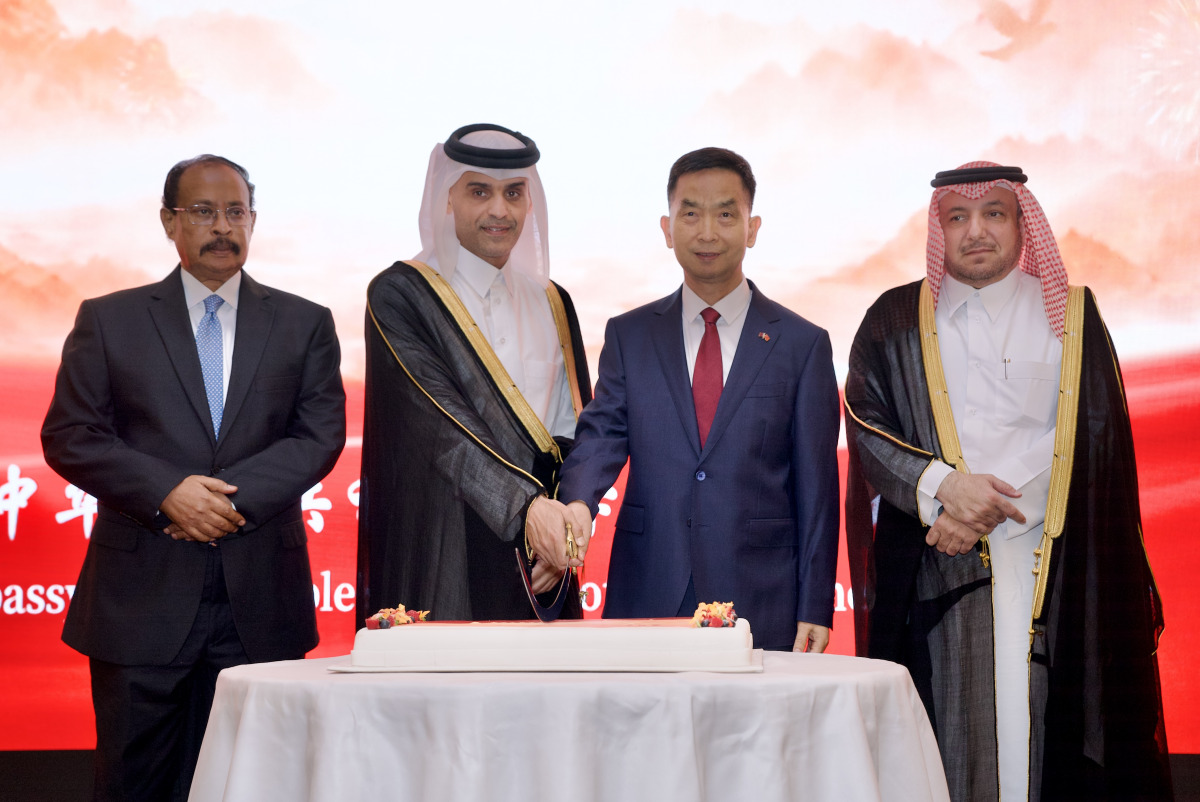
Minister of Transport H E Sheikh Mohammed bin Abdulla bin Mohammed Al Thani (second left) with Ambassador of China H E Cao Xiaolin (second right), Director of Department of Protocol at the Ministry of Foreign Affairs H E Ibrahim Yousif Abdullah Fakhro (right) and Dean of the Diplomatic Corps in Qatar and Ambassador of Eritrea H E Ali Ibrahim Ahmed at the event yesterday. PIC: Ahmed Barakat/The Peninsula
Doha, Qatar: Beijing stands ready to work with Doha to advance their strategic partnership to new heights, Ambassador of China H E Cao Xiaolin said yesterday as the Chinese Embassy marked the 77th anniversary of the founding of the People’s Republic of China.
Speaking at a reception attended by the Minister of Transport H E Sheikh Mohammed bin Abdulla bin Mohammed Al-Thani, Director of the Department of Protocol at the Ministry of Foreign Affairs H E Ibrahim Yousif Abdullah Fakhro, members of the diplomatic corps, officials from the Ministry of Foreign Affairs, and the Chinese community, the ambassador thanked friends from all sectors who have supported China’s development and the friendship between the two countries.
Diplomatic relations between Qatar and China, established in 1988, have grown steadily over the decades and were elevated to a strategic partnership in 2014.
The ambassador said the two leaders have kept up frequent exchanges this year, providing strategic guidance for the partnership.
“Earlier this month, Prime Minister and Minister of Foreign Affairs H E Sheikh Mohammed bin Abdulrahman bin Jassim Al Thani visited China and held talks with Premier Li Qiang and Foreign Minister Wang Yi, where new plans for cooperation were mapped out,” he noted.
He said China firmly supports Qatar in safeguarding its sovereignty, independence, security, and stability, and appreciates Qatar’s support for the One-China principle. Solid mutual trust, he added, remains the foundation of bilateral relations.
On future cooperation, the ambassador said China is ready to align development strategies with Qatar and pursue high-quality partnerships in two-way investment, traditional and new energy, infrastructure, artificial intelligence, and finance.
“Beijing will work with Doha on long-term, stable energy cooperation and is prepared to share its high-speed railway expertise to explore railway development and regional connectivity,” the ambassador added.
He also highlighted people-to-people ties, saying China will expand exchanges with Qatar in culture, education, and tourism, and welcomed more visitors from Qatar and the region to experience China firsthand. Reviewing China’s progress, the ambassador said the country has risen from extreme poverty to become the world’s second-largest economy.
“China’s economy grew at an average annual rate of 5.4 percent over the past five years, contributing around 30 percent of global growth. Output reached 140 trillion yuan in 2025, while growth stood at 4.7 percent in the first half of this year,” he noted.
The ambassador said China’s path of modernisation shows that self-reliance and sustained effort can help a country overcome poverty and offers developing nations another option for pursuing development independently.
He noted that the Belt and Road Initiative, proposed in 2015, now covers more than 150 countries and over 30 international organisations, with more than 4,000 projects and investments exceeding $1 trillion. China’s trade with Belt and Road partners rose 14.8 percent year-on-year in the first half of 2026, reaching 12.97 trillion yuan.
On regional developments, the ambassador said China has consistently called for a ceasefire, opposed unilateral military action, and maintained contact with all parties.