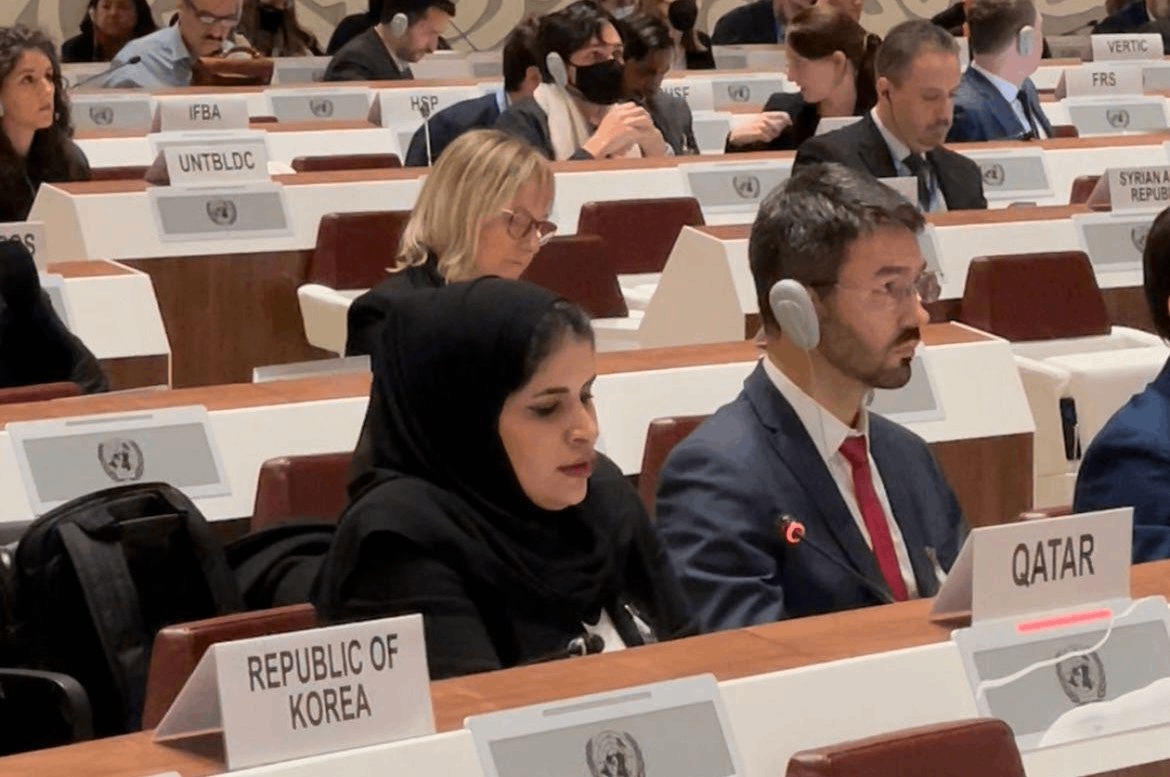
Assistant biological expert at Qatar National Committee for the Prohibition of Weapons Sheikha Nouf Ahmed Al Thani speaking during the conference.
Geneva: Within the framework of its efforts to achieve international peace and security, Qatar stressed its keenness on the effective participation in the international forums concerned with disarmament issues and to join relevant international conventions and treaties.
The most notably are the Treaty on the Non-Proliferation of Nuclear Weapons (NPT), the Biological Weapons Convention (BWC), the Chemical Weapons Convention, the Comprehensive Nuclear-Test-Ban Treaty (CTBT), and the Convention on Nuclear Safety (CNS).
This came during the speech of Qatar, delivered by Assistant Biological Expert at Qatar National Committee for the Prohibition of Weapons (NCPW) Sheikha Nouf Ahmed Al Thani, during the 9th Review Conference of the States Parties to the Convention on the Prohibition of the Development, Production and Stockpiling of Bacteriological (Biological) and Toxin Weapons and on their Destruction (BWC), at the UN headquarters in Geneva.
Sheikha Nouf said that the Convention on the Prohibition of the Development, Production and Stockpiling of Bacteriological (Biological) and Toxin Weapons and on their Destruction, as the first multilateral convention aimed at disarmament of biological weapons, represents a vital pillar of the comprehensive disarmament system to achieve an international community where security, stability, peace, and development prevail.
Nouf pointed out that Qatar established the National Committee for the Prohibition of Weapons (NCPW), a permanent committee at the Ministry of Defense that was established according to the Cabinet’s decision of 2004, which is the entity entrusted with implementing the international agreements related to disarmament issues, including weapons of mass destruction (WMD).
She indicated that Qatar - as a state party to the Convention - fulfils its obligations by not possessing or producing any biological offensive or defensive programs and not having any research activity to develop, store, or possess any biological or toxin agents.
Nouf added that through the NCPW, the State of Qatar adopted several goals and objectives in its strategic plan for the prohibition of biological weapons, most notably strengthening the national implementation through following up on the implementation of relevant national legislations and regulations to achieve the goals indicated in the Convention, promote relations and links with local authorities and international organizations, and spreading awareness of the danger of biological weapons and WMDs.
Also, NCPW developed a monitoring system with the Ministry of Public Health to exchange monitoring of communicable diseases, including events that may indicate a terrorist activity and reporting of suspected terrorist events as means to promote transparency; in addition to preparedness and crises management, as the NCPW formed a national team of specialists to respond to biological disasters at the national levels by taking preventive measure against biological attacks and how to respond to biological terrorism.