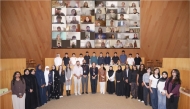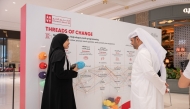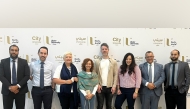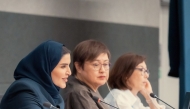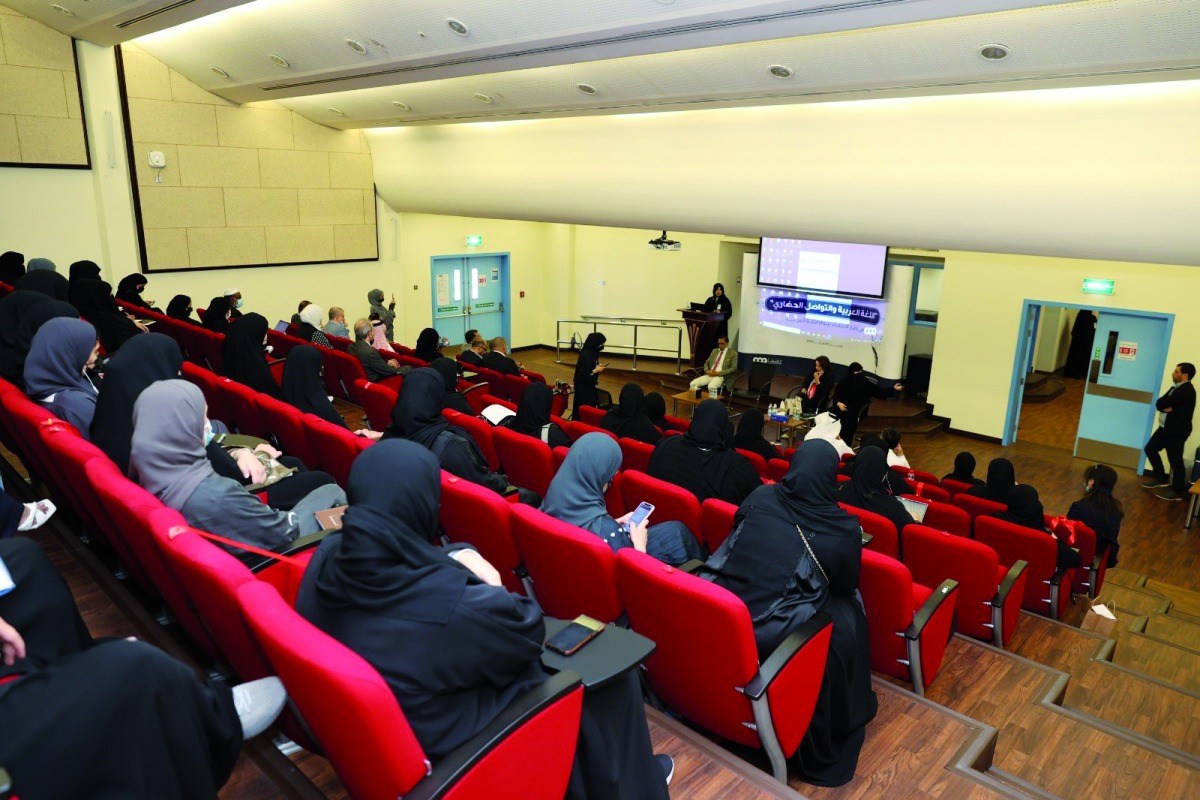
Participants during the seminar on Arabic language.
Doha: The Community College of Qatar (CCQ), in collaboration with the Qatar National Committee for Education, Culture and Science, the Qatari Forum for Authors, and Unesco, organised a seminar on “Arabic Language and Cultural Communication.”
The seminar celebrated the Arabic language, marking the International Mother Language Day and the anniversary of Doha being named the Capital of Culture in the Islamic World for 2021 by the Islamic World Educational, Scientific, and Cultural Organization (ICESCO).
The seminar hosted Abdullah Khamis Al Kubaisi, Acting Secretary-General of the Qatar Committee for Education, Culture, and Science at the Ministry of Education and Higher Education, and Maryam Yassin Al Hammadi, Director General of the Qatari Forum for Authors and Director of the Department of Culture and Arts at the Ministry of Culture.
Dr. Mariam Ibrahim Al Hammadi, Dean of the Liberal Arts Division at CCQ, inaugurated the seminar, which was moderated by Dr. Abdelhak Belabed, Associate Professor at the Arabic Language Department at Qatar University and member of the Qatari Forum for Authors, in the presence of a large number of students, faculty, and guests.
The seminar was initiated by Dr. Mounira Gannouni, Assistant Professor at the Social Sciences Department at CCQ, with a paper entitled: “The Reality of the Arabic Language between the Spoken and the Written... Social Media Platforms as an Example.” In her paper, Dr. Gannouni referred to statistics on the use of the Arabic language on social media platforms in the Arab countries, especially on Facebook and Twitter, in response to a major question: What Arabic language do Arabs use to tweet? The paper concluded that social media platforms have developed a new concept of writing and opened the door to a new era of blogging, in which users do not necessarily use classical Arabic.
In the second part of the seminar, Dr. Sheikh Ahmed Amou, Assistant Professor at the Social Sciences Department at CCQ, presented a paper entitled: “Poetic Language: A Look at the Cultural Components of the Arabic Language”.
He presented an approach to the internal qualities of the Arabic language, as a language characterised by inclusiveness at the vocal level, in addition to its many expressive potentials represented by the morphological growth of its verbal structures. The paper also explored the compositional aspect of Arabic, which makes it one of the richest and deepest languages compared to other popular languages, such as English and French.
In the third part of the seminar, Professor Asmaa Mohammad, Assistant Professor at the Social Sciences Department at CCQ, discussed a working paper entitled: “Language and Means of Communication ... A Reading of Reality”, in which she addressed the recent digital revolution’s knowledge openness that has changed the frameworks of communication discourse, resulting in a range of different linguistic shifts and patterns.
Another important topic that was addressed at the seminar, based on the questions asked by the audience, is the cultural dimension of the Arabic language, including the reality of the Arabic language, its history, and the history of its interaction with other languages.