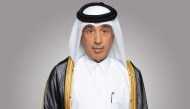
Tunis: The Arab Interior Ministers Council held yesterday its 40th session at its General Secretariat headquarters in Tunis with the participation of Qatar.
The session was attended by Their Highnesses and Excellencies the Interior Ministers of the Arab countries, high-security delegations, in addition to representatives of the Arab League, the Cooperation Council for the Arab States of the Gulf (GCC), the Arab Maghreb Union, the International Criminal Police Organization (INTERPOL), the United Nations Office of Counter-Terrorism, the United Nations Office on Drugs and Crime, Europol, the Naif Arab University for Security Sciences, and the Arab Police Sports Federation.
In his opening speech to the 40th session, Secretary-General of the Arab Interior Ministers Council, Dr. Mohammad bin Ali Kuman praised the unparalleled success achieved by the State of Qatar in organising the FIFA World Cup Qatar 2022, extending his congratulations to the wise leadership, the government and the Qatari people for this success.
Dr. Kuman said that for the first time, the World Cup events are held in an Arab country, saying that Arabs have the right to be proud of the distinguished organisation and atmosphere of the tournament, making it - as observers pointed out — the best World Cup edition. He added that the World Cup was an opportunity to spread the values of the Arab-Islamic civilization, introduce the Arab heritage, and the decisive contributions to human civilization, wishing Qatar further success, progress, and prosperity.
He noted that the Arab Interior Ministers Council has reached its peak after 40 years of tireless work in strengthening Arab cooperation in the field of internal security and combating crime, stressing that one of the reasons for this success is the council’s keenness to evaluate its work mechanisms to keep pace with security developments and addressing emerging challenges and emerging criminal threats, which is reflected in several items on the agenda of this session.
Arab League Secretary-General, Ahmed Aboul Gheit affirmed that joint Arab action in the security fields remains an indispensable necessity to mobilise a concerted collective confrontation of security phenomena, especially cross borders issues, stressing the importance of exchanging opinions regarding emerging developments in Arab societies that have many commonalities. He pointed out that this session is taking place in very delicate circumstances, especially in light of the continued suffering of the Arab region from serious civil conflicts, some of which are being torn apart, with all that entails from cross-border and transnational repercussions, as is the case with refugee flows or some dangerous security phenomena such as the spread of terrorist groups and drug trafficking.
He also stressed the urgent need for an integrated security vision that takes into account the social conditions that arose from global developments, underlining the importance of uprooting extremist thought by dismantling its ideological structure. Gheit said Arab societies, after nearly ten years since the emergence of ISIS, have become more aware of the danger of this ideology, and more alienated from its extremist approach, considering that the security solution alone is not sufficient to overcome and control the security problems in the Arab region, but rather the matter requires reaching radical solutions and political settlements to the problems that generate these negative security phenomena.