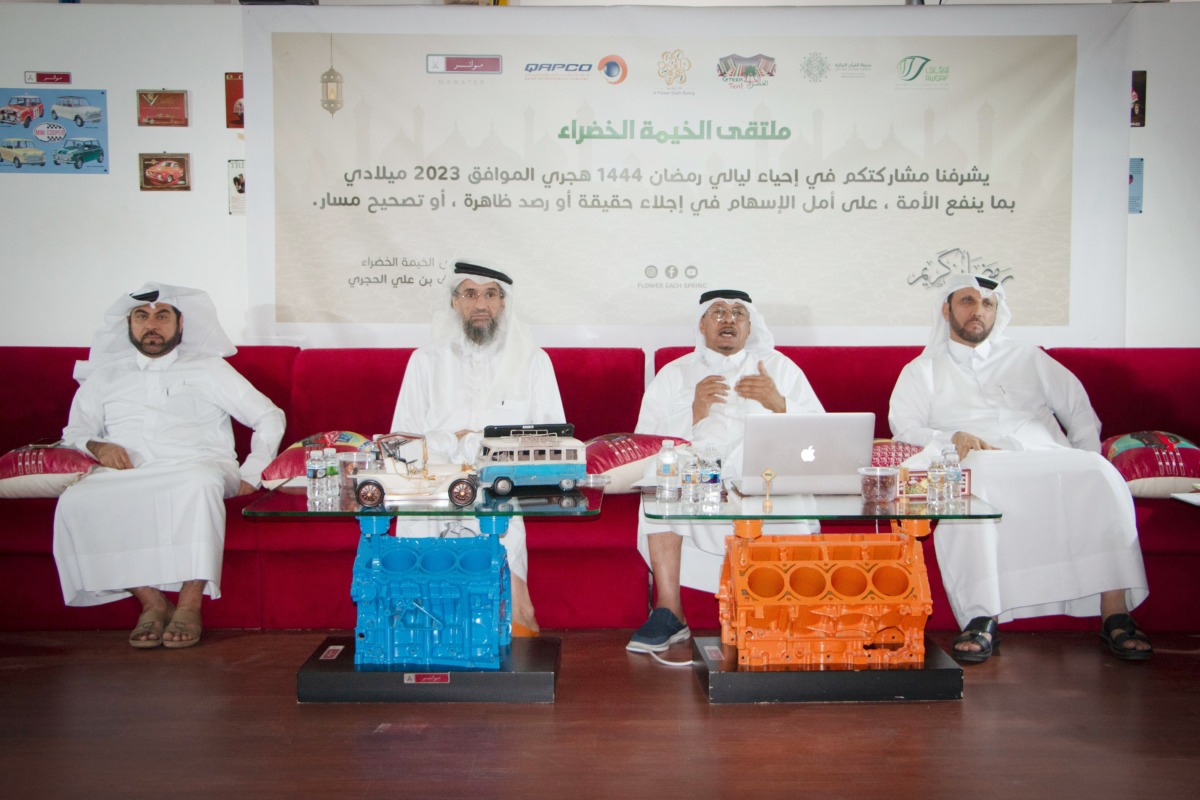
Head of A Flower Each Spring programme Dr. Saif bin Ali Al Hajri speaking at fourth symposium of the Green Tent.
Doha: A group of experts and those interested in the education and training sector in Qatar and a number of Arab countries stressed the importance of integration between university outputs, technical education, and the requirements of society and the labour market, while achieving the necessary flexibility in Arab education and training systems.
This came during the fourth symposium of the “Green Tent” of the “A Flower Every Spring” programme, which was held under the title “Education and Training Keeping Up with the Future Labor Market Requirements.”
In this context, Head of A Flower Each Spring programme Dr. Saif bin Ali Al Hajri, stressed that it is no longer sufficient to identify the features of the future labour market. Rather, he said, research centres should provide assistance in predicting the fate of a number of professions that will disappear and anticipate other professions that are not within the current labour market.
Al Hajri said that it is impossible to separate the role of the makers of educational and training systems and the labour market experts, due to the rapid change in market requirements, in addition to the global stability on the necessity of continuous training, for students or employees.
He said stressed on the need for the government and the education and training sector to work jointly to design skills-based curricula and prepare individuals to keep pace with future technology and its applications. Al Hajri pointed out the importance of education and training in the labour market being based on innovation, technology and openness to the outside world, as it includes electronic teaching, interactive learning and flexible mobility to achieve more success in the labor market.
For their part, the participants in the symposium called for the continuation of training workers in state institutions and constant knowledge of the needs of the labour market, noting that keeping pace with education and training with the requirements of the future labour market is vital to ensure the success of countries and institutions in achieving their economic goals.
On technical education and the labor market, the participants in the symposium pointed out the importance of national technical education and training systems taking into account the current and emerging needs of the markets, and assessments that determine the hard and soft skills required in the labor market.
They pointed out that technical and vocational education and training is an integral part of the national education structure and supports economic development.
Speakers at the symposium stressed the importance of integrating information and communication technology and developing basic life skills and the competencies of teachers and trainers, referring to the role of the Ministry of Education and Higher Education in preparing the necessary initiatives to develop, train and raise the efficiency of teachers and provide them with programmes that keep pace with the rapid change of this sector.
Participants drew attention to the results of a study conducted by the University of Oxford that, which suggested that 15 years from now, almost half of jobs will be automated, so we need to redefine our education system with the challenges ahead in mind. Another study showed that 80 percent of future jobs are related to STEM professions.
They explained that Qatar is increasingly interested in entrepreneurship, and that the Arab countries, especially the Gulf countries, suffer from a scarcity of technicians specialized in many fields. Students should be encouraged to enter technical disciplines.