Singapore: U.S. Defense Secretary James Mattes said Saturday that the position of U.S. troops stationed in South Korea will not be discussed "on the table" during the summit between U.S. President Donald Trump and North Korean leader Kim Jong-Un in Singapore.
"I would like to say to our Singapore hosts that were grateful," Mattis said at the International Institute for Strategic Studies Shangri-La Dialogue, which is being held in the city state this weekend.
"Our objective remains the complete, verifiable and irreversible denuclearization of the Korean peninsula," he said.
On the other hand, U.S. Secretary of Defense criticized China because of its recent actions in the South China Sea, after the deployment of China anti-ship missiles and surface-to-air missiles and electronic jamming, and recently the landing of air bombers on Woody Island.
"Despite Chinas claims to the contrary, the placement of these weapons systems is tied directly to military use for the purposes of intimidation and coercion," Mattis said, "Chinas policy in the South China Sea stands in stark contrast to the openness our strategy promotes," he continued. "It calls into question Chinas broader goals."
The Shangri-La Dialogue, which discusses security issues facing the Asia-Pacific region, began on Friday.
The annual forum brings together senior officials from around the world, with the prospect that this year's discussions will dominate North Korea's nuclear file, even though the latter is not a member, along with Beijing's training in the South China Sea.
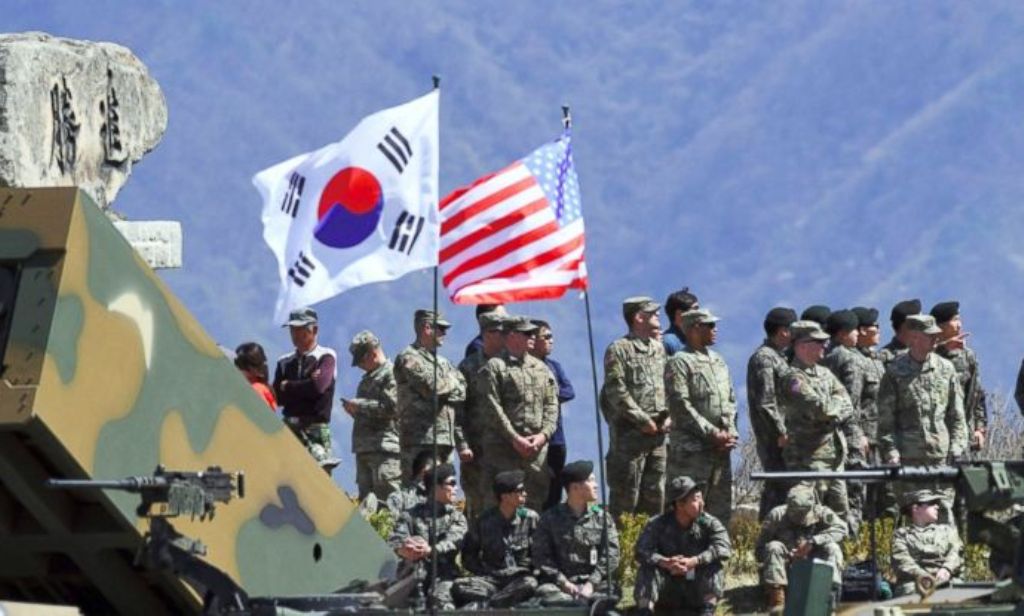
U.S. forces deployed in South Korea after the end of the Korean War in 1953 without signing any agreements, and the number of troops is currently 28,500 troops, a situation that North Korea strongly rejected, demanding the departure of U.S. forces on the Korean Peninsula and stop the joint U.S.-South Korean military exercise..
A recent media report revealed that U.S. President Trump sent a proposal to the Pentagon to reduce the number of U.S. troops in South Korea before the expected summit between Trump and North Korean leader.
The U.S. Navy regularly carries out maneuvers in the region as part of the "freedom of navigation" operations, which it has started since early 2016.