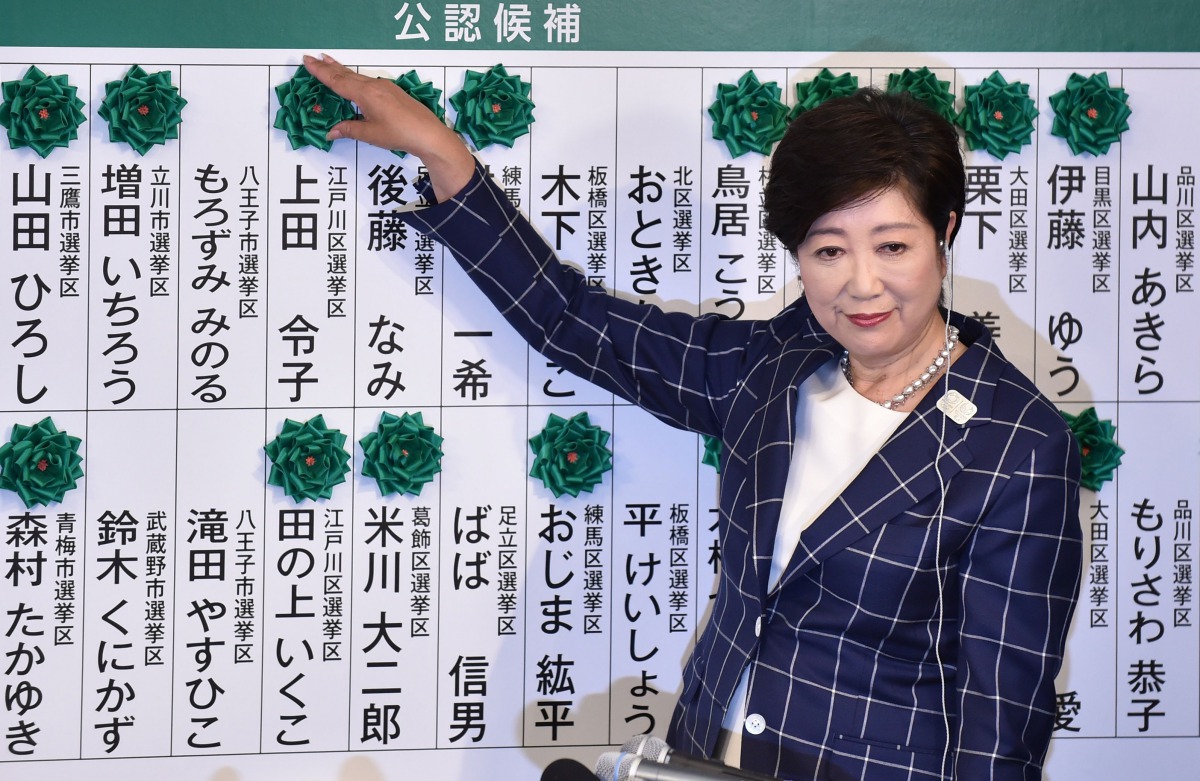
Tokyo Governor Yuriko Koike, who is the current leader of the newly-formed Tomin First no Kai (Tokyo Residents First) party, marks the names of candidates who won a seat in the Tokyo metropolitan assembly election on July 2, 2017. (AFP / KAZUHIRO NOGI)
Japanese Prime Minister Shinzo Abe’s party suffered a heavy loss at the hands of an upstart outfit in elections for Tokyo’s assembly, plunging the scandal-hit leader into one of the deepest political crises of his four and a half years in power.
Tokyo Governor Yuriko Koike’s Tomin First (Tokyo Residents First) party was projected to win 48-50 seats in the 127-seat assembly, compared with 13-39 for Abe’s Liberal Democratic Party, a survey and exit polls by public broadcaster NHK showed.
That could be the lowest number of seats for the LDP ever in the capital. With the Komeito party -- which Koike has teamed up with for the election -- forecast to get 21-23 seats, the popular governor is set for a majority. Going into the election Koike’s party had only six seats in the assembly, compared with 57 for the LDP, according to the assembly’s office.
A spate of scandals has eroded support for Abe, and Sunday’s vote may stir criticism within his party, where potential rivals are positioning themselves to end his run as Japan’s third-longest serving premier since World War II. It could also hurt the party’s chances in a national election due next year. In 2009, a big loss for the LDP in Tokyo preceded a landslide general election defeat months later.
Hakubun Shimomura, head of the LDP’s Tokyo chapter, said that national politics led to the result. Abe met for dinner with party heavyweights including Finance Minister Taro Aso and Chief Cabinet Secretary Yoshihide Suga, where they agreed they had to humbly accept the verdict of the Tokyo people, Kyodo News reported. LDP executives are set to hold an extraordinary meeting at 10 a.m. on Monday.
"This is major, it’s serious," said independent political analyst Minoru Morita. "He will have to reshuffle the cabinet, but that won’t resolve the situation. People are turning their backs on Abe and on the LDP."
Abe’s rush to change the nation’s pacifist constitution to make clear the legitimacy of the Self-Defense Forces has "handed his critics a cudgel with which to attack his leadership" and the result may force Abe to shuffle his ministers, according to Tobias Harris, a Japan analyst at Teneo Intelligence in Washington.
"Criticism over constitutional revision could be the thin end of the wedge for broader criticism of Abe’s leadership," Harris said. "I wonder whether we’ll also see Abe backed into a cabinet reshuffle that is sooner than he wanted and more extensive than he wanted."
Harris added that the LDP-Komeito coalition at the national level will remain intact for now, but the Buddhist-backed party may become a more vocal critic of Abe -- both on the scandals and constitutional issues.
LDP Defector
Koike, who defected from the ruling party last month, campaigned on a platform of open government and cutting wasteful spending in the city of 13.7 million, which accounts for about a fifth of Japan’s economy. The LDP sought to portray her as indecisive for delaying the relocation of the iconic Tsukiji fish market over pollution concerns and insisting on reviewing the ballooning cost of the 2020 Olympics.
"People appreciated the results we have achieved by taking the point of view of Tokyo residents," Koike said after the results started to come out. "I think this is an opportunity to make the Tokyo assembly what it should be."
Abe, 62, has suffered a series of gaffes by his ministers and allegations of cronyism over government support given to a school run by a friend. More popular colleagues such as Shinjiro Koizumi, the 36-year-old son of a former premier, took a prominent role in the Tokyo campaign.
A loss of Tokyo for the LDP could weigh on Japanese equities and lift the yen against the dollar over the short-term, according to Marc Chandler, global head of currency strategy at Brown Brothers Harriman & Co. The outcome could prompt Abe to increase fiscal stimulus, he said in an emailed note before the results were released.
Abe Heckled
In a speech in Tokyo on Wednesday, Abe apologized for the angry exchanges over scandals that dominated the last parliamentary session, and vowed to fight on. “A castle that takes three years to build can be destroyed in a day,” he said.
Demonstrators heckled Abe during his final stump speech on Saturday evening, calling for him to “resign” or “go home."
Koike, 64, is a former television journalist fluent in English and Arabic who has served as environment minister and defense minister, as well as an LDP executive. A big win would give her momentum to take her more populist message to the national stage.
In the 2009 Tokyo poll, the LDP and its coalition partner Komeito lost their dominant position in the assembly -- months before a resounding defeat to the Democratic Party of Japan in a general election that led to more than three years in opposition. This time, however, Abe doesn’t have to call a vote until December 2018, a few months after the LDP is due for a formal leadership election.
"It’s almost a foregone conclusion that someone will run against Abe" in 2018, Harris said. "The question is whether someone with a real chance of winning runs."