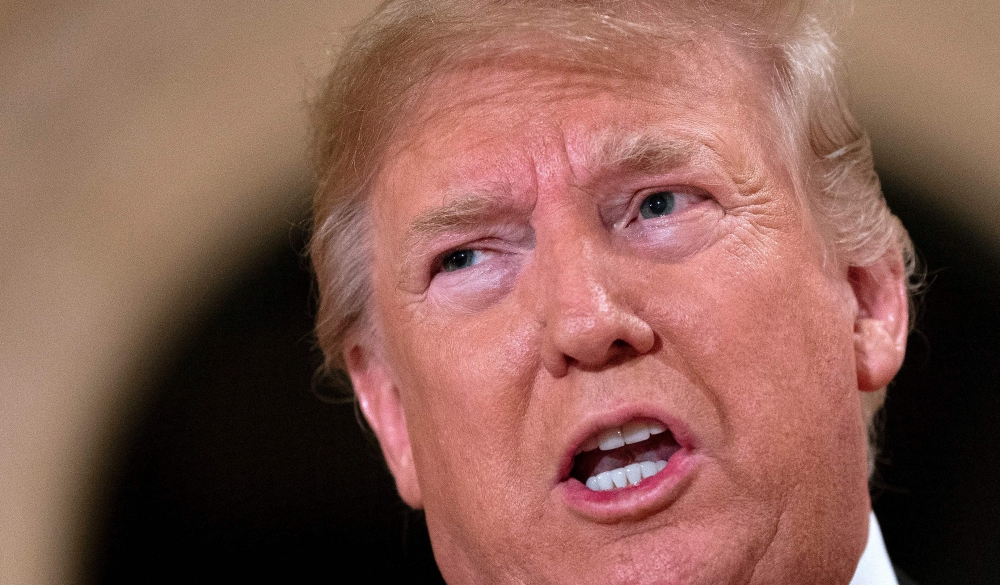
US President Donald Trump speaks to the press outside the grand ballroom as he arrives for a New Year's celebration at Mar-a-Lago in Palm Beach, Florida on December 31, 2019. AFP / Jim Watson
President Donald Trump’s first campaign event of the year is aimed at keeping evangelicals on his side after a prominent Christian magazine called the president immoral and supported his impeachment.
The president is set to speak at a Miami megachurch on Friday at an event his campaign says is intended to launch an "Evangelicals for Trump” coalition. Trump’s remarks are likely to be his first since he ordered an airstrike in Iraq on Thursday that killed top Iranian general Qassem Soleimani.
The effort to court evangelicals comes after the magazine Christianity Today, founded by the evangelist Billy Graham, published an editorial on Dec. 19 calling for Trump’s removal from office by either impeachment or defeat at the polls.
The timing of the evangelical event so soon after the editorial is coincidental, a campaign official who asked not to be identified discussing an internal scheduling matter. Yet polls have shown indications that Trump’s support is softening among white evangelical Christians, 81% of whom voted for the president in 2016.
"He needs those votes,” said Matthew Continetti, resident fellow at the American Enterprise Institute, a conservative research group in Washington. "Remember, President Trump pulled an inside straight in 2016. He won his Electoral College victory through narrow margins in just three states, Wisconsin, Michigan and Pennsylvania, so every vote counts if he is to win re-election.”
The president’s campaign took out a full-page ad touting the effort in Friday’s Miami Herald. The ad includes a picture of Trump and Vice President Mike Pence praying among religious leaders.
Creating Coalitions
The Trump campaign has created similar "coalition” events to appeal to other groups, including black voters. It’s not clear how many people are part of the evangelical coalition or other groups created by the campaign.
Polls, including one of Florida voters released this week, show Trump trailing Democratic presidential front-runner Joe Biden, who has made overtures to religious voters.
Surveys also suggest Trump’s support among white evangelicals may have slipped slightly since the 2016 election. A December Associated Press-NORC Center for Public Affairs Research poll showed 79% of white evangelicals approve of how Trump handles his job. A December NPR/PBS NewsHour/Marist Poll found 75% of white evangelical Christians approve of the president.
Trump and his campaign repeatedly sought to marginalize Christianity Today after the editorial was published. On Twitter, the president called the magazine "far left” and said it would prefer a "Radical Left nonbeliever” who would take away religion and guns. His campaign issued a statement from a granddaughter of Graham, Cissie Graham Lynch, who said she was "outraged” over the editorial.
But another granddaughter, Jerushah Duford, called the editorial "courageous” and a "first step” in an interview on CNN.
Maintaining support from white evangelicals is crucial for Trump as he responds to last month’s impeachment vote in the U.S. House and fends off attacks from Democrats running against him.
Identifying as Evangelical
About 26% of voters in the 2018 mid-term elections identified as white evangelical or born-again Christian, according to an analysis of exit poll data by the Pew Research Center.
"Evangelicals are going to be critical to Trump and to Republicans in general,” Chris Wilson, a Republican pollster and chief executive officer of WPA Intelligence in Washington. "They’re one of the key components of the modern Republican base.”
Trump is the first impeached U.S. president to seek re-election in more than 150 years. His approval ratings since 2016 have hovered mostly been below 50%, but he’s enjoyed overwhelming support among Republicans and white evangelicals.
The Trump campaign event is a move to shore up his base at a "vulnerable” point of his presidency, said Robert Jones, chief executive officer and founder of the Public Religion Research Institute in Washington. "He needs a display of strength.”
Christians have long favored Republicans because of the party’s conservative stance on social issues, such as opposition to abortion.
Tensions Exposed
The Christianity Today editorial, however, exposed tensions.
The editorial said Trump’s "Twitter feed alone -- with its habitual string of mischaracterizations, lies, and slanders -- is a near perfect example of a human being who is morally lost and confused.”
While some religious conservatives consider things the president has said and done to be coarse and inappropriate, he has championed issues many of them hold dear.
In any case, Trump and his campaign cannot afford an erosion in support from that bastion of voters, said Bryan McGraw, a politics professor at Wheaton College in Illinois.
"The Trump folks have to be worried,” he added. "They don’t have to lose too much,” he said, "to lose places like Wisconsin and Ohio.”
Trump has said he has delivered for socially conservative voters with the confirmation of judicial nominees who share their values, a ban on transgender solders in the military and faith-based initiatives.
Seeking Restraint
The president’s evangelical supporters have praised those efforts but have also urged Trump to show restraint in his language.
Chad Connelly, a former chairman of the South Carolina Republican Party and who formerly ran the national party’s evangelical outreach in the 2016 election, said that he regularly speaks with pastors that visit the White House and that they’ve told him that they’ve suggested president tone down his tweets.
John Green, author of "The Faith Factor” which analyzed the influence of religion on the 2004 election, said pastors he’s spoken with are increasingly uneasy.
"Privately, they express a lot of dismay about the president’s behavior,” Green said.