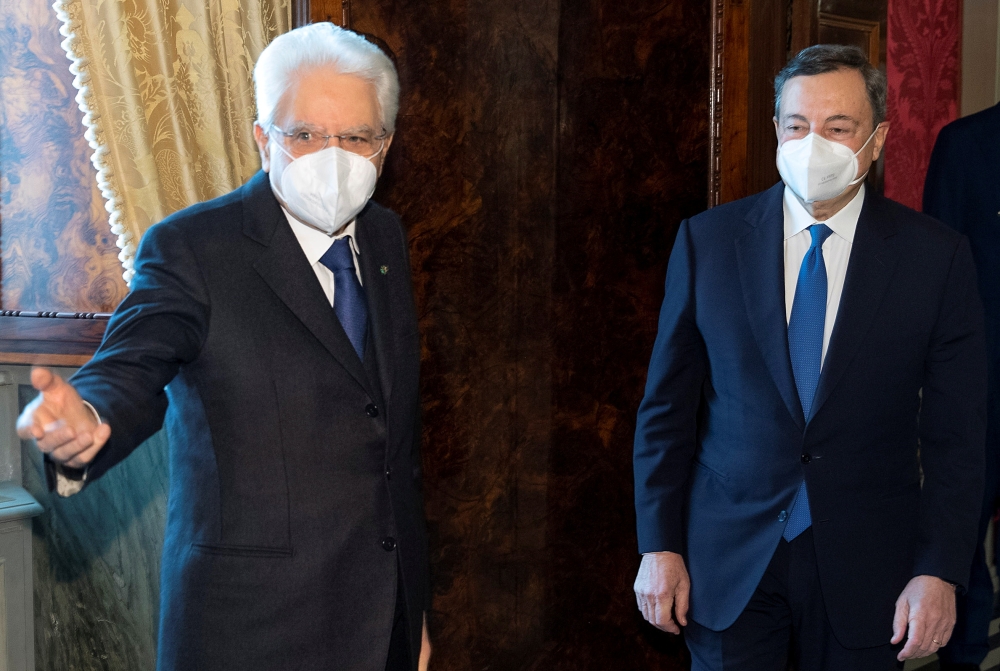
Former European Central Bank President Mario Draghi meets with Italian President Sergio Mattarella at the Quirinale Palace in Rome, Italy February 3, 2021. Francesco Ammendola
ROME: Italy’s president asked former European bank chief Mario Draghi to form a non-political government to steer Italy through the coronavirus pandemic after last-ditch negotiations among political parties failed to produce a viable governing coalition.
Draghi, 73, met with President Sergio Mattarella for just over an hour, and a presidential official told reporters that the president had given Draghi a mandate to form a government.
Mattarella had been expected to ask Draghi to try to form a technocratic, non-political government to replace caretaker Premier Giuseppe Conte’s coalition of the 5-Star Movement and Democratic Party.
Conte was forced to resign last month after ex-Premier Matteo Renzi pulled ministers of his small, centrist Italy Alive party from Conte’s government. Renzi, whose nickname is "il rottamatore,” or "the demolisher,” complained among other things about Conte’s plan to spend more than 200 billion euros ( $240 billion) in EU funds and loans to help the economy recover from the pandemic.
Draghi, known as "Super Mario” for having rescued the common currency during Europe’s debt crisis, had been rumored as a possible choice to lead a non-political government if Conte was unable to find new parliamentary support. Negotiations among political parties failed Tuesday.
"Draghi to the rescue,” said Christopher Dembik, senior European economist at Germany's Berenberg bank, predicting that Draghi would eventually succeed in forming a broad-based government.
His greatest hurdle, though, will be securing support from the 5-Star Movement, the biggest political block in the Italian Parliament and the senior partner in Conte's government. The 5-Stars had insisted on Conte remaining premier and bitterly resented Renzi’s power play that brought him down.
Five-star leader Vito Crimi said the movement would only support a political government. "As such, it will not vote in favor of a technical government headed by Mario Draghi,” Crimi said in a statement.
For the 5-Stars, a Draghi government imposed by Mattarella poses an almost existential dilemma. The anti-establishment, populist movement emerged as a potent political force in part as a response to Italy’s last technocratic government led by Mario Monti, in 2011-2013.
Under Conte, the 5-Stars had led two successive governments starting in 2018, allying first with the right-wing League and then the center-left Democrats.
Markets and analysts reacted positively to a possible Draghi mandate, with borrowing costs sinking and the Milan Stock Exchanges benchmark FTSE MIB index rallying 2.7% in early trading. A government headed by a high-profile and respected figure like Draghi is "likely to be seen, especially by market investors, as a very good solution in the short term," UniCredit analysts said in a note.
A somber Mattarella told the nation Tuesday night that he essentially had no choice: While an early parliamentary election was a necessary "exercise in democracy,” they were ill-advised at this crucial time in Italy’s history. Italy, with over 89,000 confirmed virus deaths, has the second-highest COVID-19 death toll in Europe after Britain. It is trying to ramp up its vaccination campaign and must report back to the EU how it plans to spend the recovery funds.
"It is therefore my duty to make an appeal to all the forces in the parliament so that they grant the confidence to a high profile government not linked to any political force,” Mattarella said.
Italy, the third-largest economy in the European Union, had been heading into a recession even before it became the first country in the West to be hit by COVID-19 last February. The ensuing economic devastation has only made matters worse, with gross domestic product falling 8.8% last year and nearly 450,000 jobs lost, national statistics agency ISTAT reported this week.
Renzi, who was premier from 2014-2016, blamed Conte’s forces for the failed negotiations to find a new coalition and governing program, saying they had rejected his proposals. He made clear he was pleased with the outcome, praising Mattarella’s "wise” decision.
"Now everyone of good will must welcome President Mattarella's appeal to support the government of Mario Draghi," he said Wednesday. "Viva Italia."
The right-wing opposition, which had been leading the polls prior to the government tumult, still pressed for an early election, though the Forza Italia party of ex-Premier Silvio Berlusconi indicated its support for a "high-profile” government.
Draghi, 73, is perhaps best known for his intervention as ECB chief during the peak of Europe’s debt crisis in 2012. As Italy was facing unsustainably high borrowing costs that threatened its financial stability, Draghi said in July 2012 that the ECB was ready to do "whatever it takes” within its mandate to preserve the euro.
It proved to be a turning point for Europe.
Draghi, a Massachusetts Institute of Technology-trained economist, had led the Italian central bank from 2005-2011 when he was tapped to lead the ECB, a job he held until 2019. Prior to that, he had been a vice chairman and managing director at Goldman Sachs International in London and an executive director at the World Bank.
Italy’s borrowing costs in respect to the benchmark German bund dropped considerably on Wednesday, signaling markets’ approval of Draghi as Italy faces the enormous task of spending billions in EU recovery funds. Italy needs to turn to the markets regularly to keep up with payments on the second-highest debt to gross domestic product ratio in the eurozone. Italy has historically been unable to spend all the EU funds at its disposition due to its inefficient bureaucracy.