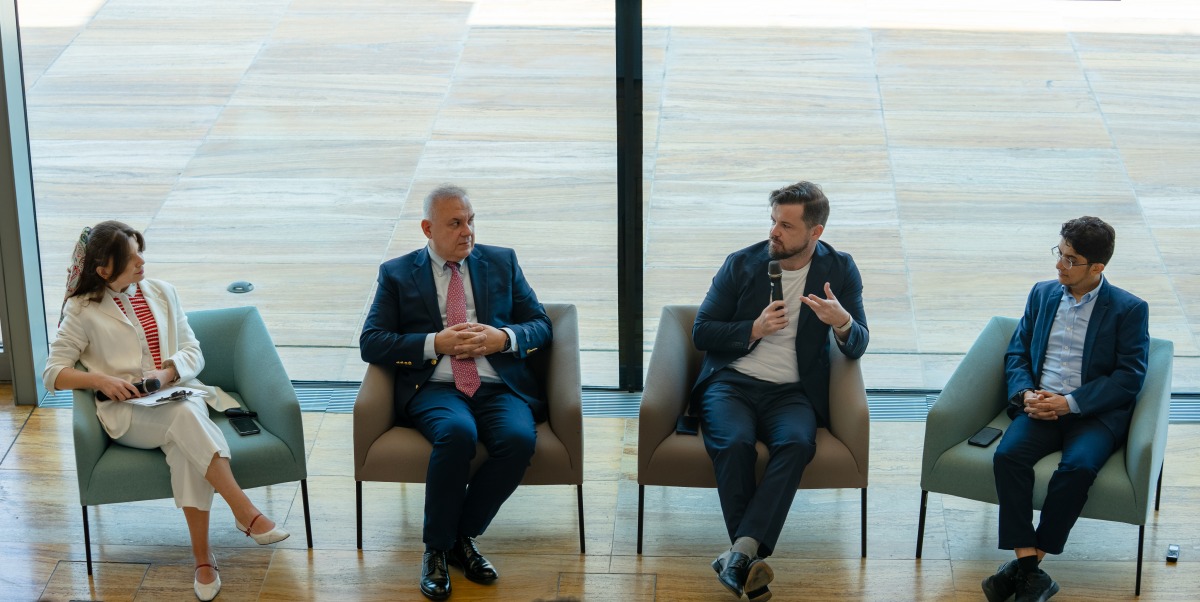
Panellists during the session.
Doha, Qatar: The World Innovation Summit for Education (WISE), an initiative of Qatar Foundation, hosted a research policy dialogue titled “Trust Me, I’m an Algorithm? AI, Disinformation, and Higher Education,” organised in collaboration with Hamad Bin Khalifa University (HBKU), Northwestern University Qatar (NU-Q), and Siren Associates.
The dialogue was anchored in an original study, “Fortifying Education in the Age of Disinformation”, conducted by WISE, HBKU, and NU-Q, whose research findings and recommendations form the foundation of the strategic framework.
Delivering the opening remarks, OBE, CEO of the WISE Dr. Asyia Kazmi underscored the imperative of addressing AI and disinformation in higher education, stating, “From the frontlines of teaching to the policy tables of higher education, AI and disinformation are reshaping the realities we face. Our research report highlights three priorities: understanding how students and faculty engage with AI, addressing language model blind spots in detecting harmful discourse, and committing to a decade long effort to strengthen information literacy. By uniting innovation with evidence, higher education can harness AI’s promise while building the resilience societies urgently need.”
Moderated by Research and Policy Lead at WISE, Sopiko Beriashvili the discussion highlighted findings from WISE’s research study about disinformation in higher education settings. The central question driving the study and conversation is “How do we keep out institutions epistemically honest when AI can manufacture plausible falsehoods at scale.”
Presenting findings from the WISE research report “Fortifying Education in the Age of Disinformation,” Professor of Digital Humanities at HBKU, Dr. Georgios Mikros emphasised: “Our research examines how AI and misinformation intersect across institutions, society, and national contexts. By engaging students and faculty directly, we identified both risks and opportunities and outlined practical steps to strengthen digital and critical literacy so higher education can respond ethically to the rapid spread of AI driven disinformation.”
The study is distinctive in its ambition to move beyond reactive responses, offering instead a proactive, evidence-informed, and human-centric framework. Central to its philosophy is the principle that AI adoption, online discourse quality, and information resilience are not separate challenges but deeply interconnected facets of a single, systemic transformation — and that addressing them effectively requires a “human-in-the-loop” approach, where technology provides scale and data, but trained people retain consequential judgment.
Organised as a comprehensive ecosystem, moving from understanding the problem, to designing solutions, to implementing them at scale the report puts forward three interconnected recommendations.
The first, Institutional Foundations, is grounded in an in-depth case study of AI adoption at HBKU, examining how students and faculty perceive, use, and are governed in their interactions with AI. The second, Healthy Digital Discourse, translates these insights into practical tools, including a curated Arabic toxicity dataset and a bilingual digital literacy platform, to help sustain respectful and informed academic communities online.
The third, National Resilience, proposes the Haqiqatar framework — a ten-year national strategy for building information resilience and media literacy in alignment with Qatar’s long-term education and innovation goals.