DOHA: Despite risk perceptions, Qatar’s macroeconomic fundamentals are strong. The country still maintains the same ratings as it did in June 2014 when oil prices were in excess of $100/barrel.
Regardless of the prospect of twin external and fiscal deficits this year, Qatar’s ‘AA’ ratings reflect its large external assets, a large hydrocarbon endowment, one of the world’s highest ratios of GDP per capita, and its fiscal adjustment efforts which have assuaged investors and credit rating agencies alike, Samba Financial Group said in its ‘Qatar economic monitor’, yesterday. These external assets include foreign exchange reserves at the central bank which currently constitute 6.9 months of imports – well above the 3 months recommended by the IMF for fixed exchange rate regimes.
Despite falling from a high of $45.9bn in November 2014 to $37.3bn in July 2016, reserves actually rose for the past two months in a row, and we expect reserves to stabilise further as oil prices recover.
On top of this, are the Qatar Investment Authority’s (QIA) investments. Liquidity remains tight in Qatar’s banking sector with the loan-to deposit ratio standing at 115 in June, down slightly on May (118).
The improvement in the ratio may have been a result of some of the $9bn in foreign capital the sovereign raised in May finding its way into the local banking system.
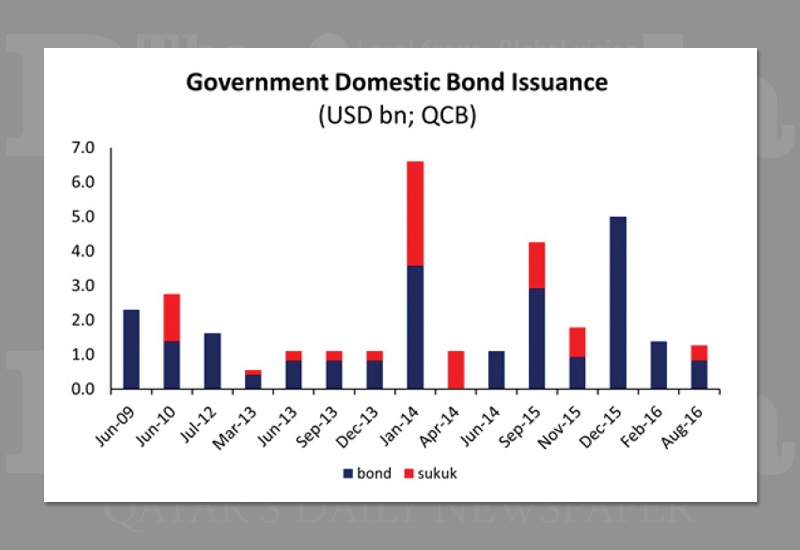
Government-related deposits continue to fall, although overall deposit growth is still positive thanks strong nonresident deposit growth. Despite constrained liquidity the government issued $1.3bn of domestic bonds and sukuks in August for which it received offers totalling $2bn.
Qatar’s total fiscal deficit over two years is forecast at $18bn, which ministry of finance has stated will be funded by debt issuance, as opposed to drawing down the substantial reserves at the QIA.
Issuance since September 2015 is already at $21.8bn, including the record $9bn international issuance in May this year. Although the need for fresh capital does not appear particularly pressing, the authorities may well decide to take advantage of extremely high international appetite for Gulf debt and make a further issue. The note said there is already evidence of fiscal consolidation in the country. The subsidy on petrol has been cut with prices rising 30-35 percent in January. The utility company Qatar General Electricity and water Corporation has implemented a new ‘cascading’ price structure for water and electricity supplied to homes and businesses. On top of the subsidy reform, there is evidence of substantial redundancies across both public and private sector companies. The authorities have implemented a pricing mechanism which fluctuates monthly to reflect changes in global prices, production and distribution costs in Qatar as well as prices elsewhere in the region. Analysts also foresee implementation of a GCC-wide VAT and likely increase in stamp duty.