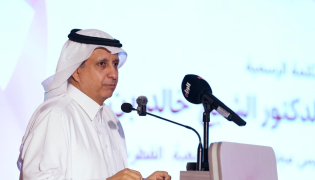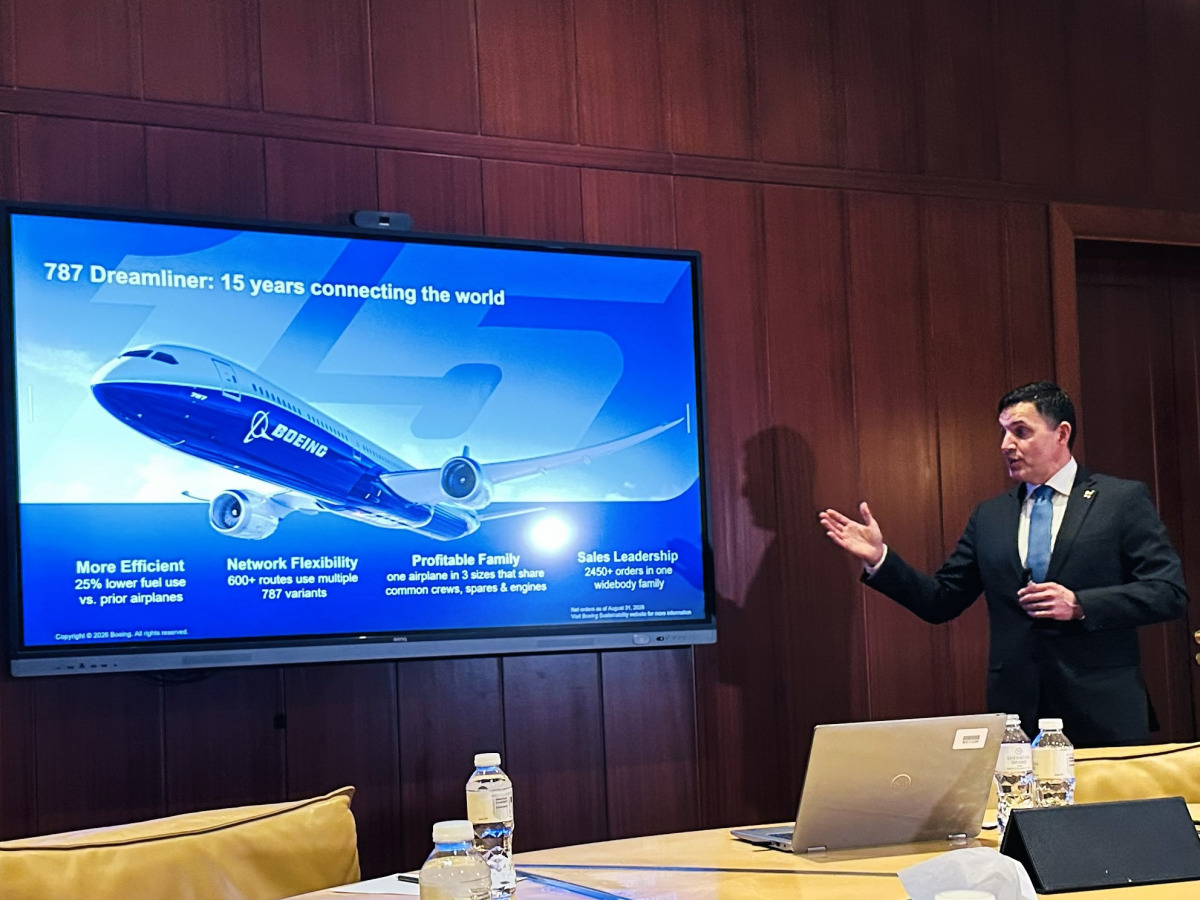
Boeing Managing Director of Commercial Marketing for the Middle East and Africa, Shahab Matin, speaking at the event.
Doha, Qatar: Boeing reaffirmed its deep-rooted partnership with Qatar in addition to highlighting the enduring resilience of Middle Eastern carriers, which continue to push forward with aggressive growth and fleet commitment plans despite ongoing geopolitical and supply chain hurdles.
During a media roundtable held on the sidelines of the 59th Arab Carrier Organization (ACCO) Annual General Meeting, Vice President of Boeing’s Commercial Sales and Marketing for the Middle East, Omar Arekat, underscored the strength of the manufacturer’s relationship with its Qatari partners.
“We are always in constant discussions with our partners at Qatar Airways,” Arekat told The Peninsula. “As you are well aware, we managed to sign the largest agreement on wide-body in Boeing’s history with Qatar Airways in 2025, and we are very proud of that.”
Arekat praised the national carrier as a global benchmark for aviation excellence, pointing to the airline’s rapid ascent and world-class product offering. Beyond aircraft orders, Boeing and Qatar Airways maintain an ongoing dialogue regarding strategic areas of partnership, including comprehensive support and maintenance services.
Addressing the broader macroeconomic and geopolitical backdrop, Arekat noted that the regional aviation sector faces persistent testing from conflicts, fluctuating jet fuel pricing, and airspace restrictions. These challenges have forced airlines to navigate complex operational adjustments, such as routing traffic through alternative connecting hubs.
Despite these hurdles, regional commitment remains steadfast, as the Boeing official remarked that airlines across the Middle East have maintained their delivery schedules without exception, demonstrating an unyielding dedication to long-term expansion.
“The airlines in the region, despite the challenges, have, without any exception, supported all their deliveries and remain absolutely committed to their plans to maintain that growth,” Arekat said.
Boeing leadership expressed confidence that the industry will successfully weather the current climate, drawing parallels to the aviation sector’s robust rebound following the COVID-19 pandemic.
During the post-pandemic recovery, the Middle East played a leading role in market revitalisation, a trajectory Boeing expects to see repeated as current regional challenges subside.
Adding depth to the roundtable’s commercial outlook, Managing Director of Commercial Marketing for the Middle East and Africa, Shahab Matin, presented comprehensive market data illustrating the robust trajectory of the industry.
Presenting long-term projections, Matin highlighted that the global aviation market anticipates a need for nearly 44,000 new jets over the next 20 years, specifically 43,625 total deliveries, with the Middle East and Africa accounting for 10 percent of this demand.
Driven by a historical average annual growth of 4.7 percent between 1990 and 2025, commercial aviation has proven exceptionally resilient against macro shocks, with future baselines projecting continued expansion.
Matin’s presentation further reinforced this wide-body focus, spotlighting versatile aircraft families such as the 787 Dreamliner, marking 15 years of connecting the world with over 2,450 orders and the market-leading 777 fleet family.
He also revealed that aviation plays a critical role in fostering economic growth in the region by creating 4 million jobs and generating $290bn in revenue.
This resilience is mirrored globally in cargo and passenger sectors, as the industry expert added that global air cargo traffic growth remains strong despite disruptions, posting over 5 percent increase between January and August 2026 compared to last year, fuelled heavily by high-value sectors such as AI-related goods.