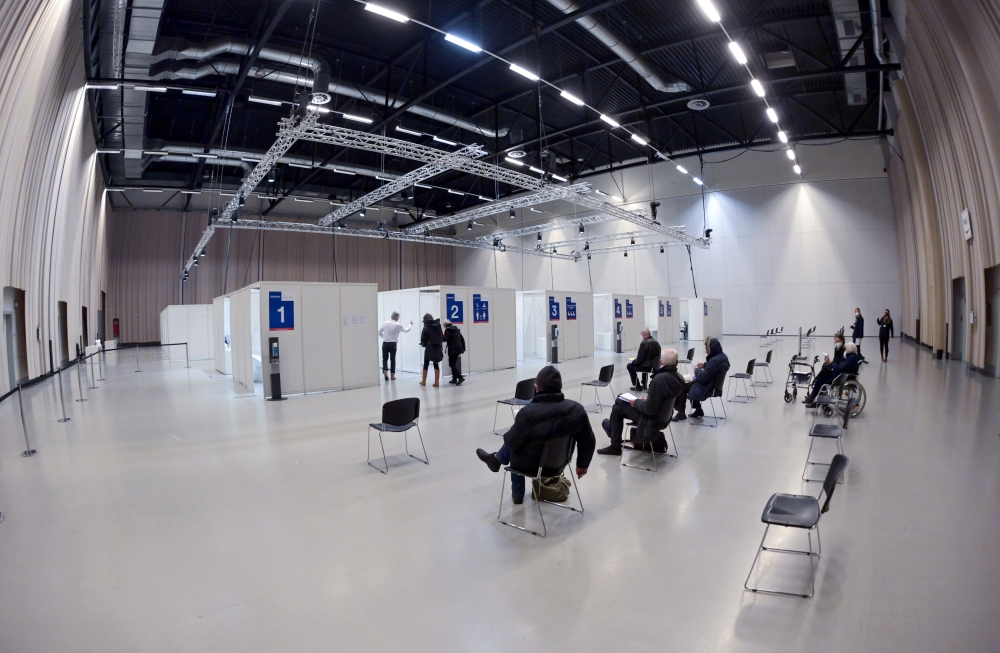
Patients wait at the Metropolis-Halle vaccination center for their injection with a dose of the Pfizer-BioNTech COVID-19 vaccine, as the spread of the coronavirus disease (COVID-19) continues in Potsdam, Germany, January 5, 2021. Soeren Stache/Pool via Re
Germany may need to tighten lockdown restrictions as well as extend existing curbs as officials struggle to distribute a Covid-19 vaccine fast enough to stem the pandemic.
Regional leaders lobbied in favor of tougher curbs ahead of talks Tuesday with Chancellor Angela Merkel to decide the next steps in fighting the disease. Merkel and the 16 state premiers will consult by video conference amid general agreement that the closing of non-essential stores, restaurants and leisure facilities last month needs to be extended beyond Jan. 10.
Officials have yet to find a consensus on whether to open shuttered schools after the holidays, and are also discussing a chancellery proposal to limit how far people living in areas with high infection rates can move from their homes, local media reported.
The first top-level meeting of 2021 on Germany’s virus strategy coincides with a rising tide of criticism that the government has bungled the rollout of a Covid-19 vaccine.
With a national election looming in September, top officials from the Social Democrats -- the junior partner in the ruling coalition -- attacked conservative Health Minister Jens Spahn over apparent delays. SPD Finance Minister Olaf Scholz, who is the party’s chancellor candidate, on Monday presented Spahn with a lengthy list of questions about why vaccinations are not happening faster, Bild newspaper reported.
Merkel, who has herself been a target for insisting on a coordinated European vaccine strategy, will announce the outcome of Tuesday’s talks at a news conference in Berlin.
"I must say that today a sharper, clearer and harder lockdown is the only way that we can get the infection numbers down,” Thuringia Premier Bodo Ramelow said in an interview with DLF radio.
His call was echoed by Manuela Schwesig, premier of the state of Mecklenburg-Western Pomerania, who said in an ARD television interview that "we have to discuss if contact restrictions need to be tightened.”
Growing concern in Germany and around Europe over diminishing hospital capacity and rapidly rising death rates has already prompted a sharpening of measures in several countries in the region.
Italian Prime Minister Giuseppe Conte extended a ban on people moving around Italy through mid-January, while British Prime Minister Boris Johnson shut England’s schools and ordered people across the country to stay at home.
Europe has become an epicenter of the pandemic since cases began ticking up again in October, with more than 400,000 coronavirus-related deaths and 17.3 million infections. Germany recorded a record 1,122 deaths on Dec. 30 and a further 957 on Tuesday, taking the total above 35,000.
In France, the government is seeking to speed up its vaccination rollout after a slow start. Merkel, meanwhile, is coming under increasing scrutiny over her decision in the summer to task the European Union with negotiating with drug companies, a move critics say slowed down the process and reduced the quantity of jabs available.
Officials in Merkel’s administration have said they are doing all they can to accelerate the production and distribution of vaccines. In addition to the shot jointly developed by Germany’s BioNTech SE, the approval of others by European health authorities should help accelerate the rollout.
According to the latest data from the RKI public health institute, about 266,000 people had been immunized in Germany through Monday, just over 0.3% of the population. That compares with around 1.4% in the U.S. and Britain, which both began vaccinating several weeks earlier.
Spahn has defended Germany’s decision to buy and distribute vaccines simultaneously among EU members. He said it was fairer for the smaller countries that wouldn’t have been able to negotiate on equal terms with manufacturers.
Spahn told ARD television Tuesday that there wouldn’t be any magical solutions overnight. "We have to be realistic,” Spahn told ARD television. "This won’t be done quicker than around the summertime in many countries in the world.”
Meantime, parents across Germany are wondering how long their children will have to stay home. School closures would cut European labor supply by about 6%, according to Bloomberg Economics, though the impact on individual countries depends on the share of households with children and working parents, ongoing access to alternative childcare for key workers and parents’ working from home capacity.
Western European nations are least likely to suffer, including Germany, the largest economy. Eastern Europe is hardest hit, with countries such as Slovenia and Slovakia losing as much as 10% of their workforce capacity.
The impact on economic output is likely to be more muted though, as workarounds are found and some people will be out of work anyway because of the pandemic. The direct impact on GDP from lower education activity will also be limited. The EU statistics office says that where schools have shifted toward remote teaching and more homework "it seems reasonable to assume that output is more or less unchanged compared to a normal situation.”