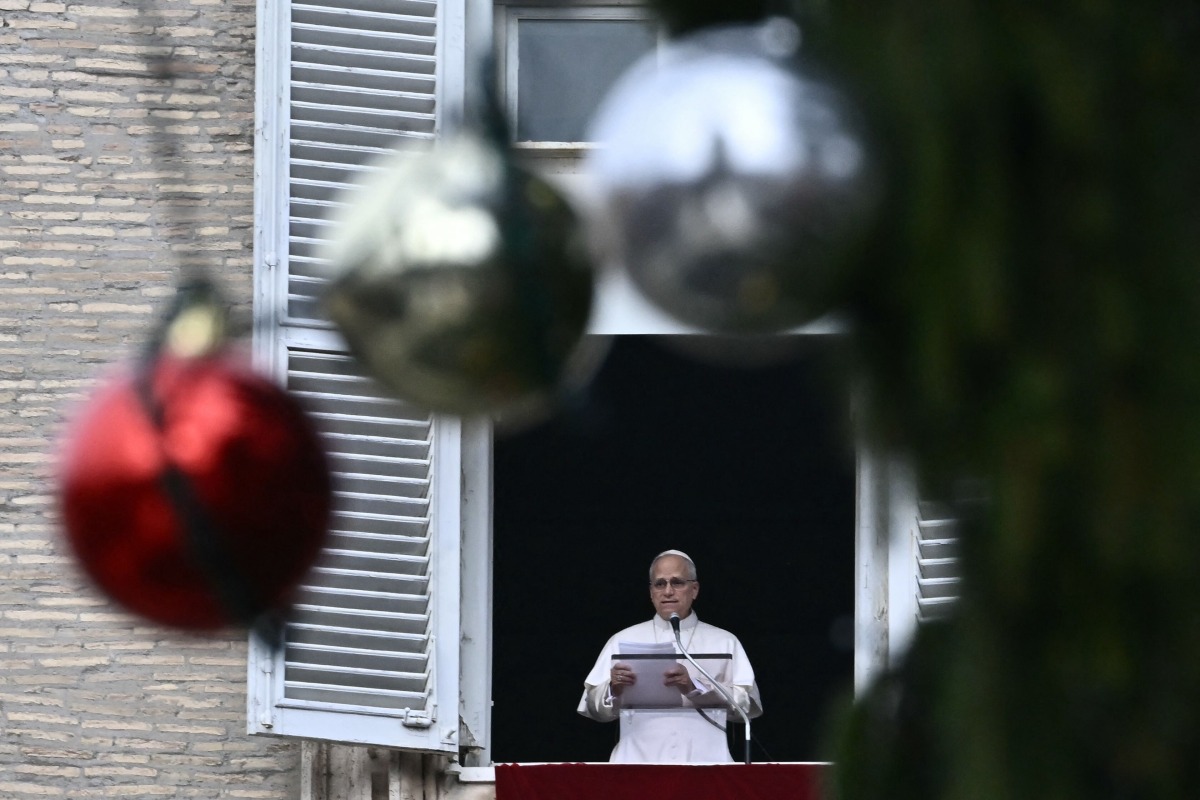
Pope Leo XIV delivers a speech to pilgrims from the window of the apostolic palace overlooking St. Peter's square during his Sunday Angelus prayer at the Vatican on January 4, 2026. (Photo by Filippo MONTEFORTE / AFP)
Vatican City: The 2025 Jubilee year of Catholic celebrations drew over 33 million pilgrims to Rome, the Vatican said Monday, as the last of the faithful passed through the "Holy Door" of St Peter's Basilica.
Pope Leo XIV will close the basilica's ornate bronze doors in a grand ceremony Tuesday, 12 months after they were opened by his predecessor Pope Francis, who died in April.
"The entire world came to Rome. Pilgrims arrived from 185 countries" for 35 major events, including a festival for young Catholics and the canonisation of the first internet saint, Archbishop Rino Fisichella told journalists.
The numbers showed the centuries-old institution was still "a dynamic church", he told a press conference.
It will also be remembered as a rare two-pope Jubilee. The last time a pope died during a "Holy Year" was in 1700.
Despite the torrential rain, thousands of pilgrims streamed through the door on the last day Monday, many pausing to cross themselves, and receiving a "plenary indulgence", or forgiveness for confessed sins.
"It's really a grace. And I feel great," said Josie Aguirre, 67, from the Philippines.
"It was emotional, the feeling was really great. The jubilee door is a way to renew people's faith, it brings people together," she told AFP.
The last pilgrim will pass through the huge door -- which is normally bricked up -- at 5.30 pm (1630 GMT).
Organised by the Church every 25 years, the Jubilee is a period of reflection and penance for the world's over 1.4 billion Catholics.
Some 60 percent of pilgrims who attended came from Europe, and 16 percent from North America, the Vatican said.
There was a sharp rise in arrivals following the election in May of Leo, the Church's first US pope, it said.
Significant areas of Rome were spruced up for the Jubilee, including monuments such as the Trevi Fountain.
Critics warned the Eternal City could struggle to cope with millions more visitors, when it already suffered from over-tourism and public transport is patchy at best.
But Rome's Mayor Roberto Gualtieri told journalists the Italian capital had risen admirably to the occasion in what was a "boom year" for tourists too.
The Jubilee's "main legacy" was a renewed "confidence in the possibility of improving and transforming the city", after "a very long period of stagnation or even decline", he said.