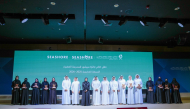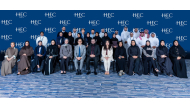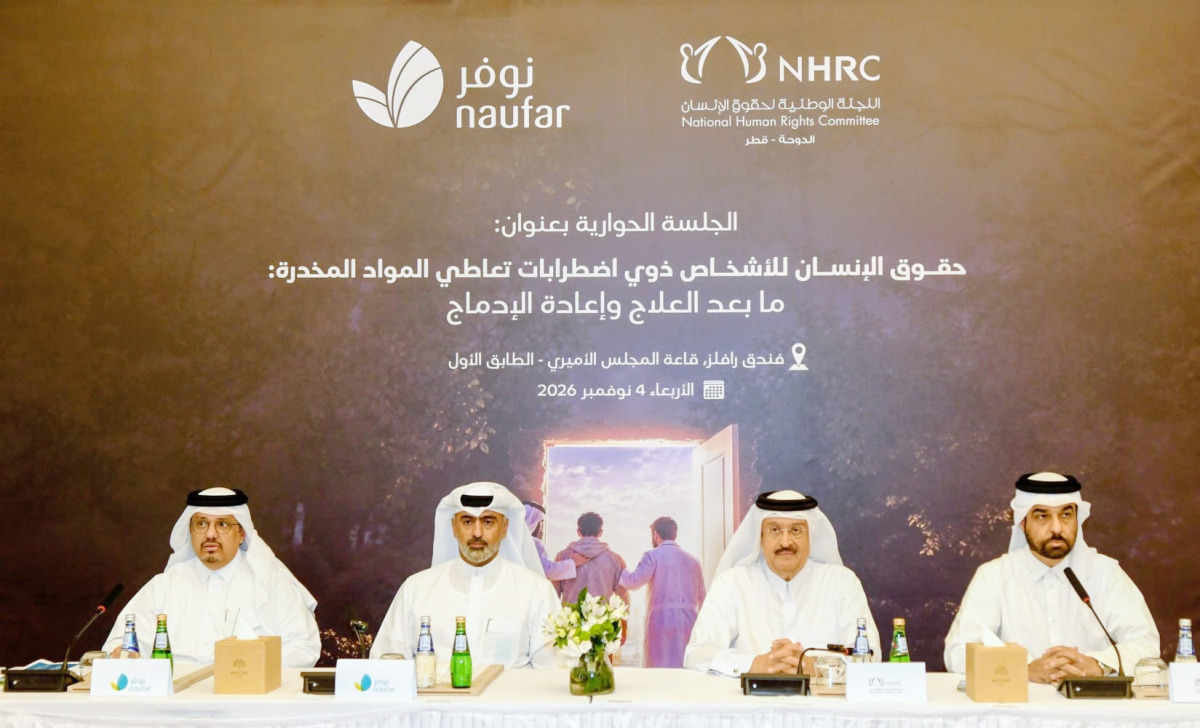
Officials during the dialogue session.
Doha, Qatar: A national dialogue session has recommended establishing a dedicated fund to support people recovering from substance use disorder , creating a permanent centre for recovery ambassadors and developing an integrated institutional framework to facilitate their social reintegration.
The seven recommendations were announced by National Human Rights Committee (NHRC) Secretary-General Sultan bin Hassan Al Jamali following a dialogue session organised by the committee in cooperation with Naufar Center yesterday under the title “Human Rights of Persons with Substance Use Disorders: Beyond Treatment and Social Reintegration”.
The recommendations seek to strengthen support for recovering individuals beyond medical treatment, remove obstacles to their full participation in society and ensure the sustainability of recovery through coordinated efforts involving government institutions, families and the wider community.
Among the key recommendations is the development of legislative frameworks and public policies to remove all barriers preventing recovery ambassadors from actively integrating into different aspects of life.
The participants also called for institutionalising communication channels among recovery ambassadors through the establishment of a permanent centre where they can meet, discuss challenges facing them and benefit from their experiences in raising awareness, educating the public and promoting prevention of substance-related risks.
Addressing social stigma was identified as another fundamental requirement for sustainable recovery and reintegration. The session recommended launching joint community initiatives and strengthening communication and coordination among the various stakeholders to promote greater understanding of addiction and the challenges faced by recovering individuals.
The recommendations also called for developing a joint institutional framework to support the post-treatment phase and ensure greater integration and coordination among the relevant institutions providing services to recovering individuals.
Another key proposal was the establishment of a dedicated fund to support recovering individuals, under the supervision of the General Secretariat of the Council of Ministers, to strengthen the support available to them as they work towards rebuilding their lives and returning to society.
The participants further stressed the importance of ensuring continuity of healthcare, medical follow-up, assistance and behavioural support, describing these services as essential foundations for sustainable recovery.
NHRC Vice-Chairman H E Dr Mohammed Saif Al Kuwari said the issue involved interconnected social, economic and health dimensions and required a comprehensive approach based on international human rights principles and standards.
He stressed that recovery did not end when an individual left a healthcare institution, as challenges related to medical follow-up, employment and family stability could affect the rehabilitation process.
He warned that discrimination and social exclusion could increase the risk of relapse, undermine rehabilitation efforts and prevent recovering individuals from rebuilding their lives.
Naufar Center Director-General Dr Khalifa Jiham Al Kuwari said respect for human rights was an integral part of quality healthcare, stressing that recovering individuals needed understanding, respect and a supportive environment.
He said the recovery journey extended beyond treatment to rebuilding self-confidence, strengthening family relationships, returning to education and employment, and participating actively in society.
The dialogue session brought together representatives of several ministries and government institutions, including the ministries of interior, labour, public health, social development and family, and justice, alongside the Public Prosecution, Supreme Judiciary Council, Civil Service and Government Development Bureau, Behavioural Healthcare Center and World Health Organisation.
On the sidelines of the event, the NHRC and Naufar Center signed a memorandum of understanding to strengthen cooperation in human rights awareness, healthcare and rehabilitation.