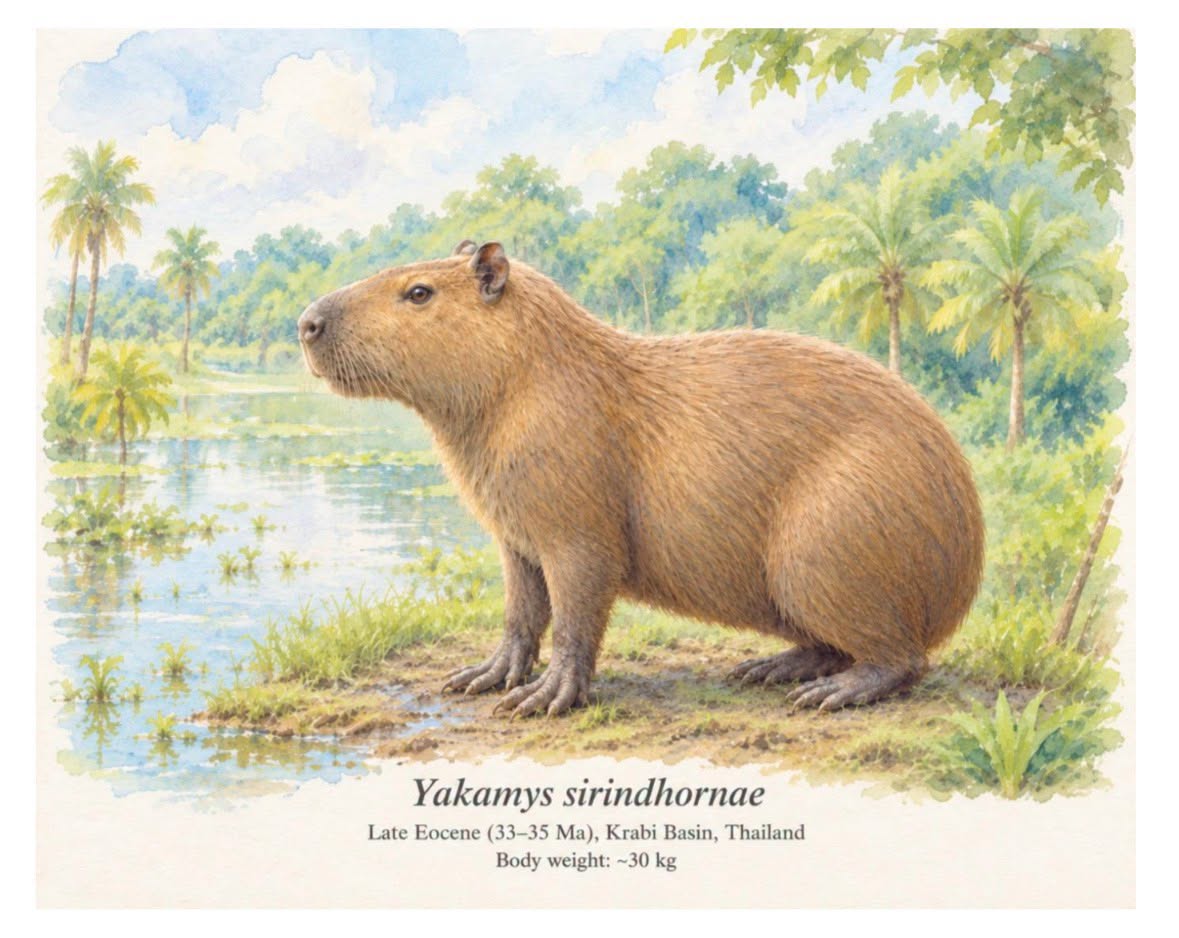
A representational picture shared by Thailand Ministry of Natural Resource and Environment on its Facebook account
Bangkok, Thailand: A giant rodent weighing around 30 kilograms roamed what is now southern Thailand 33 to 35 million years ago, scientists said, after identifying a previously unknown species from two fossilised teeth.
The ancient animal, which one geologist on the team called a "giant rat", was among the largest known from the Paleogene period, offering new clues about how early rodents evolved to enormous sizes.
The findings, published Wednesday in the journal Scientific Reports, were based on a molar and an incisor discovered in 2004 at a coal mine in southern Krabi province.
Pannipa Tian, a geologist with Thailand's Department of Mineral Resources who found the incisor, said she initially misidentified the fossil because of its "unusually large size".
"At first, I thought it was a bone. I showed it to my supervisor, who told me it was a giant rat's tooth," Pannipa, 51, told AFP on Thursday.
The cream-coloured fossil stood out against the dark coal deposits, while another expedition member found the dark-coloured molar the same day.
The Krabi basin has previously yielded fossils of ancient primates, carnivores and hoofed mammals.
But at the time of the discovery, the team lacked sufficient evidence and technology to identify the species.
More than two decades later, researchers from Thailand, France and Canada were able to do so through detailed analysis of the teeth.
The animal weighed around 30 kilograms -- an estimated half as much as a large capybara, the world's largest living rodent, they said.
Unlike the South American capybara, however, the prehistoric rodent belonged to the now-extinct Ischyromyidae family, one of the earliest major groups of rodents.
"It tells a lot about the diversity of life in the past," Pannipa said, suggesting that ancient rodents may have evolved in what is now Thailand before spreading to other parts of the world.
But with only two teeth recovered, the animal's appearance, diet and behaviour remain unknown.
The species was named Yakamys sirindhornae in honour of Thailand's Princess Sirindhorn, a supporter of scientific and palaeontological research.