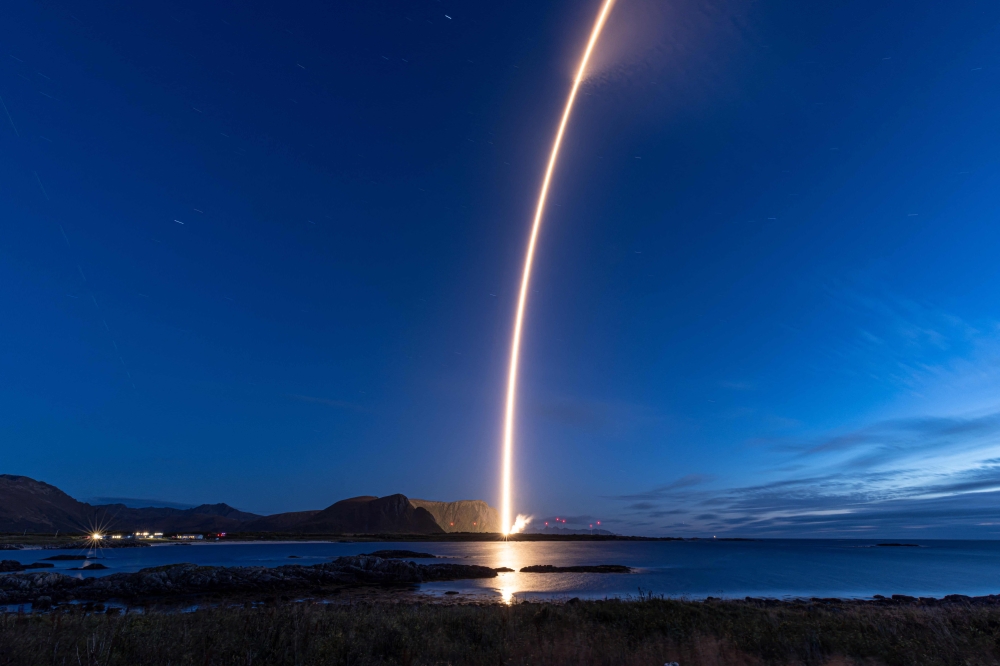
This handout photo released on September 6, 2026 by the German Isar Aerospace company shows the launch of a rocket into orbit from Andoya in Norway on September 5, 2026. (Photo by Handout / Isar Aerospace / AFP)
Berlin: Germany's Isar Aerospace launched a rocket into orbit from Norway on Saturday as Europe races to boost its ability to economically send satellites into space independently of the United States.
Isar's 28-metre (92-foot) long two-stage Spectrum rocket blasted off shortly after 2000 GMT from Andoya spaceport, north of the Arctic circle, the company said.
"We're in orbit! And just made European history: This is the first time a privately developed rocket reached orbit from continental Europe," the company said on X of the launch from the Norwegian spaceport Andoya.
About 10 minutes into the mission dubbed "Onward and Upward", the video transmission cut out after the rocket exceeded maximum range for connection.
"Germany has spaceflight capabilities," said the Ministry for Research, Technology and Space on X, hailing a "milestone that impressively demonstrates our country's innovative strength and technical expertise".
The launch follows months of delays, caused by either technical or safety issues, and a test flight in March 2025 in which a Spectrum plunged back to earth and exploded.
Once ready for serial production, the Spectrum will be tasked with sending civilian and military satellites into low Earth orbit a few hundred kilometres above the ground.
The Spectrum can haul about one tonne of payload, and Isar says its plant near Munich will be able to make more than 30 of the rockets per year.
While France's Arianespace has long operated from French Guiana, Europe is betting on competition between Isar and other companies to more cheaply launch satellites in future, as Elon Musk's SpaceX has done in the United States.
"We need capacity. We need independence," Chancellor Friedrich Merz said in March while visiting the Andoya facility with Norway's prime minister.
"For far too long we have relied on other delivery systems and other nations around the world."
Speaking in June at the International Aerospace Exhibition in Berlin, Merz said: "Space is not only crucial for our security, but it is also becoming an increasingly important part of our economic sphere."
The launch comes at a time US President Donald Trump has badly shaken European trust in the NATO alliance, with Europe worrying about its dependence on America, including in space launch capabilities.
German Defence Minister Boris Pistorius has announced a 35 billion euro (over $40 billion) drive by 2030 to build out space capacity.