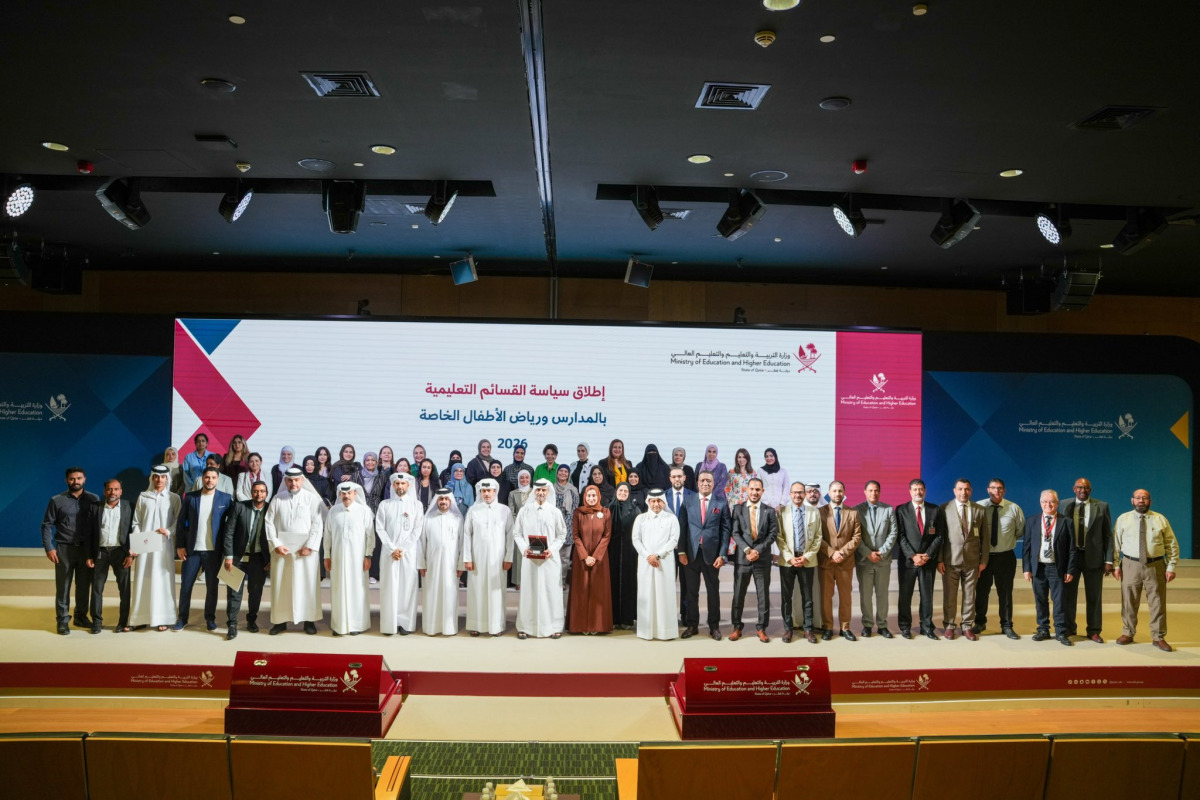
MoEHE officials and school representatives at the event.
DOHA: The Ministry of Education and Higher Education has launched an education voucher policy for Qatari students enrolled in private kindergartens and schools across all educational levels, including students with disabilities, in a move aimed at expanding educational choices and easing the financial burden on families.
The policy also extends education vouchers for the first time to standalone private kindergartens and newly established schools from the start of their operations, subject to quality standards.
The policy seeks to promote equal educational opportunities, improve the quality of education and strengthen partnerships with the private education sector, while ensuring inclusive and equitable access to quality learning opportunities for all students.
The announcement was made during a press conference held at the ministry’s permanent headquarters, attended by representatives of local media, owners and directors of private schools and kindergartens.
Speaking at the conference, Assistant Undersecretary for Private Education Affairs Omar Abdulaziz Al-Naama said investing in children’s education was an investment in the country’s future, emphasising that providing educational opportunities was a shared responsibility requiring cooperation among all stakeholders.
He said the education voucher policy reflected the ministry’s commitment to supporting learning opportunities and expanding educational choices, while promoting fairness and equal opportunities among students and enabling them to enrol in participating private schools.
Al-Naama noted that the policy would contribute to improving educational quality by encouraging schools to develop their services and meet accreditation requirements and quality standards.
It would also strengthen transparency and accountability in the management of educational support.
He stressed that clearly defined roles and procedures would help standardise practices and enhance cooperation among the ministry, schools and parents, ensuring that the policy serves students’ best interests.
Director of Private Schools and Kindergartens Affairs and Acting Director of Private School Licensing Department Dr. Rania Mohammed presented the policy’s regulatory framework, outlining its guiding principles of fairness, equality, transparency and sustainability.
She said its strategic objectives included empowering families, improving educational quality, strengthening accountability and raising public awareness, alongside facilitating access to specialised educational services and reducing the financial burden on households.
Dr Rania also explained the scope of the policy, general provisions, conditions for private schools to join the education voucher system, and the mechanisms for monitoring and evaluating its effectiveness. She outlined the respective responsibilities of families, schools and the ministry, as well as procedures for submitting grievances and the documents required to benefit from the scheme.
Among the key regulatory developments introduced under the policy is the provision of education vouchers for the first time to private kindergartens operating in separate buildings, as well as newly established schools from the commencement of their operations, subject to specific quality standards and requirements.
She also addressed eligibility arrangements in different circumstances, including cases involving students repeating an academic year, whether they had passed or failed, and the eligibility of children of retirees.
Director of the Special Education and Inclusive Education Department Amna Ali Mohammed Al Mulla outlined the categories of students with disabilities covered by the policy.
These include students with autism spectrum disorder, intellectual, hearing, visual, physical and multiple disabilities, specific learning difficulties, attention deficit hyperactivity disorder (ADHD), and speech and language disorders.
Engineer Abubakr Al Amin from the ministry’s Information Technology Section demonstrated how eligible students with disabilities can access the education voucher service and explained the stages of processing applications electronically through the Maaref portal, the ministry’s dedicated platform for public services.