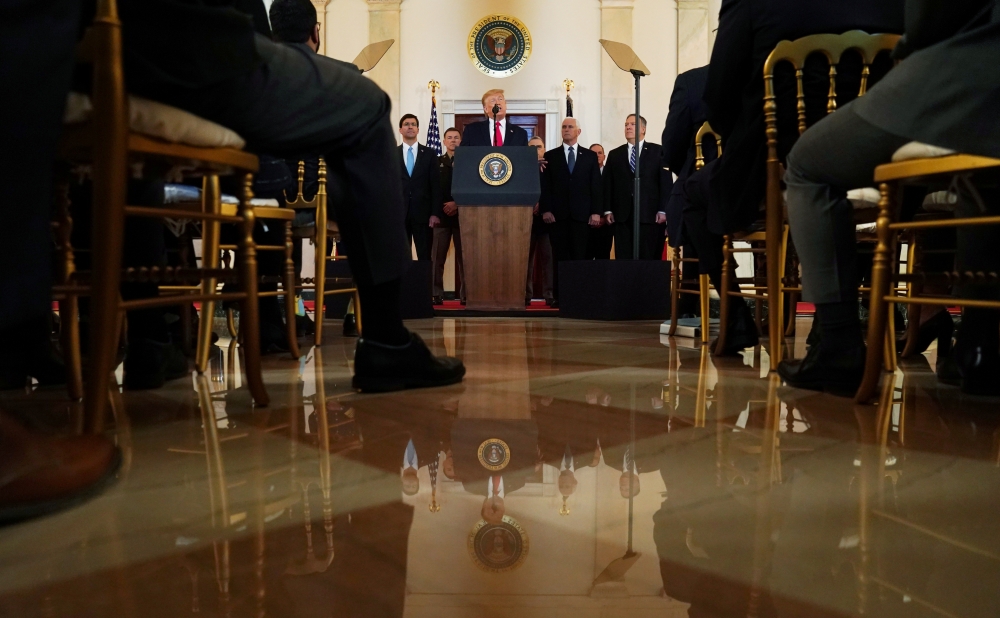
US President Donald Trump delivers a statement about Iran flanked by Secretary of Defense Mark Esper, Vice President Mike Pence, Secretary of State Mike Pompeo and military leaders in the Grand Foyer at the White House, January 8, 2020. Reuters/Kevin Lama
WASHINGTON/BAGHDAD/DUBAI: President Donald Trump said on Wednesday the United States did not necessarily have to use its military power against Iran, in an apparent attempt to defuse a crisis over the American killing of Iranian military commander Qassem Soleimani.
Speaking from the White House, Trump said no Americans were harmed in Iranian missile attacks on military bases housing U.S. troops in Iraq overnight and suggested Washington might not carry out immediate retaliation.
"The fact that we have this great military and equipment, however, does not mean we have to use it. We do not want to use it. American strength, both military and economic, is the best deterrent," he said.
"Our great American forces are prepared for anything. Iran appears to be standing down, which is a good thing for all parties concerned and a very good thing for the world," he said.
Trump stopped short of making any direct threat of military action against Iran but said the United States "will immediately impose additional punishing economic sanctions on the Iranian regime" in response to what he called "Iranian aggression."
As he spoke, the U.S. president was flanked by Vice President Mike Pence, Defense Secretary Mark Esper and Secretary of State Mike Pompeo and military officers.
He offered no specific measures.
US thinks Iranian reprisal deliberately missed American troops
Iranian forces fired missiles at military bases housing U.S. troops in Iraq on Wednesday in retaliation for the killing last week in Iraq of Iranian general Soleimani, raising the stakes in its conflict with Washington amid concern about a wider war in the Middle East.
Iranian Supreme Leader Ayatollah Ali Khamenei, addressing a gathering of Iranians chanting "Death to America," said the missile attacks were a "slap on the face" of the United States and said U.S. troops should leave the region.
Iranian Foreign Minister Mohammad Javad Zarif had said the strikes "concluded" Tehran's response to the killing of Soleimani, who had been responsible for building up Iran's network of proxy armies across the Middle East. He was buried in his hometown Kerman on Monday after days of national mourning.
"We do not seek escalation or war, but will defend ourselves against any aggression," he wrote on Twitter.
NUCLEAR DEAL
Trump again vowed that he would not allow Iran to obtain a nuclear weapon and urged world powers to quit a 2015 nuclear accord with Iran that Washington abandoned in 2018 and work for a new deal, an issue that has been at the heart of rising tensions between Washington and Tehran. Iran has rejected new talks.
There was no immediate reaction from Iranian officials to Trump's comments. The semi-official Fars news agency described the U.S. president's remarks as a "big retreat from threats."
Trump's reaction in the immediate aftermath of Wednesday's attacks had been to say on Twitter that "All is well!" and that Washington was assessing damage.
That tweet and the comment by Iran's foreign minister had acted to soothe some initial concerns about a wider war and calmed jittery financial markets. Oil prices slipped back after an early spike.
U.S. and European government sources said they believed Iran had deliberately sought to avoid U.S. military casualties in its missile strikes to prevent an escalation.
But an Iranian army spokesman had denied "foreign media reports" suggesting there had been some kind of coordination between Iran and the United States before the attack to allow bases to be evacuated, Fars news agency said.
The U.S. president, who was impeached last month and faces an election in November this year, had at the weekend threatened to target 52 Iranian sites if Iran retaliated for Soleimani's killing.
Iranian state television said Iran had fired 15 ballistic missiles from its territory at U.S. targets in its neighbour Iraq early on Wednesday. The Pentagon said al-Asad air base and another facility in Erbil in Iraq were struck.
Iranian television reported an official in the supreme leader's office as saying the missile attacks were the "weakest" of several retaliation scenarios. It quoted another source saying Iran had lined up 100 other potential targets.
AVOIDING CONFLICT
But analysts said Iran wanted to avoid any conventional military conflict with superior U.S. forces.
U.S. officials said Soleimani was killed because forces under his command planned attacks on U.S. targets, although they did not provide evidence.
After the Iranian missile attack, state television showed footage of the burial, with hundreds of people chanting "God is greatest" when the strikes were announced over loudspeakers. "His revenge was taken and now he can rest in peace," Iranian television said.
Friction between Iran and the United States rose after Trump withdrew from the nuclear deal between Iran and world powers, approved by his predecessor Barack Obama, and reimposed sanctions on Tehran slashing its vital oil exports.
In his speech on Wednesday, Khamenei ruled out any resumption of talks with Washington on the 2015 nuclear pact.
Before Soleimani was buried, his body was taken on a tour of cities in Iraq and Iran, drawing huge crowds. A stampede at his funeral on Tuesday killed at least 56 people.
Hours after Iran fired the missiles at the bases in Iraq, a Ukrainian airliner crashed shortly after take-off from Tehran on Wednesday, bursting into flames and killing all 176 people on board. Officials said speculation about what happened was premature.
Carrier Ukraine International Airlines said the plane was last serviced two days ago.
TRUMP FACING ELECTION THIS YEAR
Trump's reaction in the immediate aftermath of the attacks had been to say on Twitter that "All is well!" and that Washington was assessing damage.
Trump's early tweet and the comment by Iran's foreign miniser had acted to soothe some initial concerns about a wider war and calmed jittery financial markets.
U.S. and European government sources said they believed Iran had deliberately sought to avoid U.S. military casualties in its missile strikes to prevent an escalation.
The U.S. president, who was impeached last month and faces an election this year, had at the weekend threatened to target 52 Iranian sites if Iran retaliated for Soleimani's killing.
Iranian state television said Iran had fired 15 ballistic missiles from its territory at U.S. targets in its neighbour Iraq early on Wednesday. The Pentagon said al-Asad air base and another facility in Erbil were struck.
Iranian state television had said 80 "American terrorists" had been killed and U.S. helicopters and military equipment had been damaged. But it did not say how it obtained that information.
Germany, Denmark, Norway and Poland said none of their troops in Iraq were hurt. Britain, which also has personnel in Iraq, condemned the Iranian action and said Tehran "should not repeat these reckless and dangerous attacks".
Iraq said its forces did not suffer casualties.
More than 5,000 U.S. troops remain in Iraq along with the other foreign forces in a coalition that has trained and backed Iraqis against the threat of Islamic State militants.
READ MORE: Commercial airlines reroute flights amid US-Iran tensions
Iran retaliates with missile strike on US-Iraqi bases
US won't grant Iran foreign minister visa for UN visit
Pompeo accuses Iran of undermining Afghanistan peace efforts