Washington: Former U.S. Secretary of State Hillary Clinton needs to win 613 of the remaining 775 pledged delegates to clinch the Democratic Party nomination for U.S. president.
With Clinton neck-and-neck with Senator Bernie Sanders in the opinion polls for Tuesday's California primary, where 475 pledged delegates are at stake, it's very unlikely she'll have the required 2,383 pledged delegates going into the Philadelphia convention next month.
That means Clinton will need the votes of super-delegates, those unelected, pre-selected, party insiders chosen specifically to prevent a grass-roots insurgent candidate like Sanders.
Clinton leads Sanders in super-delegates who indicate how they intend to vote by a large margin. But unlike pledged delegates, bound by the will of the voters, the super-delegates can change their minds right up to the convention night when they must cast their ballot.
U.S. media has prematurely declared Clinton the Democratic nominee, even though she's short of the required pledged delegates. It is assuming the super-delegates will stick with her until Philadelphia.
Sanders has several strong arguments to get them to change their minds. First, he does much better in every poll against Republican nominee Donald Trump than Clinton. Second, Clinton could still be indicted by the U.S. Justice Department before the convention for her mishandling of classified information on her private email server.
Third, at this point in the 2008 Democratic race, Clinton also trailed Barack Obama by a large number of pledged delegates, yet she refused to leave the race. She even floated the possibility that Obama could be assassinated, invoking the June 1968 slaying of Robert F. Kennedy on the night he'd won the California primary..
Fourth, Sanders has very little baggage. There are virtually no scandals in his past. There is little that Trump's opposition research can dig up on him compared to multiple scandals over decades involving the Clintons. Sixth, in a year of anti-Establishment fervor on both left and right it seems very risky for the Democrats to put up a quintessential Establishment figure like Clinton to face populist Trump.
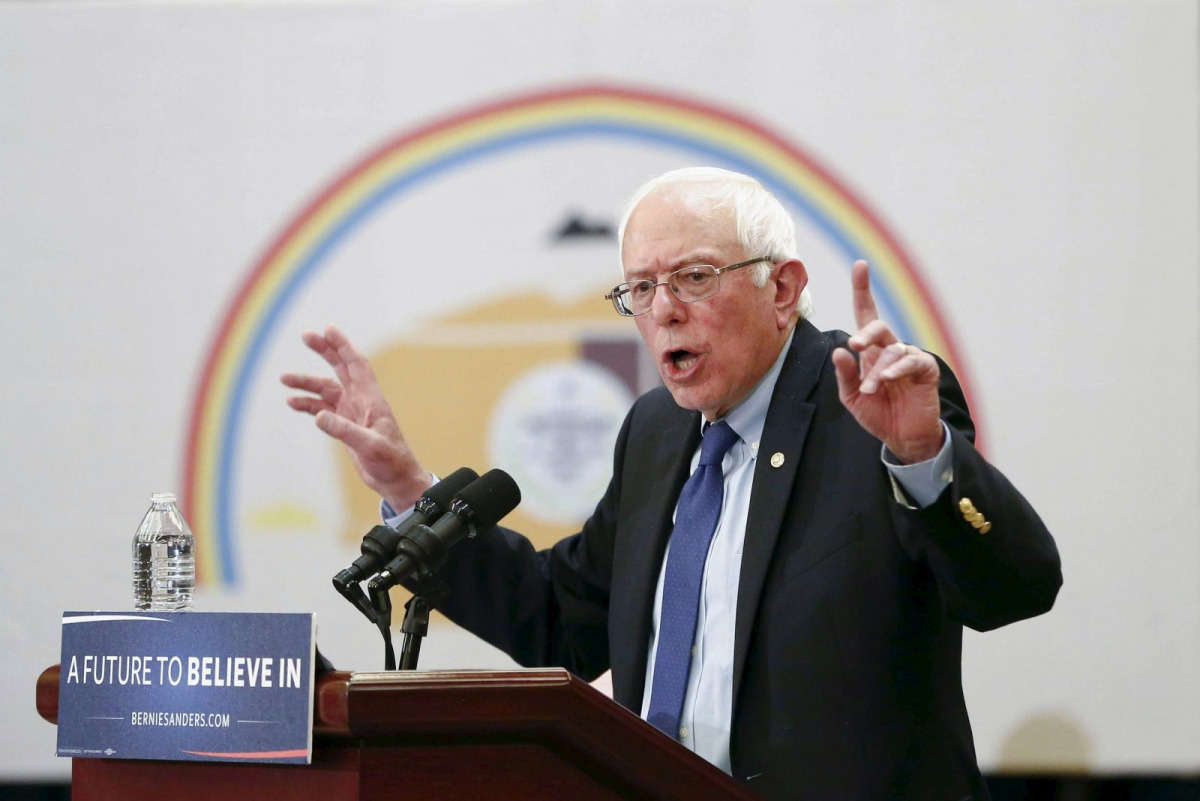
Given these facts, Sanders says he'll lobby the super-delegates until that night in Philadelphia. And that's why he's staying in the race. Because he thinks he can still win.
U.S. media instead has tended to portray Sanders as an angry, old man stubbornly staying in the race only because he wants to hurt Clinton out of vindictiveness, and thus help Trump. He supporters are often portrayed as angry and violent.
Even if he suffers a blowout in California, Sanders has several strong arguments with the super-delegates that Democrats would have a much better chance with him in November. But Sanders has stirred up masses of people who pose a threat to Democratic elite privileges.
His proposed policy changes could cut into their entrenched interest. Trump's rhetoric on the right has made similar appeals to suffering workers and formerly middle class Americans. But the billionaire Trump may only be exploiting that sentiment, while Sanders may genuinely try to make reforms that could challenge those on top.
Therefore it is unlikely, short of a Clinton indictment, that the super-delegates will listen to Sanders. And if she is indicted, there's talk in Washington of the Democrats inserting Vice President Joe Biden or Secretary of State John Kerry as the last minute nominee.
But that risks the very reaction by Sanders supporters in Philadelphia the party establishment fears most.
QNA