By Liz Hampton and Rod Nickel
LAC LA BICHE, Alberta: Canadian officials will take their first look on Monday afternoon at the oil sands boomtown devastated by a wildfire that has been raging for more than a week as the blaze turned away from populated areas and cooler weather slowed its spread.
Alberta’s premiere, Rachel Notley, will lead local officials and media on an inspection of Fort McMurray, whose 88,000 inhabitants fled the blaze that broke out on May 1.
Notley warned the nation to brace for grim images, with entire neighborhoods destroyed, though the flames had moved far enough away from the town to make an inspection safe, officials said.
“The head of the fire is well away from the community. There’s been some growth, but limited growth, and that’s due to the change in weather,” said wildfire information officer Matthew Anderson on CBC television.
Damage from the fire, while extensive, could be less costly than initially feared, according to data released on Monday.
Canada’s largest property and casualty insurer Intact Financial Corp expects to suffer losses ranging from C$130 million to C$160 million ($100 million-$123 million) from the wildfire. Intact used satellite imagery and geocoding technology to see if buildings were a total loss or partially destroyed.
Analysts said Intact’s forecast implied overall industry losses of between C$1 billion C$1.1 billion ($769 million-$846 million), much less than the earlier forecast of C$9 billion ($7 billion).
Previous analysts’ estimates, based on less precise data, had expected losses to dwarf previous records in Canadian history, including C$1.9 billion ($1.46 billion) from the North American ice storm of 1998 and the Alberta floods of 2013.
COOLER WEATHER COULD HELP
Firefighters hoped that cooler weather would aid in the battle against the blaze.
Temperatures cooled on Monday, with a forecast high of 10C (50°F), down from Sunday’s high of 17 C (63°F).
The cool weather was expected to linger through Thursday, according to Environment Canada. Still, much of the province of Alberta in western Canada is tinder-box dry after a mild winter and warm spring.
Alberta’s government said Monday the fire had consumed 161,000 hectares (395,000 acres), an estimate unchanged from Sunday. It had expanded to within 40 kilometers (25 miles) of the border of Saskatchewan, a province east of Alberta, but was not expected to cross into the neighboring province, said Travis Fairweather, an Alberta wildlife information officer.
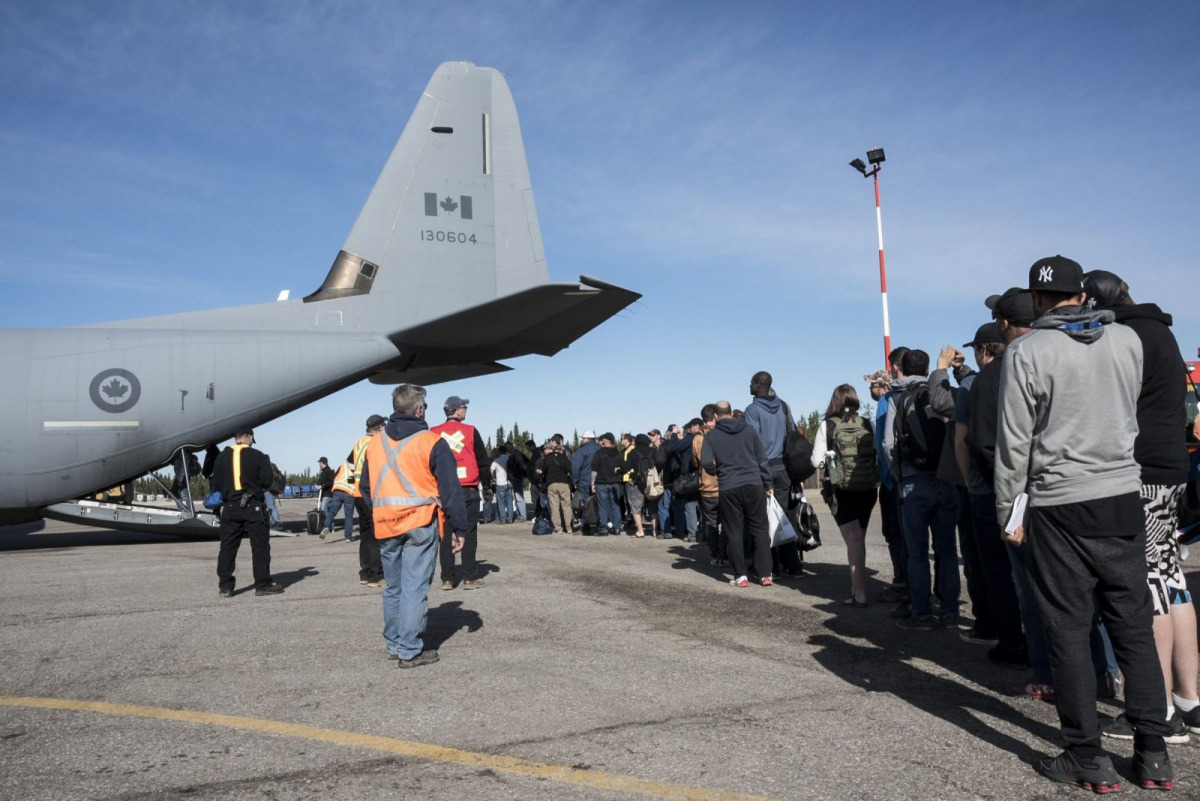
Officials said it was too early to know when the thousands of evacuees camped out in nearby towns could go back to Fort McMurray, even if their homes were intact.
The city’s gas has been turned off, its power grid is damaged and the water is undrinkable.
Fort McMurray is the center of Canada’s oil sands region. About half of its crude output, or 1 million barrels per day, has been taken offline, according to a Reuters estimate.
Statoil ASA said it will suspend all production at its Leismer oil sands project in northern Alberta until midstream terminals needed to transport crude oil via pipeline reopen.
Its move followed shutdowns of Nexen Energy’s Long Lake facility, Suncor Energy’s base plant operations, the Syncrude project and Conoco Phillips’ Surmont project.
U.S. oil prices fell 2.7 percent.
Nearly all of Fort McMurray’s residents escaped the fire safely, although two teenagers died in a car crash during the evacuation.
($1 = 1.2997 Canadian dollars)
(With additional reporting by Nia Williams in Calgary and Matt Schuffman, Ethan Lou and Allison Martell in Toronto; Writing by Scott Malone and Jeffrey Hodgson; Editing by Richard Pullin and Jeffrey Benkoe)
Reuters