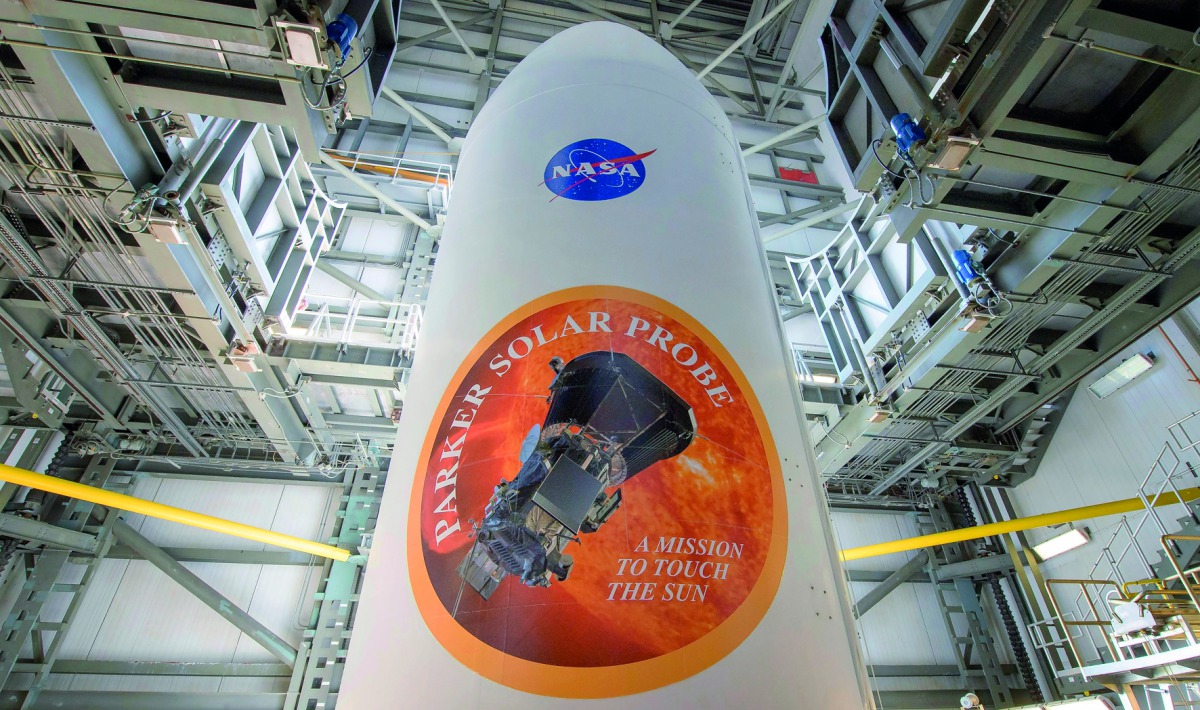
The United Launch Alliance Delta IV Heavy rocket payload fairing with the Nasa and Parker Solar Probe emblems, at Launch Complex 37, Cape Canaveral Air Force Station in Florida, yesterday.
CAPE CANAVERAL: Nasa is sending a spacecraft straight into the sun’s glittering crown, an atmospheric region so hot and harsh any normal visitor would wither.
Set to launch early today, the Parker Solar Probe is as heat-resistant as a spacecraft gets, essential for exploring our star closer than ever before.
The US got a glimpse of the sun’s glowing, spiky crown, or corona, during last August’s coast-to-coast total solar eclipse. “Well, Parker Solar Probe’s going to be in there,” said project scientist Nicola Fox of Johns Hopkins University.
Parker’s lightweight heat shield is just 11 centimetres thick. But it can withstand 2,500 degrees Fahrenheit (1,370 degrees Celsius) as well as extreme radiation, thanks to its high-tech carbon.
Although the corona reaches millions of degrees, it’s a wispy, tenuous, environment and so the spacecraft won’t need to endure such severe temperatures. The 2.4 metre shield will face the sun during the close solar encounters, shading the science instruments in the back and keeping them humming at a cool 80 degrees Fahrenheit (27 degrees Celsius). As one scientist notes, this is a shield Captain America would envy.
The spacecraft’s path to the sun runs past Venus. It will fly by our solar system’s hottest planet seven times over seven years, using the gravity of Venus to shrink its own oval orbit and draw increasingly closer to the sun. The first Venus flyby is in October, followed by the first dip into the sun’s corona in November.
There will be 24 orbits between Venus and the sun, with the final three putting Parker closest to the sun — just 6 million kilometres out —in 2024 and 2025. That’s a scant 4 percent of the 150 million kilometres between Earth and the sun.
The records will start falling as soon as Parker takes its first run past the sun.. The current close-to-the-sun champ, Nasa’s former Helios 2, got within 43 million kilometresin 1976. Parker will come within 25 million kilometres in November and then start beating its own record. During its closest solar approaches, the spacecraft will hurtle through the corona at 690 kph, setting a speed record.
Our yellow dwarf star is, in many ways, a mystery. The outreaching corona is hundreds of times hotter than the sun’s actual surface, confounding scientists.
In addition, physicists don’t know what’s driving the solar wind, the supersonic stream of charged particles constantly blasting away from the sun. By being right in the thick of it, Parker should provide some answers, shedding light not only on our star but the billions of others out there.
Sixty years ago, a young astrophysicist at the University of Chicago, Eugene Parker, proposed the existence of solar wind. Many were skeptical and told him to read up on it first “so you don’t make these killer mistakes,” he recalls.
Vindication came with NASA’s Mariner 2 spacecraft in 1962. Parker is now 91 years old and at Cape Canaveral with his family to witness his first launch— a Delta IV Heavy rocket with the spacecraft bearing his name.
It’s the first time Nasa has named a spacecraft after someone who’s still alive. In an interview with, Parker noted from a publicity standpoint, “it absolutely wipes out everything else” in his career.
“At my age, it gets fatiguing. But of course, I enjoy it.”