
Minister of Justice and Minister of State for Cabinet Affairs H E Ibrahim bin Ali Al Mohannadi (third right), Minister of Communications and Information Technology H E Mohammed bin Ali Al Mannai (fourth right), Minister of Municipality H E Abdullah bin Hamad bin Abdullah Al Attiyah (second right) and other officials at the launch ceremony yesterday. Pic: Salim Matramkot/The Peninsula
Doha, Qatar: The Ministry of Justice (MoJ) has launched new websites for the Official Gazette and Qatar’s Al Meezan Legal Portal, introducing an integrated digital platform designed to improve access to national legislation, enhance legal transparency and support Qatar’s digital transformation agenda.
The new Official Gazette website is available at www.officialgazette.gov.qa, while the Al Meezan Legal Portal can be accessed at www.almeezan.qa.
The platforms were inaugurated by Minister of Justice and Minister of State for Cabinet Affairs H E Ibrahim bin Ali Al Mohannadi in a ceremony held in Doha yesterday. The initiative aims to provide individuals, institutions and businesses with reliable, easily accessible legal information through an integrated digital system aligned with Qatar National Vision 2030 and the Third National Development Strategy 2024-2030.
The upgraded platforms represent a significant development in legal publishing and research, bringing together official legislation, judicial rulings, legal opinions and agreements through an interconnected knowledge system.
They incorporate modern search and classification methods and use artificial intelligence technologies under controls designed to ensure accuracy and reliability.
Speaking at the launch, Al Mohannadi said the project reflects the vision of Amir H H Sheikh Tamim bin Hamad Al Thani and the directives of Prime Minister and Minister of Foreign Affairs H E Sheikh Mohammed bin Abdulrahman bin Jassim Al Thani, to make digital transformation a driver of government efficiency and improved public services.
He emphasised that the initiative goes beyond upgrading two electronic platforms, representing a strategic step towards building an integrated digital infrastructure for legal knowledge in Qatar. “The project is intended to support more efficient and interconnected government services, improve transparency and contribute to a clearer and more competitive legal environment.”
The minister said the development was designed in line with international trends in digital government, where progress is measured not simply by the number of electronic platforms available but by the reliability, accessibility and usability of services, the availability of government information and the level of integration between institutions.
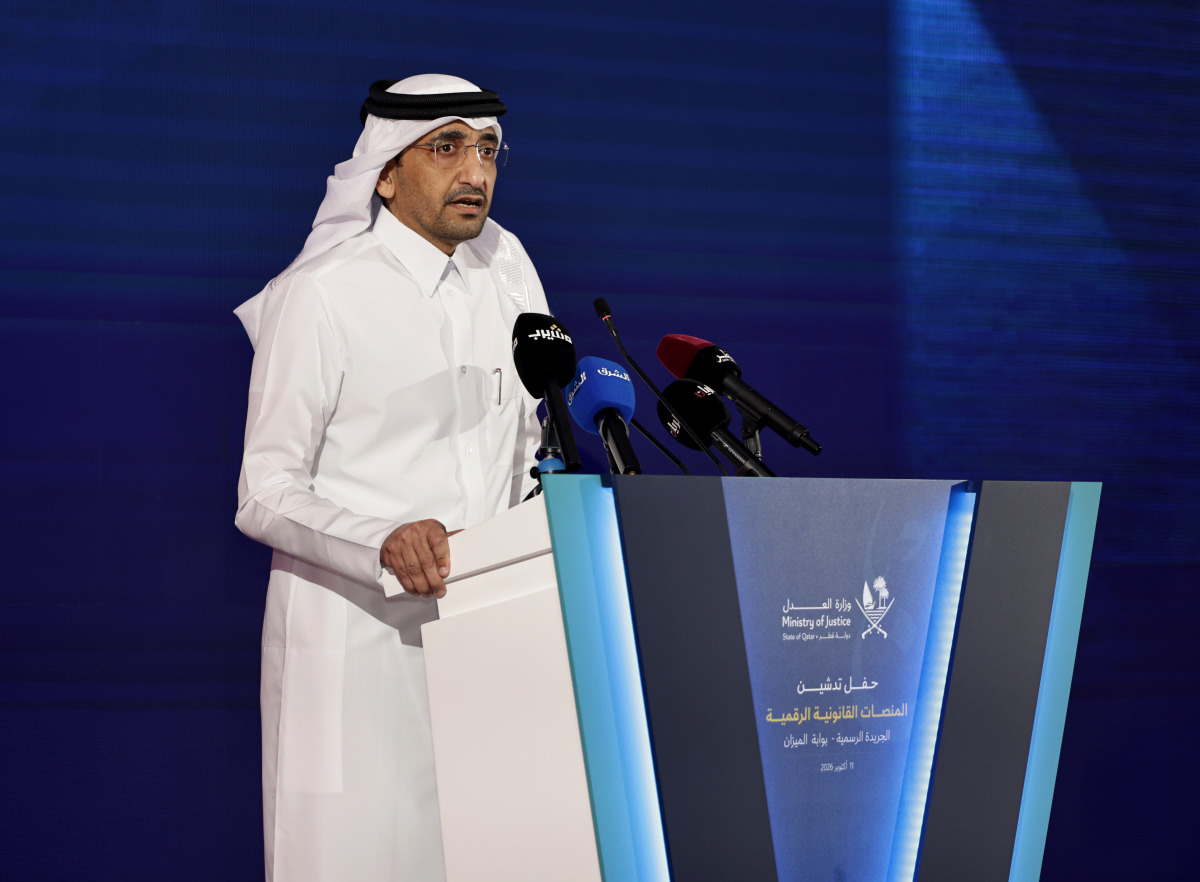 Minister of Justice and Minister of State for Cabinet Affairs H E Ibrahim bin Ali Al Mohannadi speaking at the event. Pic: Salim Matramkot/The Peninsula
He added that the Ministry of Justice aims to make legal knowledge an integral part of Qatar’s wider digital ecosystem, enabling users to understand national legislation more comprehensively and access relevant information through a trusted and interconnected system.
The revamped Official Gazette strengthens its role as the authoritative source of published legislation by providing official legal texts in a reliable digital format that can be accessed quickly.
The platform is intended to make it easier for users to consult legislation and follow subsequent amendments. The digital publishing process is also governed by a regulatory framework established under Minister of Justice Decision No. 129 of 2026, which sets out procedures and requirements for publication and authentication. The electronic edition is issued as an authenticated and officially approved text within the framework of Law No. 12 of 2016 concerning the Official Gazette.
Meanwhile, the upgraded Al Meezan Legal Portal offers a broader legal research environment, connecting legislation with judicial rulings, legal opinions and agreements to help users understand legal provisions alongside their context and application.
The portal currently contains more than 9,659 legislative instruments, 3,758 judicial rulings and 709 agreements, providing a central resource for legal professionals, researchers, businesses and members of the public.
Access to both platforms is available to individuals and institutions, with accessibility standards taken into account for people with disabilities. Emphasising the importance of making legal information available to everyone, Al Mohannadi said: “The law belongs to everyone, and access to it is a guaranteed right, not a privilege.” The ministry said modern technologies and artificial intelligence would help improve the efficiency of legal research and make relevant information easier to find. However, it stressed that official legal texts would remain the sole authoritative reference, with technology serving as a guide to the law rather than a substitute for it.
The new Al Meezan portal also provides channels for public participation in the development of the legislative environment. In coordination with the General Secretariat of the Council of Ministers, users can submit suggestions on draft legislative instruments opened for public consultation. The platform also allows the public to comment on legislation currently in force, strengthening communication between government institutions and society and supporting the development of legislation that responds to changing needs.
The project is the result of institutional cooperation between the Ministry of Justice, the Supreme Judiciary Council, the Ministry of Communications and Information Technology, the National Planning Council, the Civil Service and Government Development Bureau, and the General Secretariat of the Council of Ministers, alongside the ministry’s strategic partners in implementing its 2025–2030 strategy.