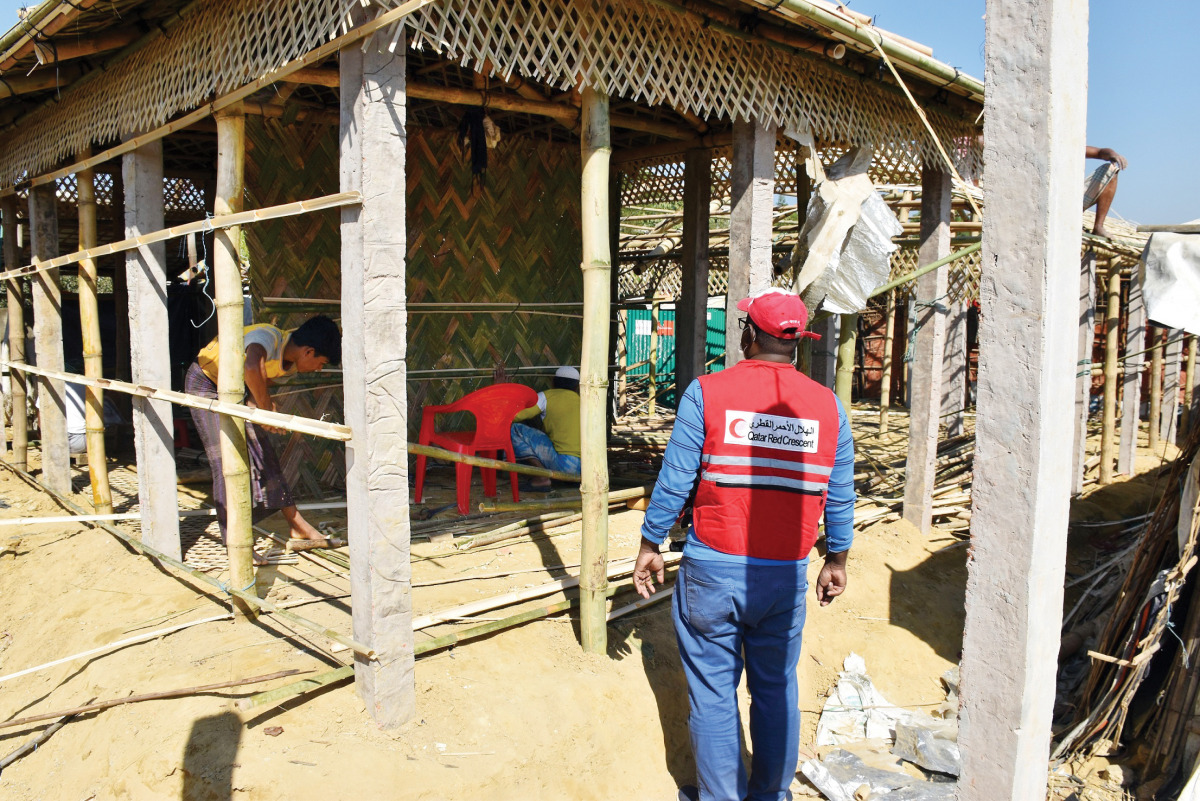
One of the shelters being built under a project implemented by QRCS in Bangladesh.
Doha: The representation mission of Qatar Red Crescent Society (QRCS) in Bangladesh has carried out multiple activities for the Myanmar refugees and host communities, funded by the donations of charity payers in Qatar.
In cooperation with Bangladesh Red Crescent Society (BDRCS), a new project was initiated to provide adequate shelter for the Myanmar refugees. The construction of 100 shelters commenced at Camp#18 in Cox’s Bazar, following months of delay due to the Coronavirus pandemic.
Responding to the outbreak, QRCS is promoting personal hygiene practices among the most vulnerable groups at camps. Together with BDRCS, QRCS distributed 1,000 handwashing containers to refugee families at Camp#18.
The field personnel launched an awareness campaign to advise the beneficiaries as to washing hands regularly with soap and water, given the fact that hands are the most common medium transmitting the virus from person to person.
A water well was dug by QRCS’s mission to secure drinking and personal cleaning water at the camps. Another three water wells are being in progress at other camps.
Executive Director of Relief and International Development Division at QRCS, Faisal Mohamed Al Emadi, emphasised the importance of QRCS’s humanitarian activities in Bangladesh, amid lack of services.
“Last year, QRCS offered $2.6m worth of aid for those in need. We reached out to over 728,000 beneficiaries with health, shelter, food, water, and sanitation aid,” said Al-Emadi.
The projects done by QRCS in Bangladesh include construction of water and sanitation facilities and collection of solid waste to preserve public health, improvement of health care services by deploying and operating a field hospital, training and remuneration for local medical professionals, distribution of food and nonfood items, provision of safe shelter up to the Sphere Project standards, and installation of solar lighting systems.
Other activities include the deployment of medical delegations in several vital specialisations, emergency winterisation relief for those affected by cold weather, flash floods, or tropical storms, construction of water and sanitation at the quarantine facility operated by QRCS inside the field hospital, operation of two health centers at Camp#E8 and Camp#19 to offer primary health care services and supply of medications and medical consumables.