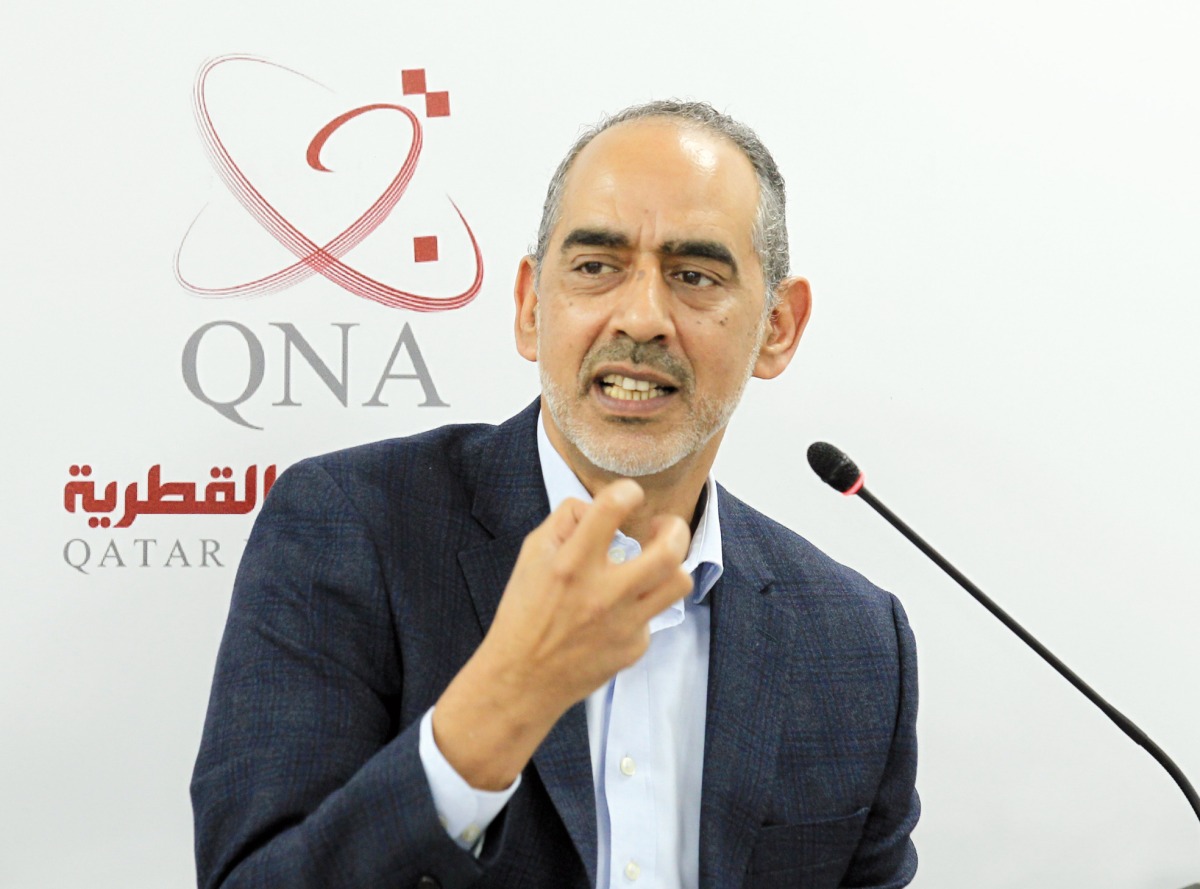
Director of the Middle East Council on Global Affairs, Tariq Mohamed Youssef
Doha: Director of the Middle East Council on Global Affairs, Tariq Mohamed Youssef (pictured) has said that the voices criticizing Qatar and its World Cup hosting, since the kick-off of the tournament, grew lower after seeing and experiencing the on-the-ground realities.
He was speaking in a panel discussion on ‘The Unfair View of Some Western Media Towards Qatar’s Organising FIFA World Cup 2022’ organised by QPC and QNA.
Upon watching the distinguished World Cup opening ceremony, the anti-Qatar campaigns faded, with major issues and topics replacing the superficial and side issues, Dr. Youssef said.
He pointed out that this type of Negative media campaigns targeted more than one country and more than one major event in the world, as was the case in the Olympic Games in China, as well as before the start of the World Cup in Russia in 2018.
However, these campaigns decreased in intensity over the time over the success achieved, he said.
Dr. Youssef added that the media campaigns against the State of Qatar in the last months ahead of the kick-off of the tournament were more intense and fierce, highlighting their focus on aspects that go beyond Qatar’s pledges within the framework of its policies, programs and development plans.
He noted that this prompts everyone to inquire about the purpose of these campaigns, their potential connection to the historical Western stereotypical image of Arab countries, their cultural, civilization, and the current Western agenda and the cultural wars in many parts of the world, especially in the Western world.
There is a cultural conflict in these countries over issues related to gender, the role of women and employment, which have been exported and crystallized in order to focus on this tournament, Youssef said, questioning the reason for raising these issues at this particular time.
He called for work to find out causes of these issues, away from explanations related to a specific theory, so that they would not be repeated in other tournaments during the coming period.
Dr. Youssef voiced his concern that the new world is abuzz with changes, differences and tensions that affect values, customs, cultures, civilization and other fundamentals.
He stressed the need not to underestimate these hypotheses because, according to him, the Western world is going through internal challenges and social tensions, known by some as cultural wars, that may tear its societies politically and culturally, and push them to unprecedented models of governance and legal challenges.
The Director of the Middle East Council for Global Affairs noted that the media campaign that Qatar faced is in fact a warning of what may happen in the world, and of the challenges that Arab countries may face at all levels in the coming period.
The Arab world is on the verge of a cultural war of a new kind that showed its early signs after Qatar won the World Cup bid; Arabs now face issues that seemed too far from their heritage and civilization, he said.
Commenting on the stances of the Arab countries and the region regarding these campaigns, Youssef said that there was not a clear Arab position at the level of states, governments, legislative bodies, or even at the level of intellectuals and observers in general.
When Qatar won the World Cup bid in 2010, human rights organizations and some countries raised questions related to freedoms and labor rights, he said, stressing Qatar’s achievements in these fields that were commended both at home and abroad, including concerned international institutions.
He added that all these achievements that made Qatar a leading country in the field of expatriate workers’ rights, did not obtain its right of media coverage. They were overlooked, and new issues were raised to impose themselves on the whole world, he added, indicating that the World Cup in Qatar may appear as one of the basic phases of conflict in this regard.
In a related context, he touched on the cultural differences between the societies of Eastern and Western European countries, and the fierce media campaigns faced by China and Russia, which indicates that everyone is now on the verge of a new cultural and civilizational conflict that affects very sensitive files, linked to basic values of societies and their civilizational and religious heritage.
This requires further attention and initiatives and effective policies that preserve values and societies and support countries to stabilize, as well as dealing with them with a cultural, civilized, and humane approach.
He said that the media and diplomatic campaigns against China and Russia are understandable, but he lambasted the fierce campaign against Qatar as a friend and ally of the West, as a paradox. He explained that the new international order is being reformed amid a lot of diversified relations.
Dr. Youssef hailed as a world Cup legacy that many visitors and fans from Western countries closely watched the Qatari, Gulf and Arab customs, traditions and heritage, including their wearing Qatari and Gulf uniforms during matches, as well as the acquisition of many things that represent cultural symbols of Arab countries.