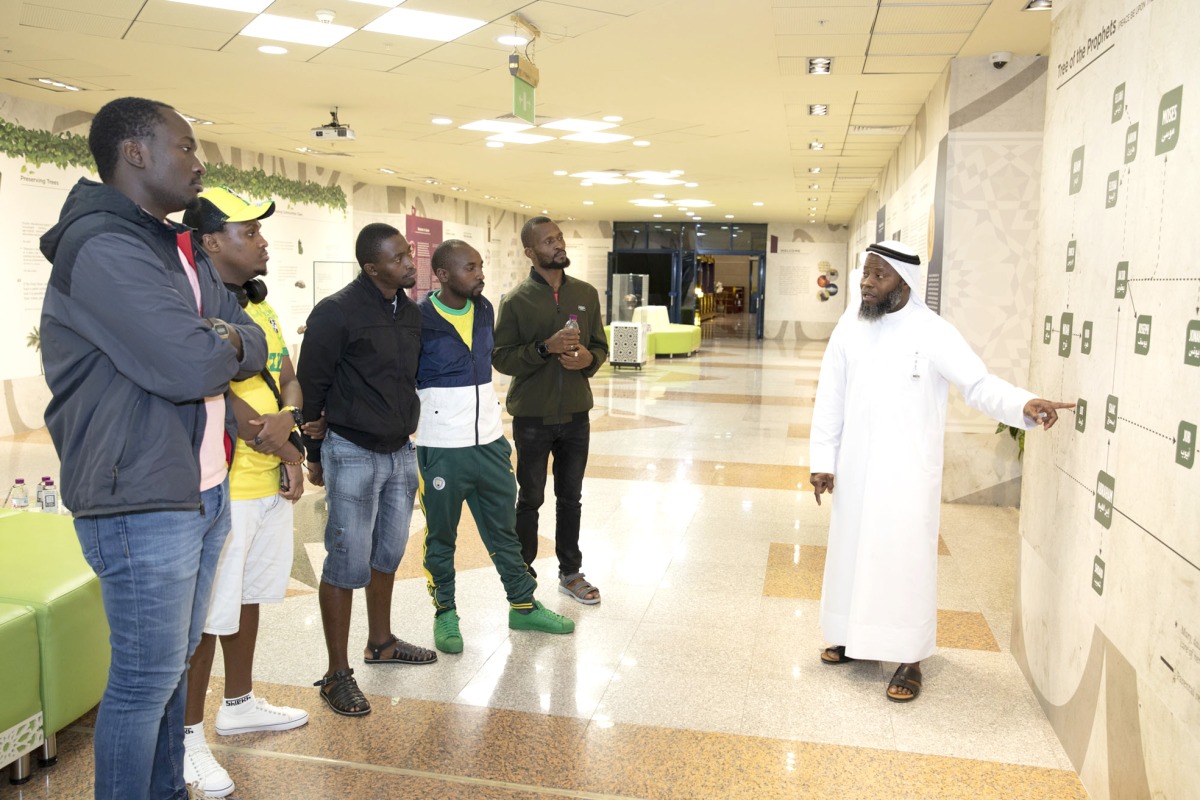
Visitors being briefed at the Abdullah Bin Zaid Al Mahmoud Islamic Cultural Center.
Doha: Abdullah Bin Zaid Al Mahmoud Islamic Cultural Center run by the Ministry of Awqaf and Islamic Affairs received 10,000 visitors of different nationalities during FIFA World Cup Qatar 2022.
The exhibition, organised by the centre at Imam Muhammad bin Abdul Wahhab Mosque, was visited by 12,000 people, while the number of visitors to the virtual reality event organised by the centre in Katara Cultural Village reached 9,900 people.
The centre’s pavilions in Ras Abu Fontas and Lusail received about 3,000 people, said the Ministry of Awqaf and Islamic Affairs in a statement.
The centre’s employees distributed 81,000 various gifts to guests and visitors, and the number of books distributed in different parts of the country reached about 100,000 on different subjects. During the World Cup, high-ranking foreign delegations visited the Imam Muhammad bin Abdul Wahhab Mosque, where they were received by Dr. Saleh bin Ali Al Marri, Director of the Sheikh Abdullah bin Zaid Al Mahmoud Islamic Cultural Center, and a number of the centre’s employees.
The delegation was briefed on the contents of the exhibition, and the visitors acquainted with some issues related to Islam, Muslims, and their civilisation, including customs, traditions, and the impact of the Q'uran on life and behaviour.
With the beginning of the new year, Sheikh Abdullah bin Zaid Al Mahmoud Islamic Cultural Center continued its programmes and activities in the field of Islamic culture. The Arabic language is one of the major programmes of the centre, which receives great response from all communities, as well as religious preaching programmes and lectures that the centre holds for Muslim communities in their languages.
This week, the Arabic language courses were launched with the participation of 176 students, who will study in several levels: conversation, the first level in its two sections, and the second level in both sections, through curricula prepared by the centre. It was developed by a group of teachers who have accumulated experience in teaching Arabic to non-native speakers.
The classrooms are also equipped with advanced audio visual aids that allow a variety of applications by teachers and students.