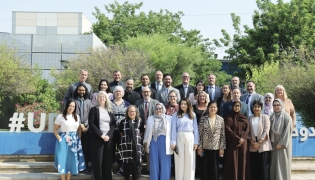
In the Vienna declaration, which emerged from the 5th Forum of UN Alliance of Civilisations (UNAOC), held in the Austrian capital Vienna last weekend under the title “Promoting Responsible Leadership in Diversity and Dialogue”, the participants confirmed the commitment of governments and international organisations to bolstering intercultural dialogue and called for achieving peace and dialogue between nations, with a special focus on the crises in Syria and Mali and peacemaking between Palestinians and Israelis.
On the second day of the forum, the friends of Syria group met in Rome to discuss support for the opposition battling the regime of Syrian President Bashar Al Assad. The ways of support suggested by major international players were not only varied, but most of them were marred by fears of Islamists fighting in Syria. These fears diverted the international effort away from the aim of protecting the human rights of the Syrian people and their right to determine their own destiny, to redrawing the map of Syria in order to serve the interests of some countries.
The senior UN representative to the Alliance of Civilizations forum said last week: “We will work hard to use the means at our disposal amid these difficult conditions across the world”. He expected this attitude to contribute to making the alliance more effective in easing tensions among races and religions.
The forum has been held in different places, including Madrid, Istanbul, Rio de Janeiro, Doha and, lastly, Vienna. A large number of shocking and painful events have occurred across the world in general and in the Middle East in particular. While we have trust in the objectives of such alliances, things happening around us make us skeptical about the effectiveness of such dialogue, just as we doubted the usefulness of the United Nations earlier. Is this a real dialogue or a dialogue of the deaf? Were there any achievements from this dialogue that narrowed gaps between nations and races or helped overcome divisions created by complex political discussions at the UN Security Council?
Has the Council managed to go beyond theorizing and churning out papers and statements that usually end up on the website of the United Nations Alliance of Civilizations in New York where the UN General Assembly is located?
The UN General Assembly had ratified the formation of the United Nations Alliance of Civilizations Forum in 2005 with the aim of promoting intercultural dialogue between civilizations. Is sponsorship of the dialogue by the UN behind its ineffectiveness?
This causes deep pain. The dialogue was launched by humans for humans – who are the builders of civilisations. Human beings have been falling, their rights destroyed by totalitarian regimes and international conspiracies. While Unesco has shown care for tangible heritage, it has not been able to challenge political powers that do not care about people, civilisations or cultures.
I mention here another painful example: humans are being killed in cold blood in Syria. Despite this, the competing interests of superpowers have made everyone ignore the killing of innocent Syrians, whose history is being destroyed, too. Historical sites and mosques are being destroyed in Damascus and Aleppo, which hosted the first European consulate in the Arab world in 1230 AD and was once the second most important town after Istanbul, the centre of the Ottoman Empire.
The attitudes of the allied nations during international conferences is making us reconsider these alliances because we only believe in work for the sake of human beings, work in the best interests of humanity, effective cultural dialogue and human heritage. A small country can lead an effective effort in this regard away from the conferences and the ineffective discussions of the United Nations. Such international organisations have the power to turn practical effort into mere talk that destroys ties among people because they are simply the weakest link in a series of superpowers who seek to destroy civilisations in order to serve their own interests.