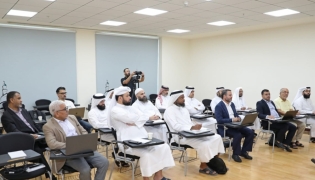
DOHA: The annual Qatar University Life Sciences Symposium (QULSS) was held with a focus on Environmental health in the GCC recently in Doha.
The symposium was organised by the Department of Biological and Environmental Sciences (DBES) at the College of Arts and Sciences (CAS).
Presentation of findings of a research project by assistant professor of marine science Dr Yousra Souliman Al Fahman on the composition and origins of PAHs in the coastal sediments of Qatar, and a talk by assistant professor Dr Radhouan Benhamadou on his experience in sustainability research, were centre of the symposium.
It was an opportunity for researchers, experts, academics, government and private sector representatives to exchange ideas and solutions on environmental health in the region, drawing discussion on contemporary issues facing the region such as environmental contaminants and related health effects and challenges, environmental monitoring and management, environmental policy and sustainable development, and climate change and its consequences on the region’s environment and peoples.
The event was held in conjunction with the first Annual Meeting of the Society of Environmental Toxicology-Arabian Gulf Branch (SETAC-AGB), and in collaboration with Total, Qatar Ministry of Environment, Texas A&M-Qatar, Total Research Center-Qatar, Weill Cornell Medical College in Qatar, Exxon Mobil Research, Qatar Petroleum, RasGas and the Supreme Council of Health.
Speaking on behalf of CAS, Dean Dr Eiman Mustafawi, the College’s Associate Dean for Research Dr Mohamed Ahmedna, said: “This symposium has over the years established itself as a leading forum for dialogue and exchange of ideas, bringing together members of the scientific community whose research is focused on the Gulf area. The topics raised here have been of paramount importance to both Qatar and the wider region.
He said over the years, QULSS has highlighted wide-ranging issues of immediate relevance — from diabetes to date palm conservation, marine environment to mangrove habitats and biotechnology.
“This year is no different as we focus on the growing global issue of environmental health, and specifically within the Gulf region, addressing some of the pressing environmental health issues facing the region and sharing recent findings on the relationship between the environment and health,” Dr Mohamed Ahmedna said.
Dr Robert Diaz from the Virginia Institute of Marine Science, College of William and Mary USA gave a brief in which he noted that the status of hypoxia and its consequences for the environment, society, and economics will depend on a combination of climate change and land-use change.
“The overall forecast is for all forms of hypoxia to worsen with increased occurrence, frequency, intensity and duration. Reversing the expansions of oxygen minimum zones will be more difficult, requiring a global management approach to mitigate global warming trends. Hypoxia and dead zones represent a potentially enormous ecological and economic threat to global ecosystem services, which likely in the billions of US dollars annually,” he said.
The Peninsula