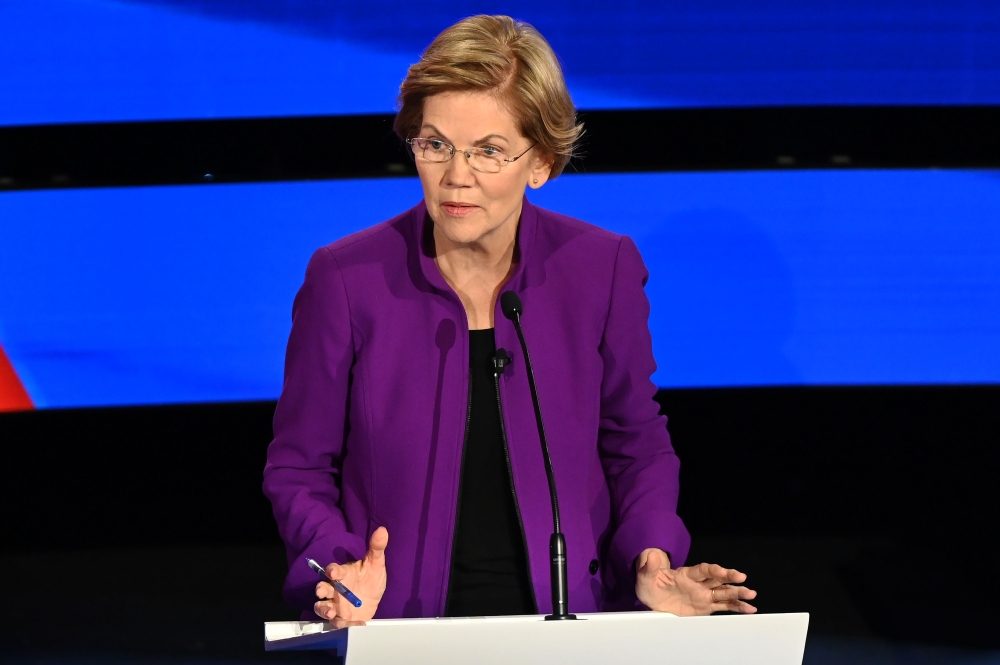
Democratic presidential hopeful Massachusetts Senator Elizabeth Warren participates of the seventh Democratic primary debate of the 2020 presidential campaign season co-hosted by CNN and the Des Moines Register at the Drake University campus in Des Moines
An online feud between two of the top Democratic presidential candidates took an odd turn Wednesday morning when supporters of Senator Elizabeth Warren helped promote a hashtag ostensibly attacking her. It was an instructive moment in the mechanics of online political discourse as passions around the 2020 election season rise.
The situation began Tuesday at the Democratic presidential debate. Some of the most dramatic moments of the night were exchanges between Warren and Senator Bernie Sanders, in the wake of reports that he had told Warren a woman could not be elected president, which she confirmed and he denied. After a back-and-forth during the debate itself, a video circulated appearing to show Warren refusing to shake Sanders’ hand, followed by a sharp exchange ending with Sanders turning and walking away abruptly.
On Wednesday morning, the hashtag #NeverWarren appeared at the top of Twitter’s trending topics. As of late Wednesday afternoon, it had been mentioned more than 80,000 times, according to Ben Nimmo, director of investigations for social media monitoring company Graphika. "It looks like it started off among some long-standing Sanders supporters,” he wrote in an email, "but the most striking thing is that all the most-retweeted posts are of people criticizing the hashtag and the mentality behind it, and/or calling for unity.”
The hashtag fit into a long-running narrative about Sanders supporters, who some Democrats criticized in 2016 for being insufficiently supportive of Hillary Clinton in the general election. Even before the debate Tuesday a faction of his fans had signaled they might not vote for any other Democratic nominee. This faction was clearly somewhat responsible for pushing the anti-Warren hashtags Wednesday.
The Sanders campaign itself didn’t seem to be involved. His spokeswoman, Briahna Gray, repeatedly Tweeted the hashtag #WomenForBernie, but did not use the #NeverWarren hashtag. Some pro-Sanders activists discouraged others from using it.
A significant amount of the #NeverWarren activity actually came from those trying to rebut its message. NBC News reporter Ben Collins used a disinformation identification tool to determine that the three most popular tweets using the hashtag were all denouncing it. Mehdi Hasan, a columnist at the Intercept, tweeted, "Yep, let’s be clear: if you’re tweeting in support of this ludicrous #NeverWarren hashtag, you’re not only dumb but you’re also telling the world that you’re ok with kids in cages and bans on Muslims.” That message has received more than 1,700 retweets.
Britt Julious, a Chicago Tribune columnist, posted a tweet attacking the hashtag (while still deploying it). She received more than 1,200 retweets.
"I thought it was odd that it was trending when I woke up this morning. When I looked through the hashtag, I saw that it was a lot of Warren supporters who seemed upset that it was trending,” Julious wrote in an email, saying she remembered a similar dynamic during the 2016 campaign. "Twitter tends to have that echo effect. Like one person will say something weird and then someone else finds it, replies back trying to shoot it down, and the pileup begins.”
There has been evidence of significant manipulation of trending topics for years, including numerous media reports exposing coordinated activity pursuing commercial and political ends.
Nor is this the first example in the 2020 Democratic primary. Late last year, a comedy troupe managed to get the hashtag #DropOutBloomberg onto the list of trending topics, after members pretended the Michael Bloomberg presidential campaign had fired an intern for tweeting a bizarre (and fictional) Bloomberg campaign staff dance video. Some of the people tweeting the hashtag were clearly in on the joke.
Others didn’t seem to be.