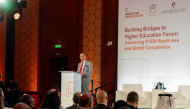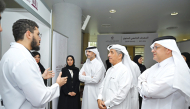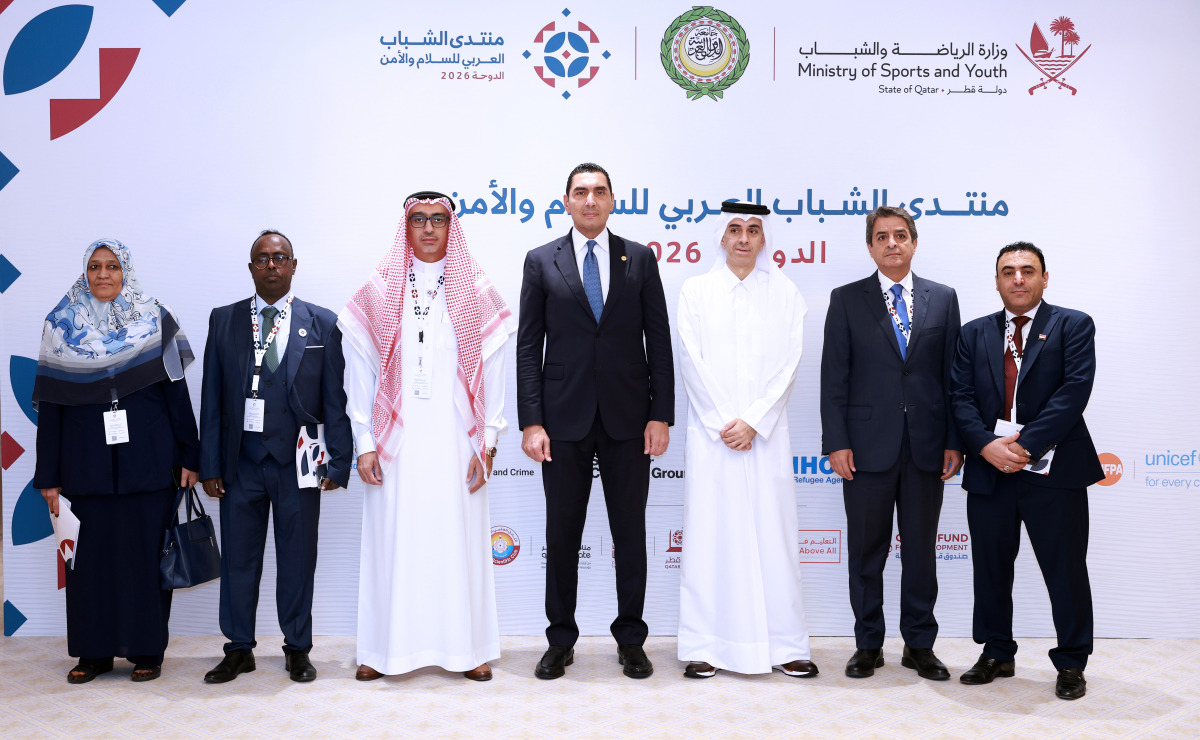
Undersecretary of the Ministry of Sports and Youth, Eng. Yasir bin Abdullah bin Ahmed Al Jamal (third right) with Egypt’s Minister of Youth and Sports H E Gohar Nabil (centre), Jordan’s Minister of Youth H E Dr. Raed Al-Adwan (second right) and other officials at the event. Pic: Rajan Vadakkemuriyil / The Peninsula
Doha, Qatar: Qatar has reaffirmed its commitment to empowering young people as active partners in peacebuilding and decision-making, stressing that sustainable peace and development cannot be achieved without their meaningful participation.
Ministry of Sports and Youth (MSY) Undersecretary, Eng. Yasir bin Abdullah bin Ahmed Al Jamal, made the remarks yesterday at the opening of the Arab Youth Forum for Peace and Security – Doha 2026, which brought together youth delegations from 17 Arab countries, alongside ministers, senior officials and representatives of regional and international organisations.
The three-day forum, organised by MSY in cooperation with Arab League, runs until November 17.
The opening ceremony was attended by several dignitaries, including Egypt’s Minister of Youth and Sports H E Gohar Nabil; Jordan’s Minister of Youth H E Dr. Raed Al-Adwan; Director of the Youth and Sports Department at Arab League Dr. Faisal Ali Ghassal; UN Assistant Secretary-General for Youth Affairs, Dr. Felipe Paullier; and Unicef representative Abdoulaye Fofana.
Addressing the event, Al Jamal said young people remain among those most affected by conflicts, humanitarian crises and emerging digital challenges, but also possess enormous potential to overcome these difficulties and contribute to building peaceful societies.
“Peace built without the participation of youth cannot endure, and development designed without their input is equally unsustainable,” he said.
He stressed that youth empowerment has remained central to Qatar’s national development agenda, with the country translating its commitment into practical initiatives across education, sports, leadership and innovation.
Al Jamal highlighted Qatar’s international contributions, particularly through Education Above All, which has expanded educational opportunities for millions of children and young people affected by conflicts and humanitarian crises.
He also pointed to Qatar’s efforts to amplify youth voices internationally, promote dialogue as a means of conflict resolution and use sports to strengthen understanding between nations.
According to him, the forum represents an important step towards implementing the Arab Strategy for Youth, Peace and Security, with particular emphasis on strategic dialogue and partnerships. He explained that participants would work alongside policymakers and experts to develop the “Doha Youth Outcomes,” translating discussions into practical recommendations and initiatives.
“You are not merely guests here; you are partners,” he told participating youth, urging them to develop innovative solutions and become ambassadors for peace in their communities.
Egypt’s Minister of Youth and Sports H E Gohar Nabil praised Qatar’s leadership and commitment to strengthening joint Arab action and supporting youth initiatives.
He stressed that young people should not be regarded merely as recipients of programmes and services but as essential partners in shaping policies and addressing challenges confronting Arab societies. The Minister emphasised the importance of UN Security Council Resolution 2250, which recognises the contribution of young people to conflict prevention and peacebuilding.
He called for effective mechanisms to implement the Arab Strategy for Youth, Peace and Security, ensuring youth participation becomes an integral part of institutional decision-making rather than occasional engagement.
Nabil also highlighted Egypt’s experience in promoting youth leadership and expanding opportunities for young people to assume responsibilities in public institutions.
Meanwhile, Dr. Ali Ghassal, stressed the importance of translating the Arab Strategy for Youth, Peace and Security (2023–2028) into practical programmes. Dr. Paullier also called for greater youth involvement in peacebuilding, while Fofana highlighted the humanitarian and educational challenges facing children and young people across the region.
The forum features high-level discussions, workshops and working groups addressing youth participation, governance, protection, education, innovation and sustainable partnerships. Its concluding sessions on November 17 will produce a joint youth declaration, the “Doha Forum Outcomes,” outlining recommendations and practical initiatives to strengthen youth participation in peacebuilding and regional stability.