Doha: Staging the 2022 World Cup in the Middle East is ‘more necessary than ever’ considering the current global political climate, Hassan Al Thawadi, Secretary General of the Supreme Committee for Delivery and Legacy (SC) said in an interview with the SC website.
“People from all corners of the world will come together on Arab soil, to celebrate and enjoy the world’s greatest sporting event and we consider this a precious opportunity to enhance cultural understanding between people of different cultures and backgrounds, uniting through a shared passion for football,” Al Thawadi said.
“We spend a huge amount of time working with all of our stakeholders and our communities as we prepare for 2022. We do this to make sure we communicate the benefits of this tournament, to ensure people understand why this will be so special for them and Qatar. What’s really exciting is you can see the closer we get, the stronger that feeling will return,” he added.
Al Thawadi expressed pride to be leading the preparations for the 2022 FIFA World Cup.
“This is an once-in-a-lifetime opportunity. It’s an honour to be in this position as we prepare for the first World Cup in the Middle East.”
“There is nothing in the world that unites people the way football does. It builds bridges, it brings people closer to each other. When you look at some of the issues the world is facing right now this World Cup has never been more important. There have been some difficult times over the last few years but when you look at everything we have achieved it has been worth every second.”
Asked about preparations for the showpiece, the SC Secretary General said what pleases the committee the most is that “the promises we made during the bid are already being delivered.”
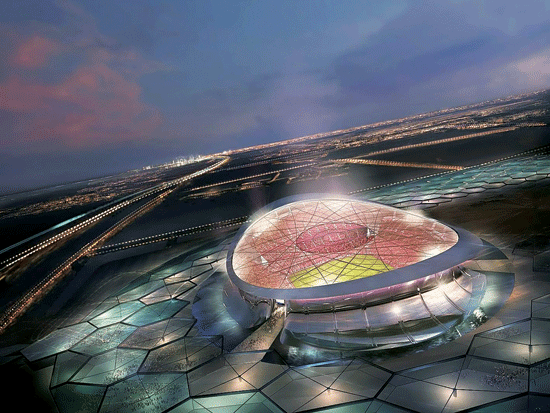
“We stood up in front of the world and promised this tournament would leave a true legacy – and that’s proving to be the case. We’re delivering on our stadiums, first and foremost. Six proposed stadiums for the tournament are under construction right now, with more to follow. We are on track with all of them and are happy with our progress,” he added.
“It’s not just about the stadiums though. We knew the opportunity to host the World Cup would give us the opportunity to contribute to the social legacy of Qatar. We set out a very clear mandate for ourselves to help accelerate the Qatar National Vision 2030. The foundations to achieve this have been laid through strategic programs designed to benefit the people of this region.”
Asked whether winning the 2022 bid five years ago has affected the level of interest and participation of football, Al Thawadi said the Middle East region has always been passionate about football.
“Despite popular belief, we have a rich football history. Since winning the bid what’s been evident is the focus on the national team and the progress or younger players are making. You can see that from the U-19s first ever Asian title in their age category to the senior team’s triumph of the 2014 Gulf Cup in Saudi Arabia. The focus isn’t simply on elite footballers though. Not every player will make the grade, so there has also been a focus on developing a grassroots football infrastructure for the country. The purest example of this is the number of young soccer schools established for children in Qatar.
“One of the developments we are proud of is the creation of the Qatar Amateur League – an initiative which was a bid promise. Now in its third year, the QAL offers amateur footballers the chance to play the game they love in professional surroundings. They train and play in the stadiums of the Qatar Stars League and it’s been a huge success. We also support the Workers’ Cup, a tournament that offers blue-collar workers the same opportunity – to play football in professional surroundings. Coupled with the schools and universities leagues, participation in Qatar is huge and is only going to grow,” he added.
Asked whether the uncertainty at FIFA is of concern for the Qatar World Cup, Al Thawadi said “what is happening at FIFA is a completely separate issue compared to Qatar’s right to host the World Cup, which people will hopefully start to realise.”
“The Supreme Committee, much like football fans, players and clubs around the world, is committed to working towards a game that is played and managed in a fair and transparent manner and we welcome the reforms FIFA has proposed,” he added.
Al Thawadi highlighted the support of GCC for Qatar, pointing out the recent GCC communique shows the support Qatar has from the other countries in the Gulf. “The Gulf Cooperation Council has made its support for Qatar perfectly clear on numerous occasions, so their statement last week wasn’t a surprise. It reinforced the fact this World Cup is for the entire Middle East – not just for Qatar.”
Concluding his interview, Al Thawadi spoke about the next seven years rather than the five that separate the country from the World Cup. “We’ve achieved a lot since 2010 but the hard work is only just beginning, believe me. Hopefully with the same level of commitment and desire from all of our staff and stakeholders the next seven years will see us deliver an amazing tournament and leave a legacy the entire country can be proud of.”
QNA