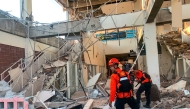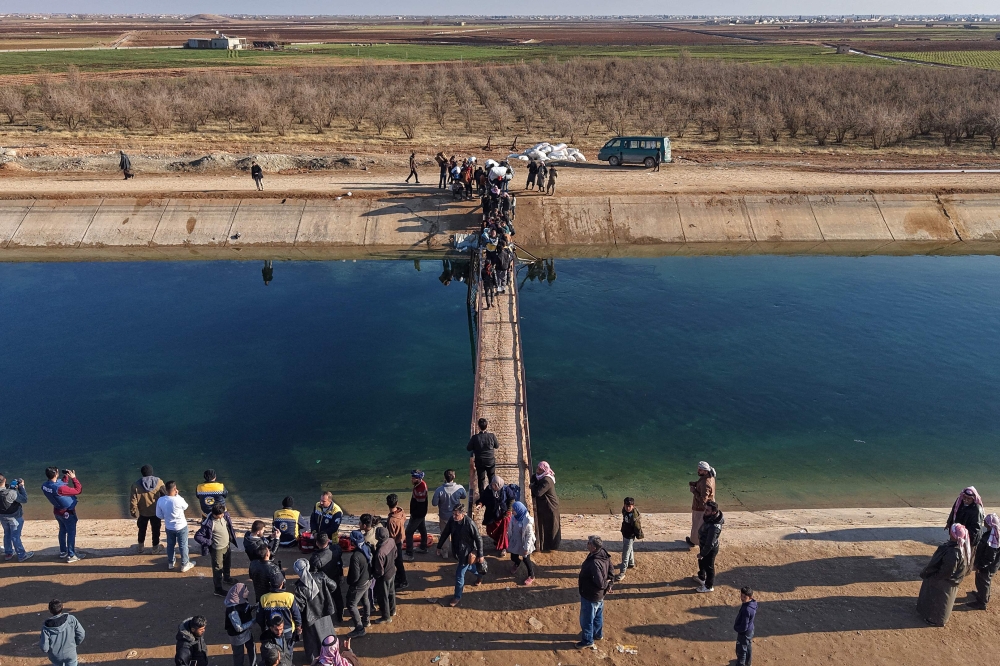
This aerial photograph shows people along with their belongings walking across a damaged bridge as they flee from a Kurdish-controlled area, in Rasm al-Harmal, east of Aleppo city on January 16, 2026. (Photo by Bakr ALkasem / AFP)
Aleppo, Syria: Syria's army said Saturday its forces had started entering an area east of the city of Aleppo after Kurdish forces agreed to withdraw from the region following recent clashes.
In a statement carried by state television, the army said its forces "began entering the western Euphrates area, starting with the town of Deir Hafer", after Kurdish forces had agreed to withdraw on Saturday morning.
An AFP correspondent saw army forces advancing towards the area, including with tanks.
In a statement carried by state television, the military urged civilians "not to enter the operations area" until the army had secured it and "cleared it of all mines and war remnants".
After driving out Kurdish forces from Aleppo city last week following deadly clashes, Syria's army deployed reinforcements near Deir Hafer and told the SDF to evacuate the area between the town and the Euphrates River, around 30 kilometres (18 miles) further east.
On Friday, Kurdish leader Mazloum Abdi committed to withdrawing his US-backed, Kurdish-led Syrian Democratic Forces on Saturday morning "towards redeployment in areas east of the Euphrates", based on "calls from friendly countries and mediators".
The defence ministry had welcomed Abdi's announcement, saying army troops would deploy in the areas after the SDF withdrew.
The Syrian army had urged civilians to flee the Deir Hafer area in recent day, with at least 4,000 people leaving according to Syrian authorities.
On Friday, Syrian President Ahmed al-Sharaa on Friday issued a decree declaring Kurdish a "national language", in an apparent gesture of good will towards the minority after the recent violence.
Sharaa's announcement on Friday is the first formal recognition of Kurdish national rights since Syria's independence in 1946.
The decree stated Kurds were "an essential and integral part" of Syria, where they have suffered decades of marginalisation and oppression under former rulers.
It makes Kurdish a "national language" that can be taught in public schools in areas where the minority community is heavily present.