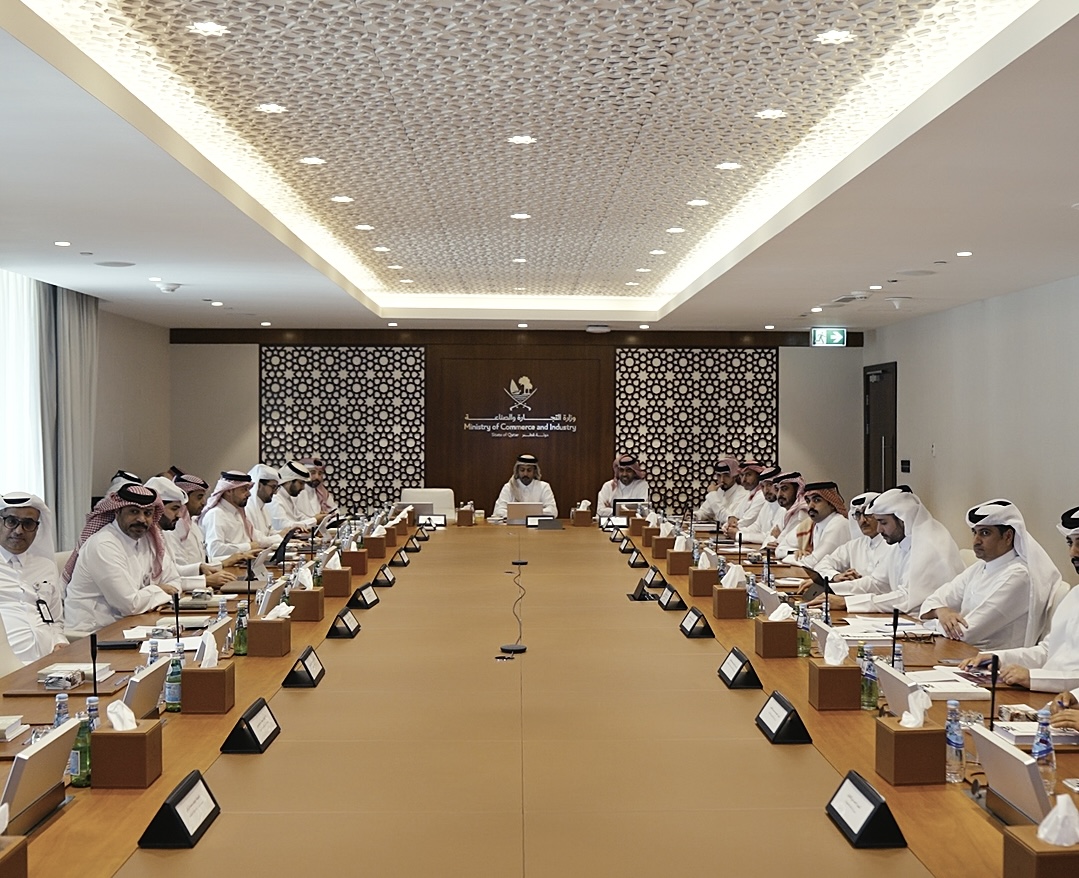
Minister of Commerce and Industry, H E Sheikh Faisal bin Thani bin Faisal Al Thani with other officials during the meeting, yesterday.
Doha, Qatar: Minister of Commerce and Industry, H E Sheikh Faisal bin Thani bin Faisal Al Thani, chaired the Ministry of Commerce and Industry's (MoCI) fourth quarterly performance review meeting for 2025, in the presence of H E Dr. Ahmed bin Mohammed Al-Sayed, Minister of State for Foreign Trade Affairs; H E Mohammed bin Hassan Al-Malki, Undersecretary of the Ministry; as well as the Assistant Undersecretaries and department directors.
The meeting reviewed the Ministry’s key achievements and qualitative initiatives during the fourth quarter of 2025, including continued efforts to enhance economic diversification, strengthen public-private partnerships, accelerate digital transformation of services, empower small and medium enterprises, and protect intellectual property rights, in line with the objectives of Qatar National Vision 2030 and the Third National Development Strategy.
Discussions also covered the Ministry’s overall performance results for Q4 2025, including sectoral and departmental KPIs, key operational challenges, and a number of solutions and initiatives aimed at accelerating implementation of approved plans and projects, enhancing performance efficiency, and improving service quality.
In the Trade Affairs sector, indicators showed notable progress. Approximately 28,000 commercial registrations were issued in 2025, representing 57% growth compared to 2024. In addition, 34,500 commercial licenses were issued, marking a 53% increase year-on-year. Sixteen auditors were registered, along with eight accounting firms and offices during 2025.
Within the Intellectual Property Rights domain, performance indicators showed marked improvement. In 2025, 255 patent applications were granted, reflecting 6% growth compared to 2024. Additionally, 9,218 trademark registration applications were approved, up 23%, alongside 258 copyright registrations, representing an 89% increase year-on-year.
In the Industry and Business Development sector, manufacturing contributed approximately QR14.2bn to GDP in Q3 2025. The industrial base continued to expand, with 39 factories registered in 2025, and 100 factories assessed under the Smart Industry Readiness Index. Investments in new factories reached approximately QR758m in Q4 2025, bringing cumulative investment in the industrial sector to QR270bn during the same period.
As part of efforts to improve the business environment and support the private sector, 10 public-private partnership (PPP) projects were studied in 2025. The duration for issuing industrial licenses, preliminary approvals, and customs exemptions for factory production inputs was reduced to one working day during Q4 2025.
In the Consumer Protection sector, indicators reflected improved procedural efficiency. A total of 18,400 special licenses (discounts and promotional offers) were issued in 2025, representing 26% growth compared to 2024, with issuance time reduced to less than one working day. The average processing time for price adjustment requests (registration, addition, deletion, modification) was reduced from two working days to one working day in Q4, while the annual average processing time for price increase requests reached 25 days in 2025, reflecting a 63% reduction compared to 2024.
During 2025, 229,000 inspection visits were conducted, with violations accounting for 19% of inspected establishments, most commonly due to establishments not operating at their registered locations, as part of efforts to strengthen market oversight and consumer protection. The Consumer Affairs sector received 23,400 complaints in 2025, all of which were closed, achieving a 100% resolution rate.
Furthermore, 450,000 beneficiaries received food subsidy support during Q4 2025, while 8,535 beneficiaries received livestock feed subsidies during the same period.
In closing, the Minister of Commerce and Industry emphasized the importance of continuing to adopt an integrated institutional approach focused on enhancing performance efficiency and effectiveness, accelerating digital transformation pathways, and elevating service quality, in a manner that strengthens the competitiveness of the national economy and contributes to achieving the objectives of Qatar National Vision 2030.