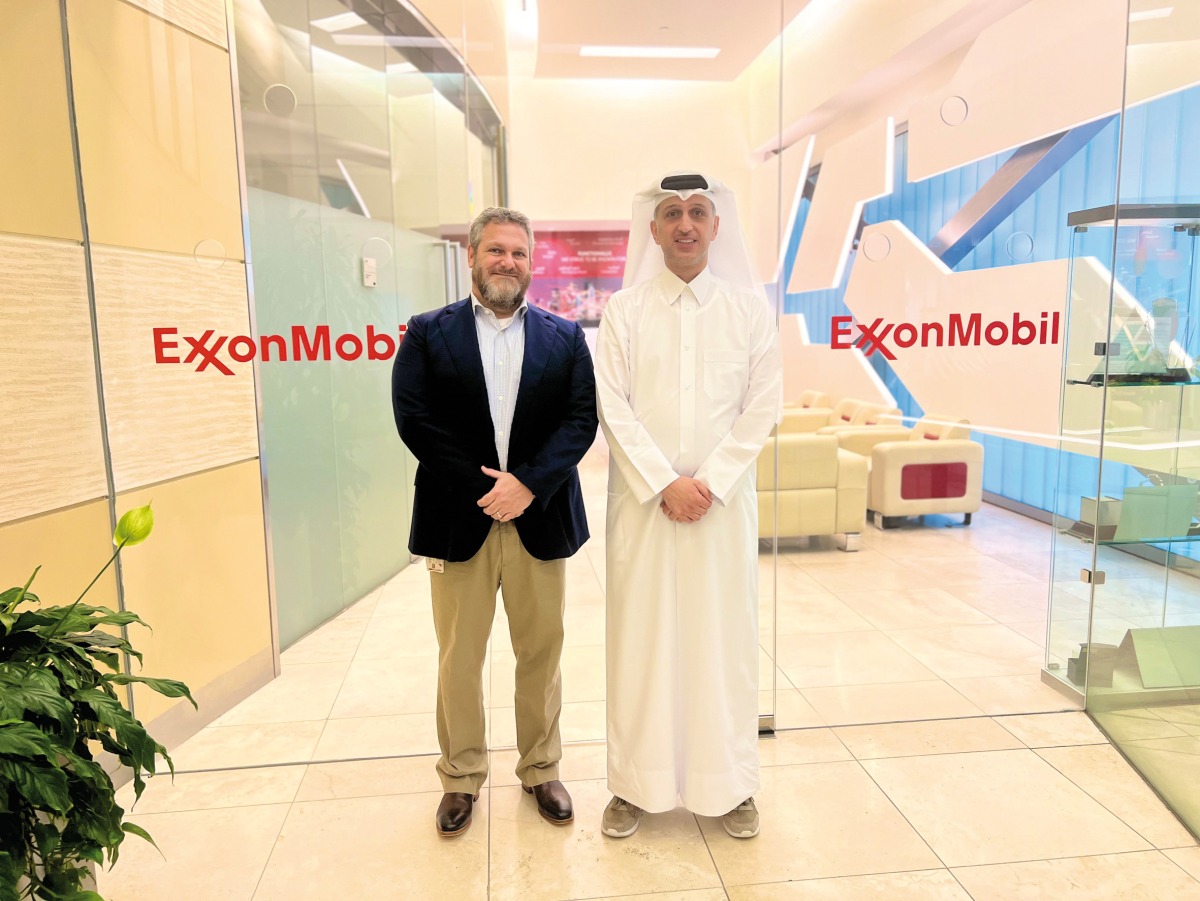
Dr. David Palandro, Vice President and Research Director at EMRQ, (left) with an official during the QSTP Meet The Expert session.
Doha: The crucial role of research and technology in powering Nature-based Solutions (NbS) to address environmental challenges and protect ecosystems was the focus of Qatar Science and Technology Park’s (QSTP) most recent ‘Meet the Expert’ session.
Delivered by experts from QSTP’s longstanding anchor partner, ExxonMobil Research Qatar (EMRQ), the session showcased EMRQ’s dedicated research initiatives and use of cutting-edge technologies to reduce climate risks, encourage ecological resilience, and advance Qatar’s sustainability agenda.
The session opened with an introduction of EMRQ and the center’s ongoing contributions toward preserving Qatar’s environment and marine life, and protecting its people. EMRQ was established in 2009 as one of the first anchor tenants at QSTP and has invested more than QAR 200M (5 y) on projects aligned with Qatar National Vision (QNV) 2030 and NbS.
EMRQ is leveraging effort and expertise across three research areas; environmental management, water resource management and geoscience, to focus on identifying, assessing, and implementing NbS to support Qatari initiatives.
Dr. David Palandro, Vice President and Research Director, EMRQ, said: “We’re very happy to engage with our Qatari stakeholders from academia and industry to develop new technologies for NbS that support the National Strategy for Environment and Climate Change, and provide truly positive impact in Qatar.”
Dr. Palandro presented findings of a current study that is focused on enhancing the marine biodiversity in Qatar’s coastal zones. “The benthic habitat mapping and collection of environmental DNA from these zones has helped us to better understand the biodiversity in terms of species richness and habitat coverage. This has allowed us to put in place the needed procedures that can be applied to NbS and biodiversity enhancement applications. The next step is to develop actions to protect, manage, and restore Qatar’s marine ecosystems.”
Another one of EMRQ’s NbS that is currently in its early testing phase focuses on water treatment.
From studying Qatar’s produced water (PW) – water that comes out of the well with the crude oil during crude oil production - the team has identified 33 strains of microalgae that are capable of biodegrading contaminants in PW. With the goal of promoting water security through its reuse, EMRQ plans on deploying all pilot testing at industrial scales to identify and quantify water reuse options.
Nayla Al Naema, Senior Environmental Researcher, EMRQ, said: “We focus on sustainability projects that not only serve ExxonMobil but also Qatar. We leverage our expertise and use novel technologies that would position Qatar in a leadership position in environmental research and also support the QNV 2030.”