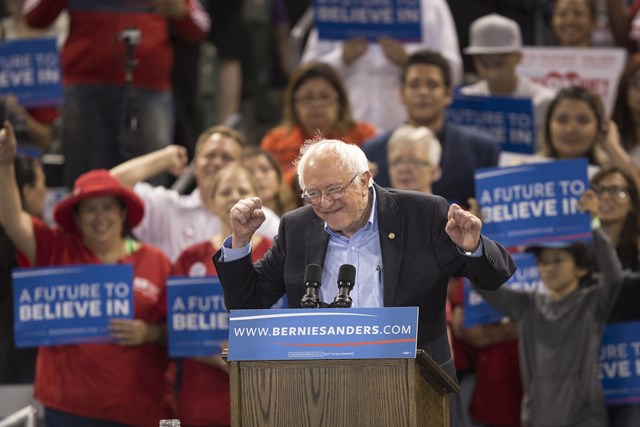
Kentucky: Tensions erupted between supporters of Sen. Bernie Sanders and Democratic officials Tuesday as voters cast ballots in two state primaries that were not widely expected to alter front-runner Hillary Clinton's march toward her party's nomination.
As Kentucky and Oregon voters cast ballots Tuesday, Sanders was locked in a controversy with party leaders in Nevada over the conduct of his supporters at the state convention over the weekend, which was cut short after security officials declared they could no longer contain the disruption.
Sanders dismissed accusations from the Nevada Democratic Party, which had filed a formal complaint that the campaign had fomented violence at the convention. Although Sanders condemned alleged threats, he also stood by unhappy supporters who had claimed the convention rules were being carried out unfairly to favor Clinton. Afterwards, pro-Sanders graffiti was found scrawled on the state party headquarters building.
The dispute raised the prospects for a contentious nominating convention in Philadelphia this summer - something that Democratic leaders say would be harmful to the party as well as to Clinton's prospects for preparing to confront Republican Donald Trump in the fall election.
The fight also highlighted the never-ending nature of the Democratic nominating process. Although Tuesday's primaries were not expected to alter Clinton's advantage in the delegate count, they could draw further attention to Clinton's inability to put the nomination behind her.
Ahead of voting Tuesday, Sanders trailed Clinton by 283 pledged delegates, which are awarded based on the results of primaries and caucuses, according to the most recent tally by the Associated Press. He would need to win lopsided victories in nearly all of the remaining primaries in order to overtake her in the delegate count.
Although Trump is the only remaining GOP candidate in the race, Republican voters cast ballots Tuesday in Oregon, too - but not in Kentucky, which held its GOP caucuses in March.
In Nevada, Democratic Party officials accused Sanders supporters of inciting violence and sending threatening messages to party officials, including the state party chairwoman, Roberta Lange. The party filed a formal complaint with the Democratic National Committee about the conduct of Sanders supporters.
The Sanders campaign refused to back down. In a statement, Sanders called the Nevada Democratic Party's claim "nonsense."
"If the Democratic Party is to be successful in November, it is imperative that all state parties treat our campaign supporters with fairness and the respect that they have earned," Sanders said. "Unfortunately, that was not the case at the Nevada convention.
"At that convention the Democratic leadership used its power to prevent a fair and transparent process from taking place," he added.
The Clinton campaign did not respond to a request for comment on the fracas.
However, Democratic National Committee Chairwoman Debbie Wasserman Schultz (Florida) and Senate Minority Leader Harry M. Reid (Nevada) called on Sanders to condemn the violence.
"This is a test of leadership as we all know, and I'm hopeful and very confident that Senator Sanders will do the right thing," Reid said.
Both primaries on Tuesday were open only to registered Democratic voters, a fact that likely hurt Sanders given how strongly he has performed among independent voters in states that held open primaries.
In Kentucky, both Clinton and Sanders fought aggressively for the upper hand. Sanders campaigned in the small western city of Paducah on Sunday, drawing nearly 2,000 supporters to a convention center.
"What we have learned throughout this campaign is we do well when the voter turnout is high. We do not do well when the voter turnout is low," Sanders said. "Let us see on Tuesday a record-breaking turnout."
In recent days, Clinton also engaged heavily in the state, sensing an opportunity to secure an unexpected victory. By the end, the Clinton campaign had slightly outspent Sanders on the airwaves.
Clinton made her pitch to Kentucky with the help of a well-worn weapon: nostalgia for her husband's administration.
"I want to help bring back the kind of economy that worked for everybody in the 1990s," Clinton said in Paducah on Monday morning, when she dropped by a packed dinner to shake hands. "I've already told my husband, if I'm so fortunate enough to be president and he will be the first gentleman, I'm expecting him to go to work . . . and get incomes rising."
Clinton has said before that the former president would play a central role in her administration - especially on issues such as the economy. But while campaigning in coal country, she indicated that he would have a special charge to help "revitalize" the economy in hard-hit communities.
That theme was particularly resonant in Kentucky, a state where Democrats recall Bill Clinton as the last of an era of Southern Democrats they identified with culturally.
"I saw you and your husband when you came through . . . and you stopped," Holly Erwin, 63, told Clinton breathlessly in the Lone Oak Little Castle diner near Paducah. "My daughter saved her gum."
That encounter was in 1992, when Bill Clinton campaigned with former vice president Al Gore and Hillary Clinton in the state.
Stories like these abound in Kentucky, but a general move away from Democratic leanings, particularly among those dependent on the coal industry, was a drag on Clinton's performance.
Sanders dominated in the eastern part of the state, Kentucky's coal country. With the race still close to call, returns showed Clinton performing well in Lexington and Louisville, two large population centers, helping to offset the coal impact.
Kentucky's economy is more diverse than in West Virginia, where she lost to Sanders by 16 percentage points last week. But voters angry over the coal industry's decline do not view Clinton favorably, particularly after she said, in trying to describe her plans to help retool coal country, that she planned "to put a lot of coal companies and a lot of coal miners out of business."
Even as the two candidates continued campaigning for the Democratic nomination, signs emerged that the general election was already in full swing.
A pro-Clinton super PAC released two scathing ads Monday aimed at the presumptive Republican nominee. The $6 million ad buy takes aim at Trump in a handful of swing states: Ohio, Florida, Virginia and Nevada.
Foreshadowing the fight to come over suburban female voters, the ads use Trump's own words to paint him as insensitive and out of touch.
At the same time, Clinton has continued to largely ignore Sanders and focus instead on a general-election message that contrasts with Trump's polarizing candidacy.
"There is no substitute for treating each other with respect," Clinton said Monday in Hopkinsville, Kentucky. "I will never disrespect anyone who has a good idea. If it's a good idea, then by definition it's an American idea.
"I'm tired of people being on the Republican team or the Democratic team or the red team or the blue team. Let's be on the American team."
The Washington Post