By Satish Kanady
DOHA: Despite the economic slowdown, driven by low oil prices, Qatar’s banking system is stable, unchanged since 2010. This resilience is underpinned by the government’s continued deployment of its ample resources to maintain capital expenditure which will help maintain solid economic growth and create a supportive environment for the country’s banks, Moody’s Investors Service’s ‘outlook for Qatar’s banking system’ noted yesterday.
The report that expresses the ratings agency’s expectation of how bank creditworthiness will evolve in Qatar over the next 12-18 months, projected a 4.1 percent GDP growth for 2016 despite continued low prices.This is due to strong government spending on infrastructure projects that will drive economic expansion and support the FIFA World Cup in 2022. “We expect continued spending by the Qatari government to support credit growth, thereby providing a relatively robust lending environment for the country’s banks,” said Nitish Bhojnagarwala, as Assistant Vice President at Moody’s.
While GDP growth has slowed over the last few years from extremely high rates — around 13.4 percent in 2006-2014 – Qatar’s economic growth still remains the strongest in the GCC.
Loan quality, however, is expected to face modest pressure over the outlook horizon. Moody’s forecasts problem loans to increase to around 2 percent of total loans by December 2016, compared to 1.5 percent the year before. Nevertheless, the rating agency notes that the nonperforming loan ratio is likely to remain the lowest in the GCC heading into 2017.
Underlying capital buffers should also remain strong. The rating agency expects Tangible Common Equity (TCE) to remain around 16.5 percent of risk-weighted assets (December 2015: 16.6 percent) into 2017, driven by slower credit growth combined with higher profit retention. “Even under our low probability ‘stress scenario,’ modelling a significant slowdown in economic activity, Qatari banks’ capital ratios remain resilient,” added Bhojnagarwala.
Similarly, despite some slight weakening, profitability is expected to remain solid overall in 2016, according to Moody’s. The rating agency expects return-on-assets to decline to around 1.7 percent for 2016 from 1.9 percent in 2015. This is a result of Moody’s expectations of rising funding costs over the next few quarters, competitive pressure among banks on asset yields, as well as an increase in provisioning expenses as delinquencies rise.
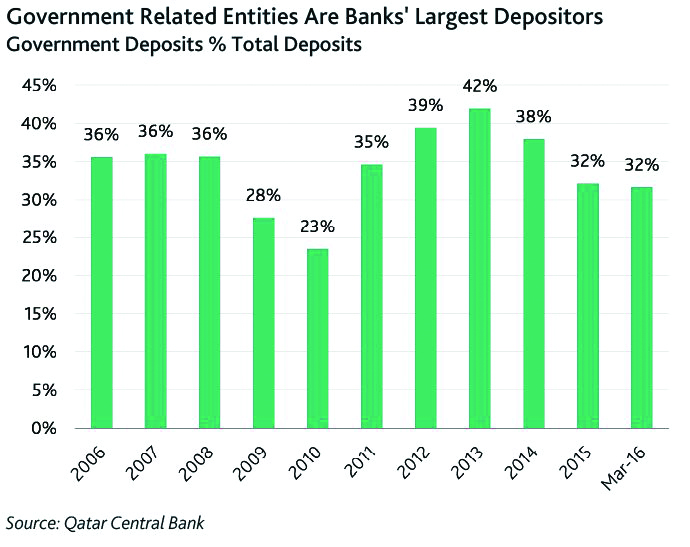
However, despite the overall resiliency of the operating environment, banks in Qatar are still likely to face funding shortfalls — the result of the continued credit growth, compounded by a sizable reduction in deposit inflows from the government and related entities due to lower oil prices. Aggregate deposit levels from these entities had recently fallen to 32 percent of the system total as of March 2016, down from 42 percent since 2013 creating a funding gap. Consequently, we expect a higher reliance on market funding heading into 2017, raising refinancing risks and hence leaving the banks more vulnerable to shifts in market sentiment.
The rating agency notes, however, that banks’ liquid assets should remain at around a healthy 25 percent of total assets – down from around 28 percent as of December 2014 – as banks’ continue to raise additional liquidity in capital markets. Moody’s expects Qatari authorities’ willingness and capacity to support banks to remain very high in case of need. This is despite the government’s ongoing fiscal pressures associated with low oil prices.
The Peninsula