The month of December confirmed that the divergence in global monetary policies is now in motion, said QNB in its Economic Commentary yesterday. On December 8, the European Central Bank (ECB) introduced a further dose of monetary stimulus.
Almost a week later, the US Federal Reserve (Fed) tightened monetary policy through a 25-basis points (bps) increase in rates. The divergence in the actions of the two central banks reflects divergent economic performance.
The US is operating at near capacity and its growth is expected to accelerate, while the Euro Area still has significant slack and its growth is expected to slow down or, at best, stabilise at a lower rate than the US.
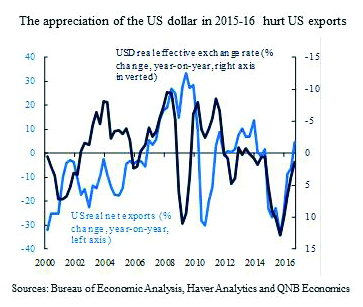
But the divergence in global growth cannot last for long. The fiscal stimulus and tighter monetary policy in the US will lead to a strengthening of the US dollar against the euro. This would benefit European exports at the expense of their American counterparts, helping to close the growth gap between the two regions. The same dynamics were at work in 2015-16. The tightening of monetary policy in the US and the easing in the Euro Area reflect differences in economic conditions and outlooks.
In the US, growth is expected to rise to 2.1 percent in 2017 from 1.9 percent in 2016—partially boosted by the expected fiscal stimulus from the new administration; the unemployment rate is expected to fall to 4.5 percent, below its target of 4.8 percent; and inflation is expected to rise close to its target of 2 percent by end-2017, according to the Fed’s forecasts. Growth in the Euro Area is expected to stabilise at 1.7 percent in 2017, lower than the US; and inflation is expected to be only 1.3 percent, according to the ECB’s forecasts. These forecasts suggest that inflation will remain below the target of around 2 percent as far out as 2019.
The combination of easier fiscal policy and tighter monetary policy in the US is likely to lead to an appreciation of the dollar against the euro. This will reduce the competitiveness of the US exports compared to their European counterparts, which will in turn shift growth from the US towards the Euro Area, leading to a narrowing in the diverging growth gap.
The expected appreciation in the US dollar will shift some of the demand generated by Trump’s fiscal stimulus to the rest of the advanced economies. In 2015-16, the boost to the US aggregate demand from the strong growth in private consumption, expectations of higher rates in the US and monetary easing by the ECB led to a sharp movement in currencies. The US dollar strengthened from 1.33 to the euro in 2014 to around 1.11 in 2015-16.
This shifted some of the demand away from the US towards the Euro Area and helped close the growth gap between the two regions. Other factors were also important in that period, such as the decline in oil prices which benefited the Euro Area more than the US, but the exchange rate was the deciding factor.
Some might argue that the new US administration would pursue an anti-trade policy through the imposition of tariffs, which could stop the leakage of growth out of the US and maintain the divergence in economic performance.
But this scenario is unlikely to happen for three reasons. First, the Trump administration may take a more moderate approach to trade, relative to the campaign rhetoric. Second, protectionism can only restrict imports to the US, it cannot help boost US exports. Third, US exports would in fact be hurt by any protectionist measures as other countries would likely retaliate.
Movements in the exchange rate are likely to be strong enough to ensure that other advanced economies would benefit from Trump’s fiscal stimulus and that the regional growth gap would not widen.