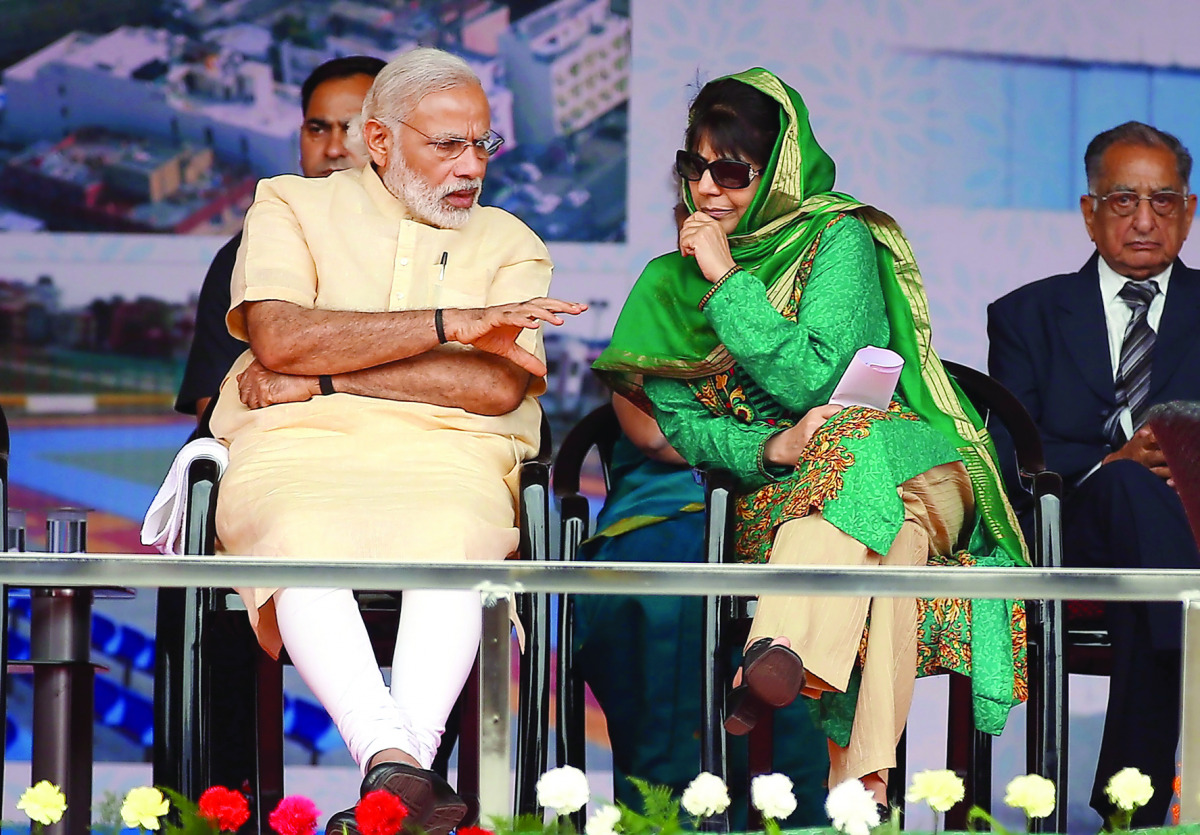
A file picture of Prime Minister Narendra Modi (left) with Jammu and Kashmir Chief Minister Mehbooba Mufti during a public rally in Katra near Jammu.
Jammu/Srinagar: The ear 2016 began on a politically ominous note for Jammu and Kashmir as Chief Minister Mufti Muhammad Sayeed passed away after a brief illness in New Delhi on January 7. Politics for the state, especially for the People's Democratic Party (PDP), which Sayeed had so painstakingly created to provide people with a regional alternative to the National Conference (NC), has never been the same after his death.
Sayeed's daughter and the present Chief Minister, Mehbooba Mufti, took three months to decide whether she should don her father's mantle and pick up the baton of governance in India's most troubled state.
Mehbooba was initially so reluctant to assume power that some confidantes of her father were reported to have started working on a Plan B. This plan was projected by erstwhile Sayeed loyalists as their last-ditch effort to save the party from slipping into political oblivion.
She finally began her governance innings on April 4. Political rivals called her "a reluctant Chief Minister" because she "wasted three months" to even decide whether to govern. Soon she faced an agitation over the alleged molestation of a girl student in Handwara town. And, tension erupted between local and non-local students in the National Institute of Technology (NIT) in the summer capital Srinagar.
But, just when everybody believed Mehbooba Mufti's teething troubles were over, Burhan Wani, the Hizbul commander who had become the poster boy of militancy, was killed in a gunfight on July 8.
Nobody believed that Burhan had not been a militant commander, and yet Kashmir burst like a volcano that very day.
The government had to literally go into hiding. The only symbol of governance became the ubiquitous presence of the security forces. Kashmir came to a grinding halt. Ninety-six protesters were killed and over 12,000 were injured, including security personnel.
The separatists have since been issuing weekly protest calendars.
The Kashmir Valley has mostly remained shut during this period even though the intensity of the separatist campaign has broken as a function of time and because of the people's patience giving way with the logjam.
Gradually the state government has been re-establishing its writ. Offices, banks, post offices and other semi-government organisations have now started working almost normally across the Kashmir Valley.
Whether or not Mehbooba Mufti and her party emerge stronger from the political crisis faced in 2016 would be proved in the early months of the next year.