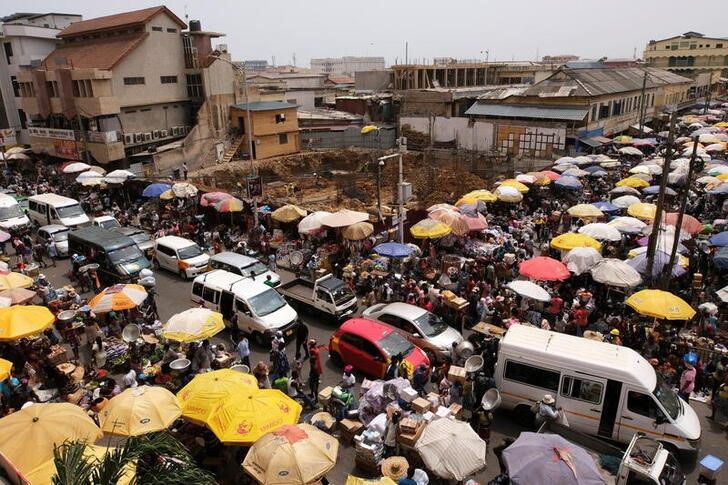
A general view of the Makola market, one of the country's largest trading centres in Accra, Ghana, on March 26, 2022. File Photo / Reuters
Ghana’s public debt declined by a quarter at the end of December from the previous month as the nation’s external obligations decreased.
Public debt, excluding loans of state-owned enterprises, dropped to 434.6 billion cedis ($40.4 billion) from 575.7 billion cedis in November, the central bank said in a summary of economic and financial data on its website. External debt declined 37% to 240.2 billion cedis, Bank of Ghana said without providing an explanation.
Domestic obligations inched up to 194.4 billion cedis.
In December, Ghana unilaterally suspended interest payments on most of its overseas obligations as it engages with lenders for talks on debt restructuring to qualify for a $3 billion International Monetary Fund support program. Those external obligations include $13 billion of eurobonds and $5.5 billion of bilateral loans.
While the country received financing assurance on May 12 from an official creditor committee chaired by China and France under the Group of 20 Common Framework, the specific terms of debt relief are yet to be agreed.
The financing assurance was, however, enough for the IMF Executive Board to approve Ghana’s Extended Credit Facility days later.
The West African nation also implemented a domestic debt exchange, with bondholders swapping 88 billion cedis of local notes that paid an average of 19%, for bonds returning as little as 8.35% to qualify for the IMF bailout.