DOHA: A slew of developments kept the global oil market on its heels during this month that included a 2.1 million increase in US crude oil inventory during the week ending August 5. Rig count also saw the biggest jump in 2016 and rose for the seventh straight week.
The second week of August saw strong support for oil with renewed speculation that Opec is seriously considering curbing its output. The statement by Minister of Energy and Industry and current Opec President H E Dr Mohammed bin Saleh Al Sada that Opec would discuss the possibilities of “oil production freeze” in September, along with a weak US dollar after flat US retail data, pushed oil to enjoy the best week since April 2016, KAMCO’s oil market monthly report for August noted.
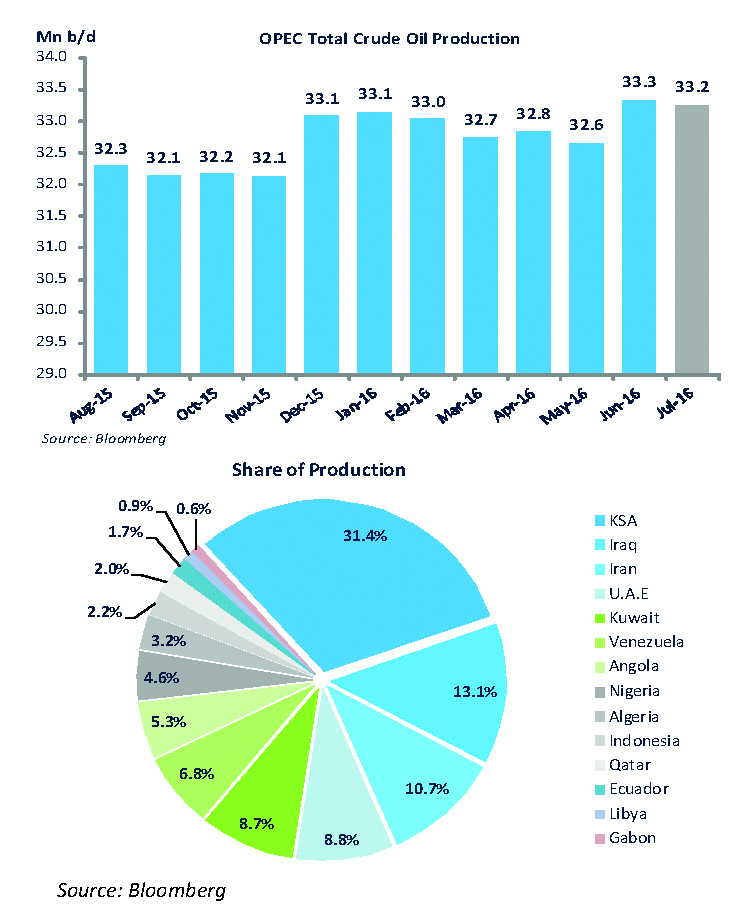
On the production side, Saudi Arabia reportedly produced at record pace during July breaking the output record it set last year in June-15. However, a majority of the increase in production was primarily aimed at domestic consumption in order to deal with the seasonal summer demand where electricity consumption is at its peak in the region. Average Opec monthly oil price declined for the first time in over six months during July to $ 42.68/b, a 6.9 percent decline as compared to the previous month. Brent and Kuwait Crude also declined at a similar pace during the month.
Oil supply concerns continued during July led by developments on rising crude inventories in the US and across the globe, including China, as well as rising oil production or resilient oil production in the US. Moreover, there is a looming concern that as the seasonal maintenance kicks in the US, oil demand will further decline leading to further pressure on oil prices.
The latest American Petroleum Institute (API) report highlighted the biggest crude inventory in over the past three months with an increase of 2.1million barrels.
The US Energy Information Administration’s (EIA) short term energy outlook also pointed to figures not supportive of oil prices while highlighting July production of 8.57 mb/d, a decline of 180 tb/d and the lowest level since April 2014. In the report, the EIA raised the production forecast for US oil producers indicating a slower than expected decline in US oil output as US oil producers are proving more resilient to oil prices.
The agency raised US oil production forecast to average at 8.73 mb/d in 2016, up from its previous forecast of 8.61 mb/d as it expects higher output with the expected increase in drilling later during this year. Its 2017, US oil production forecast was also raised from 8.2 mb/d to 8.31 mb/d. The agency also lowered the average US oil price forecast for 2016 to $41.16/b from $43.57/b and for 2017 to $51.58/b from $52.15/b.
Average Opec monthly oil price declined for the first time in over six months during July-16 to $ 42.68/b, a 6.9 percent decline as compared to the previous month. Brent and Kuwait Crude also declined at a similar pace during the month.
The Peninsula