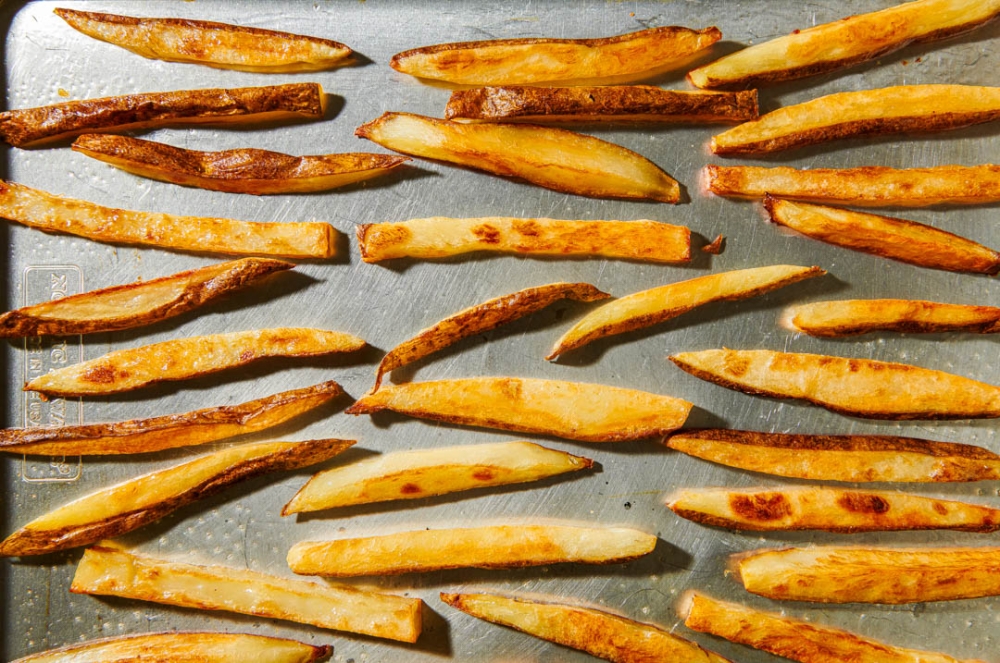
Oven fries can be the basis of a fun, filling meal. Rey Lopez for The Post; food styling by Lisa Cherkasky
About halfway down Shop Street in downtown Galway, Ireland, there’s often a crowd outside Chipeen, where they serve hundreds of pounds each day of what they call "proper Irish chips” - chunky peeled potato batons cut thicker than a typical American fry. Crispy and golden outside, with a fluffy interior texture, Chipeen elevates these chips beyond a side dish to make them a meal - and nothing could be bad about that.
Sure, fries love a condiment, and at Chipeen (formerly known as Prátaí, which means "potatoes” in Irish), there’s plenty of inspiration to be had, including a peanut satay sauce and mayonnaise spiked with white truffles or bacon, as well as such loaded toppings as shrimp scampi and sautéed mushrooms that take them to the next level. In December, the shop even serves a holiday-dinner-inspired version topped with Sunday roast gravy, onion and sage stuffing, and cranberry sauce. I’m already starting to think about a fry-centered Thanksgiving.
Poppy O’Toole, author of "The Potato Book” and widely known in the United Kingdom and across social media as the "Potato Queen,” says there’s nothing wrong with using frozen fries (or chips) - but don’t be afraid to try your hand at homemade.
"When making from scratch, you control the surface roughness and fats used, which creates an entirely different texture and crispiness that a frozen chip will struggle to replicate,” O’Toole says. "However, frozen chips are amazing for convenience, especially when used on things like loaded fries, where they act as a base.” When it comes to cooking truly crispy homemade fries, using the oven by preheating the oil on a sheet pan can be a great alternative to a deep fryer. "Oven roasting takes longer overall,” notes O’Toole, "but it’s more hands-off, more accessible and has potential for more crunch.”
Here’s how to give fries top billing in your next meal.
- - -
Swap fries in for other carbs
Wherever you might normally use pasta, rice or bread, try giving fries pride of place. Once we start thinking about them as more than a side dish, the possibilities are endless. Fries make a fiber-full, potassium-rich base for a spicy tomato sauce, flaked canned tuna with tartar sauce or even a tangy kale salad. Imagine them fortifying a frittata, supporting shawarma or transforming a tagine. Here in America, you’ll find Springfield, Illinois, locals lining up for the open-faced horseshoe sandwich, a generous pile of cheese-sauce-drowned fries on top of ham steak (or other meat) and toast, while San Diego’s California burrito features fries inside a tortilla with carne asada, cheddar and, sometimes, guacamole.
- - -
Get them extra crispy
Water is a potato’s best friend, starting with a cold plunge to help remove the surface starch, which allows the spuds to cook more evenly, with better texture. Once they’ve had a good soak, parboiling is key to getting a fry that is crisp on the outside and tender within. "Thin fries can be fried from raw because the heat penetrates quickly,” says O’Toole, while cautioning that "doing this with a thick-cut chip means you’ll brown the outside before the inside is soft.”
After parboiling, it’s essential to let the fries dry before cooking. Drain them in a colander, then place it over the hot pot, tossing occasionally, or set the potatoes on a wire rack on the countertop, covered lightly with a kitchen towel, for 10 to 15 minutes. This final step makes all the difference to getting the best crispy texture, whether you choose to bake or fry.
You’ll find both these techniques put to good use in our new oven fries recipe. (And, yes, there’s an air fryer variation as well.)
- - -
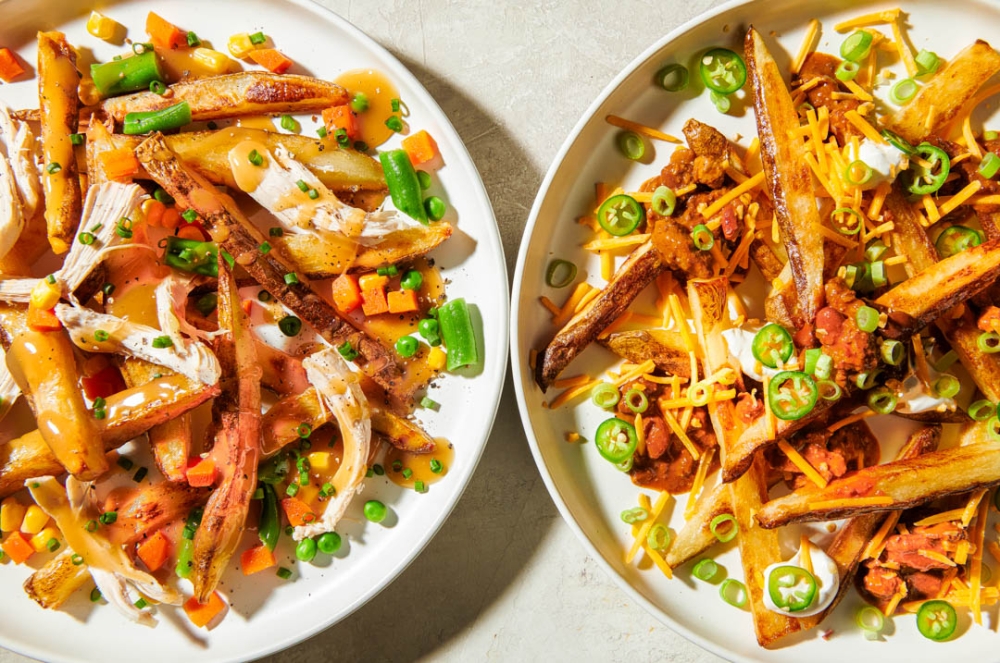 Toppings loaded on oven fries. MUST CREDIT: Rey Lopez for The Post; food styling by Lisa Cherkasky
Layer on the flavor
Just like pasta, rice, quinoa or other base ingredients, potatoes take well to seasoning throughout the cooking process. "I like to salt the water,” says O’Toole, "and throw in aromatics like onion, garlic or herbs to give the chips a little flavor boost.” Oven fries can be tossed with earthy spices before or after baking, then brightened with chopped fresh herbs. Once you start building the final dish, layer proteins and vegetables directly on top the hot fries before drizzling with any wet sauces - this helps keep the fries from getting completely soggy, while still allowing them to soak up the flavors of the other components. For fries directly topped with something like a rich Cincinnati chili, try a layer of fries, followed by a generous layer of sauce, then another layer of fries with less sauce, as well as shredded cheese and other garnishes, to help ensure a good ratio of crispy to smothered fries when serving.
- - -
Pick the right fry for the job
Thick-cut fries provide a welcome, and easy, twist to ordinary weeknight meals, including marinara sauce and meatballs, butter chicken, and vegetable goulash, but if your taste runs to shoestring or waffle, or even potato tots, there’s a dish to suit it. Thin fries offer a great alternative to traditional grain bowls, well suited to being topped off with roasted vegetables, salmon or tofu, and a tangy dressing. Waffle-cut potatoes, with their hefty shape, can stand up to a generous layer of charred skirt steak with a smoky chimichurri sauce, while tots - even if they aren’t technically fries - can stand in for tortilla chips when topped with fajita-style chicken and all the trimmings.
- - -
Oven Fries
Servings: 4
Active time: 30 mins, Total time: 2 hours
Crispy, thick-cut french fries - what the British refer to as chips - baked in the oven are easily achievable with a few smart tricks. Soaking the potato batons in water helps remove excess starch (the longer you let them soak, the better), while parboiling and baking on a preheated, oiled sheet pan ensure the best texture. (See Variations for air fryer instructions.) The result is a fry that’s crisp on the outside and tender inside, ready to dunk into your favorite condiments or serve with chili, butter chicken, mushroom gravy or your favorite creative topping.
Make ahead:The cut potatoes can be refrigerated in a bowl of water for up to 1 day.
Storage: The fries taste best the day they are made, but leftovers can be refrigerated for up to 4 days and reheated in a 350-degree oven until crisp and warmed through.
INGREDIENTS
- 3 large russet potatoes (2 3/4 to 3 pounds total), peeled, if desired
- 2 teaspoons fine salt
- 4 tablespoons high-heat neutral oil, such as peanut, sunflower or avocado
- Flaky sea salt, such as Maldon (optional)
DIRECTIONS
Step 1
Trim the ends of the potatoes and cut into quarters lengthwise. Cut each quarter into several thick batons, about 3/4-inch wide, roughly the width of your thumb or index finger. Place the batons into a large bowl and cover with cold water, then set aside to soak for at least 1 hour, and, if refrigerated, up to 1 day.
Step 2
When ready to cook, thoroughly drain the batons in a colander and rinse briefly in cold water.
Step 3
Position racks in the upper and lower thirds of the oven and preheat to 425 degrees if using dark sheet pans, or 450 degrees if using light sheet pans.
Step 4
Transfer the batons to a large (at least 5-quart) pot, add the fine salt and just enough water to cover, then bring to a boil and cook for 5 minutes, or until the batons can be pierced with the tip of a knife but still hold their shape. Drain the batons in a colander, gently shaking to remove excess water. Place the colander with the potatoes over the pot, cover with a dish towel and allow to dry for 15 minutes. The batons should feel dry to the touch, so if they still feel a little damp or gummy, remove the towel and let them air dry for a few more minutes.
Step 5
Meanwhile, divide the oil between two large sheet pans, tilting so the entire surface of each pan is coated in oil. Transfer to the oven to preheat while the potatoes cool. (For air fryer instructions, see Variations.)
Step 6
When the batons are dry, carefully remove the hot sheet pans from the oven and set on a heatproof surface. Taking care to avoid any hot oil splattering, divide the potatoes between the pans, quickly turning each baton over to coat in oil and spacing them roughly 1/2 inch apart. Return the pans to the oven and bake for 20 minutes, then flip the batons for even browning and rotate the pans from top to bottom and front to back, and bake for another 10 to 20 minutes, or until the fries are golden brown with darker brown edges (there will be some variations in color) and easily pierced with a knife.
Step 7
Transfer the fries to a large bowl lined with paper towels and gently toss to remove any excess oil, then remove the paper towels and toss the fries with flaky salt, if desired. Serve immediately.
Substitutions: Russet potatoes >> yellow or gold potatoes, though the interior might be slightly less fluffy.
Variations: To make these in an air fryer, toss the parboiled, dried potato batons with 2 tablespoons of oil. Working in batches as needed, air fry at 400 degrees for 20 minutes, shaking the basket several times, or until crisp and golden. We tested in the Cosori 5.8-quart air fryer. Depending on the appliance you use, you may need to adjust the cooking time and/or temperature to achieve the desired results. Prefer thin-cut fries? Cut the batons into narrow strips, about 1/2-inch wide, roughly the width of your pinky finger, then soak as directed but skip the parboiling and go straight to baking on the preheated, oiled sheet pans. They’ll bake in 18 to 20 minutes; use tongs to toss them halfway through for even browning.
Nutritional facts per serving: Calories: 329, Fat: 7 g, Saturated Fat: 1 g, Carbohydrates: 61 g, Sodium: 90 mg, Cholesterol: 0 mg, Protein: 7 g, Fiber: 4 g, Sugar: 2 g.
This analysis is an estimate based on available ingredients and this preparation. It should not substitute for a dietitian’s or nutritionist’s advice.
From food writer Kristen Hartke.