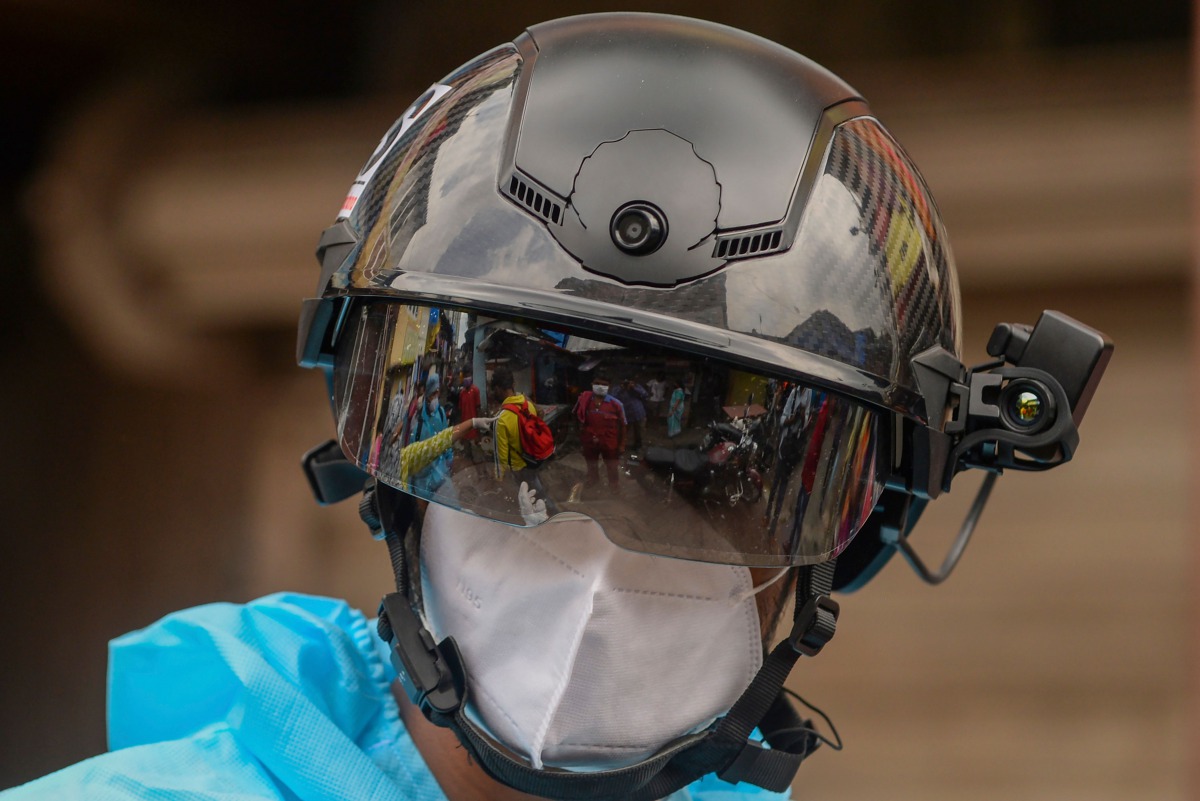
A volunteer health worker of the Non-Governmental Organization (NGO) Bharatiya Jain Sanghatana (BJS) wearing Personal Protective Equipment (PPE) looks through a smart helmet equipped with a thermo-scan sensor to check the body temperature during a door-to
Mumbai - As coronavirus infections climb in Mumbai, authorities in India's worst-hit city are turning to high-tech "smart helmets" to speed up screenings and identify suspected cases in the financial capital's densely-populated slums.
The portable thermoscanners -- previously deployed in Dubai, Italy and China -- enable health workers to record the temperatures of dozens of residents per minute and could emerge as a key weapon in Mumbai's quest to eradicate the virus from the city of 18 million.
"Traditional screening methods take a lot of time. You go to a slum with 20,000 people and it takes you three hours to screen 300 people," said Neelu Jain, a medical volunteer affiliated with the non-profit group Bharatiya Jain Sanghatana.
"But when you use these helmets, all you have to do is ask people to come out of their homes, face them and you can screen 6,000 people in two-and-a-half hours," she told AFP.
The helmets were donated to authorities in Mumbai and the nearby city of Pune, which have both been locked in a months-long battle against the pandemic, with cases across India soaring past one million on Friday.
But with just two helmets in use in each city, the push to identify and isolate infected residents will take a long time.
The imported helmets -- which cost around 600,000 rupees ($8,045) -- are also in high demand in places like Dubai, said Jain, making it very difficult to expand capacity.