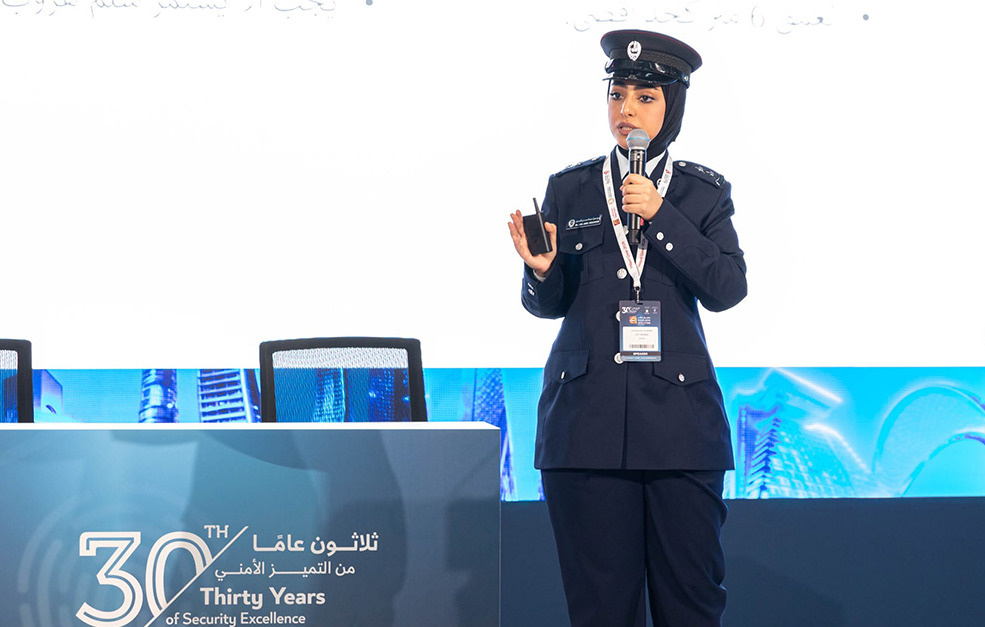
Doha: Represented by the General Administration of Civil Defense, the Ministry of Interior (MOI) showcased the most prominent updates in the third edition of the Civil Defense Technical Requirements Guide, within the second day of the activities of the Milipol Qatar 2026 Exhibition and Conference for Internal Security and Safety.
During a security seminar on civil defense and national preparedness for emergencies and crisis management, First Lieutenant Eng. Hessa Ahmed Al Jassim, an officer from the General Directorate of Civil Defense at the MOI, said that the third edition of the guide includes updates to several technical requirements for installing sprinkler systems in industrial facilities and warehouses, as well as provisions regarding single-staircase configurations in residential buildings, hotels, labor accommodation, and offices.
She indicated that these updates are intended to help address the challenges faced by consulting firms when implementing fire prevention and safety requirements.
The updates include requirements for staircases in residential buildings, offices, hotels, labor accommodation, and military housing, as well as regulations for basement levels, which allows for greater design flexibility, while maintaining compliance with requirements for fire-resistant separation and protective doors, she added.
In regard to medium-risk warehouses and factories, First Lieutenant Eng. Al Jassim emphasized the necessity of installing automatic sprinkler systems in buildings with a total area exceeding 1,115 square meters, pointing out that all spaces located under a single roof are counted toward the total area when determining whether this requirement applies.
She also noted that the updates include regulations for adjacent buildings, allowing them to be treated as separate structures provided that specific requirements are met, such as the inclusion of a two-hour fire-rated partition wall with no openings, while also taking into account the construction materials used and the independence of the roof structures.
First Lieutenant Eng. Hessa Ahmed Al Jassim concluded the seminar by pointing out that handling modifications to buildings that have already received prior approval depends on the nature of the change and its impact on safety and fire prevention requirements, in accordance with the technical specifications adopted by the General Directorate of Civil Defense.