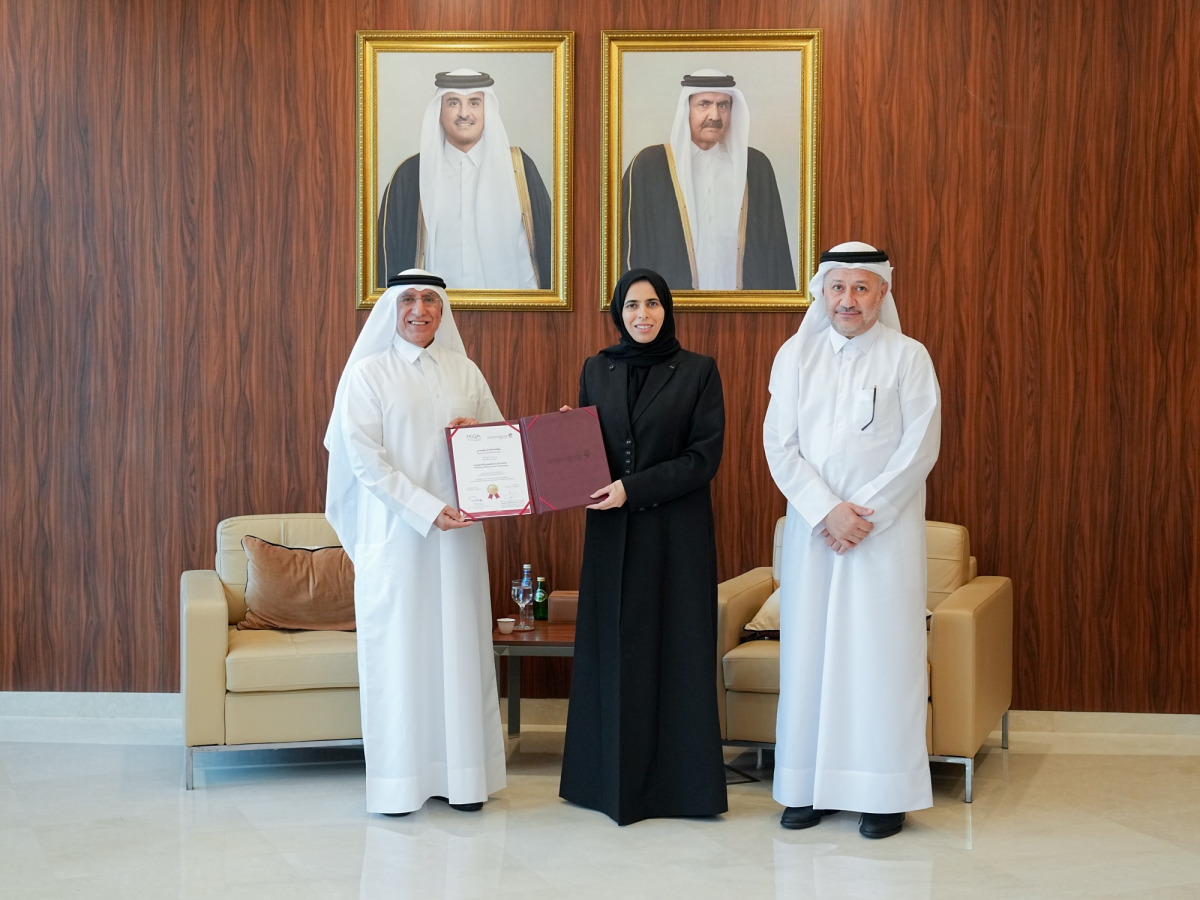
Minister of Education and Higher Education H E Lolwah bint Rashid bin Mohammed Al Khater presenting accreditation certificate to President of UDST Dr. Salem Al-Naemi.
Doha, Qatar: The Qatar’s National Committee for Qualifications and Academic Accreditation (NCQAA) has granted institutional accreditation to the University of Doha for Science and Technology (UDST), making it the first university in the country to receive this accreditation.
Speaking at a press conference yesterday, Chairman of the Committee, Dr. Mazen Omar Hasna, said the accreditation is awarded upon meeting five criteria established by the Committee to promote the quality of Qatar’s higher education sector.
These criteria cover the institution’s mission and organization, integrity assurance, the availability of institutional resources, planning and institutional effectiveness, fulfillment of the institution’s mission, and its impact on the surrounding community, Dr. Hasna highlighted.
He emphasized that this feat demonstrates the effectiveness of UDST’s practices and strengthens its standing and the recognition of its qualifications both domestically and internationally.
Dr. Hasna presented an overview of the various accreditation phases, along with the Committee’s recommendations following the granting of accreditation, congratulating UDST on receiving the award. He further highlighted the University’s efforts, which culminated in the decision to grant this accreditation.
He revealed that nearly 14 universities nationwide are engaged in the institutional accreditation process, with seven having been visited and the other seven conducting self-studies throughout this year and next year.
President of UDST Dr. Salem bin Nasser Al Naemi expressed pride in UDST’s achievement in receiving this accreditation, which, he said, reflects the university’s stalwartness and sense of responsibility, illuminates the path forward, and demonstrates that distinction knows no boundaries but extends toward an infinite horizon.
Dr. Al Naemi noted that this accreditation is a testament to the university’s clear mission, robust governance, and deeply rooted integrity, emphasizing that its resources are as substantial as its ambitions, its planning is as deliberate as its mission demands, and its performance is measured with transparency and accountability.
The university, he asserted, fulfills its commitments to students and the wider community while making a substantive impact that extends well beyond the campus. Dr. Al Naemi continued, stressing that this accomplishment carries particular significance for UDST’s students and graduates, conveying a clear message that their qualifications now command greater recognition and distinctive value.
For the university’s partners in the labor market, it signals that the talent the institution develops is cultivated in accordance with top-flight standards, the official said. At the national level, the achievement marks another step toward Qatar National Vision 2030, which places people at the core of development and positions knowledge as the fulcrum of the future.
Applied education has taught us that knowledge remains incomplete unless it is translated into action, and ideas aren’t judged by their beauty, but by their impact, Dr. Al Naemi remarked, adding that this approach views the accreditation as a launching pad and a promise that the university has made to remain steadfast in carrying out its educational mission and persistently promoting distinction in this field of education.
Dr. Al Naemi noted that this achievement grew out of the combined efforts and dedication of all members of society. He thanked everyone who had contributed to achieving this feat.
Established in 2022, the NCQAA is responsible for overseeing and updating the National Qualifications Framework in line with the State’s general policies.
It also accredits the qualifications- certificates and academic degrees- awarded by higher education institutions in Qatar to ensure their alignment with this framework and the application of quality assurance standards. Compliance is further strengthened through the academic accreditation system standards established by the Committee.