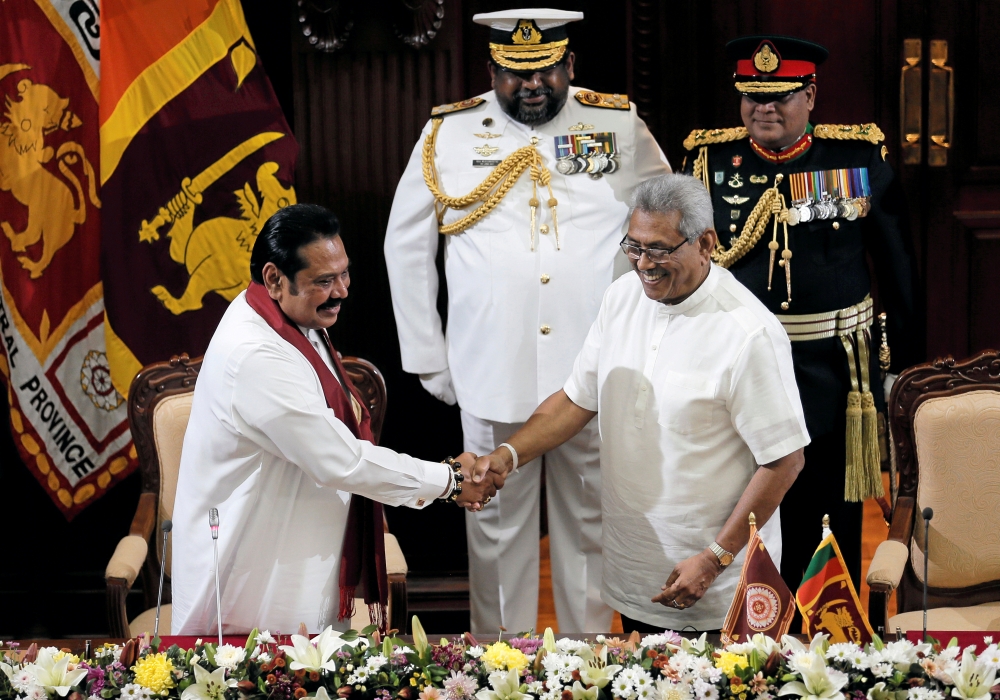
Sri Lanka's President Gotabaya Rajapaksa and his brother and former leader Mahinda Rajapaksa, who was appointed as the new Prime Minister, shake hands during the swearing in ceremony in Colombo, Sri Lanka November 21, 2019. REUTERS/Dinuka Liyanawatte
Sri Lankan President Gotabhaya Rajapaksa has appointed his brother Mahinda Rajapaksa, who forged close ties with Beijing during his 10-year rule, as the island’s new prime minister.
Mahinda Rajapaksa was sworn in Thursday a day after Ranil Wickremesinghe quit following his candidate’s loss in the country’s bitterly contested presidential poll.
Wickremesinghe said he was resigning to allow for the appointment of his replacement and the establishment of a new government, although the coalition led by his United National Party still holds a majority in parliament.
Gotabhaya Rajapaksa’s Sinhalese-Buddhist nationalist sri lanka Podujana Peramuna party has been calling for a snap parliamentary election, which is not due until after February 2020.
The constitution allows the option of a vote on the dissolution of parliament with the backing of two-thirds of lawmakers in order to call early general elections.
Rajapaksa, 70, won 52.3% of the vote, while the ruling alliance candidate Sajith Premadasa trailed with 42% at the final count in Saturday’s poll.
The former defense secretary made national security his key campaign platform, riding the tide of disillusionment that grew after the Easter Sunday attacks that killed over 250 people, highlighting the security failures of the present government.
He also promised sweeping tax cuts and offered more subsidies for farmers.
During his decade in power, former strongman Mahinda borrowed heavily from Beijing to fund infrastructure projects after the war ended. One of them, a port in southern Hambantota, lost money and was eventually sold to a state-owned
Chinese firm by the current government in a much-criticized debt-to-equity swap on a 99-year lease.
The new president’s major challenges will be dealing with an economy where growth has slowed to a more than five-year low of 1.6% in the quarter ended June and a debt level hovering at 83% of gross domestic product.