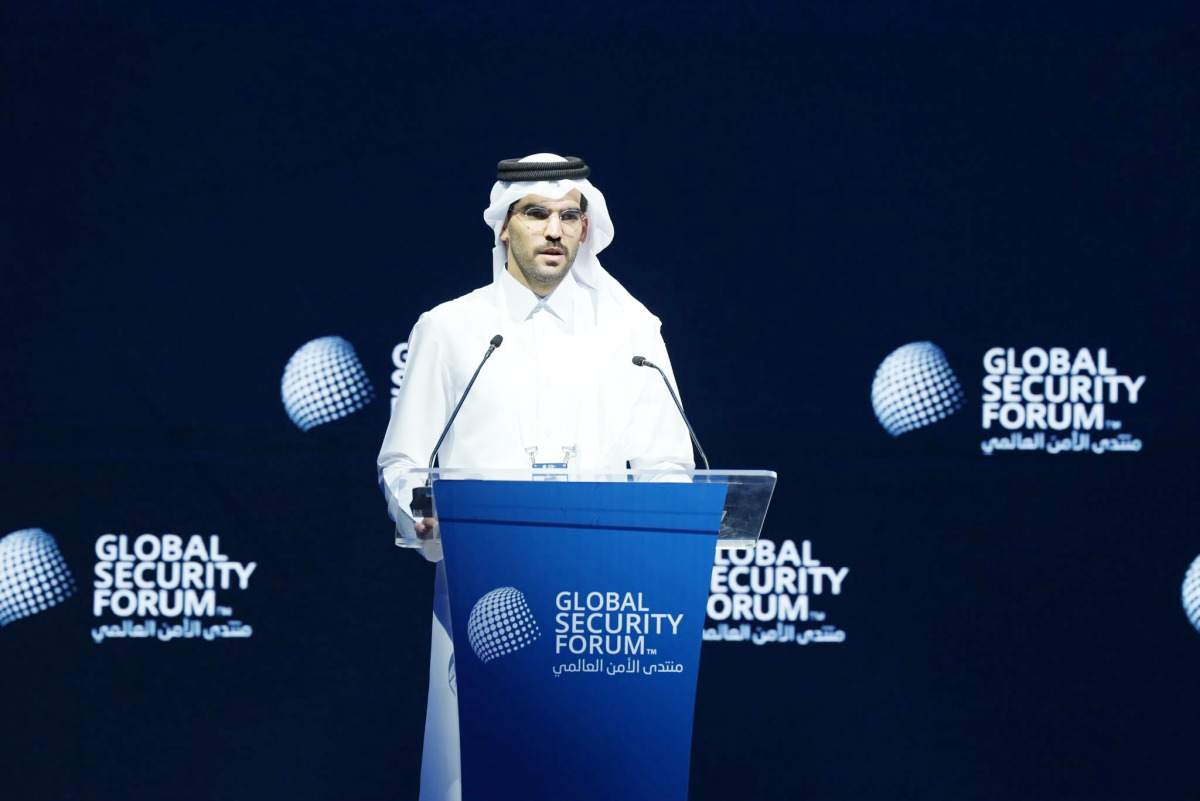
NCSA Director-General Ahmed Mohammed Al Mutawa Al Hammadi speaking at the Global Security Forum 2026 yesterday.
Doha, Qatar: Qatar has underscored the importance of international cooperation and strategic alliances in strengthening cybersecurity, protecting critical infrastructure and safeguarding national sovereignty amid increasingly sophisticated cyber threats.
Director-General of the National Cyber Security Agency (NCSA) Ahmed Mohammed Al Mutawa Al Hammadi highlighted the need for countries to deepen collaboration and share expertise to address evolving digital security challenges while speaking at the 8th edition of the Global Security Forum 2026 yesterday.
Addressing the forum, Al Hammadi said the event provided an important platform for global security leaders and experts to discuss emerging challenges. This year’s theme, “The Future of Alliances,” comes at a time when international relations are undergoing significant changes and cooperation has become increasingly important.
He noted that the transition towards a multipolar world has reinforced the need for alliances built on common interests and shared priorities, enabling countries to protect their national interests and sovereignty.
Al Hammadi said the rapid adoption of digitalisation, emerging technologies and artificial intelligence across critical government functions and other sectors has created significant strategic opportunities. However, the globalised and commercialised nature of digital tools and assets has also expanded the range of threats facing states.
He warned that advances in technology have made cyberattacks more sophisticated, contributing to an increase in automated attacks, supply chain threats, social engineering and ransomware incidents.
The financial consequences of cybercrime are also growing, with data breaches imposing significant costs and global cybercrime losses already reaching trillions, he said. These developments pose serious risks to global security and national sovereignty, making coordinated international action increasingly essential.
Against this backdrop, Al Hammadi said Qatar considers international cooperation a key pillar of its strategic cybersecurity approach.
He highlighted the NCSA’s efforts to build partnerships with international counterparts to strengthen national and international security. Bilateral cooperation with countries including the United States, the United Kingdom, Saudi Arabia and Singapore has provided a foundation for exchanging knowledge and experience, with further partnerships envisaged.
These partnerships aim to support the exchange of lessons in policymaking, improve the protection of critical national infrastructure, strengthen institutional and human capacities, and promote operational cooperation, he said. At the regional level, Qatar is working with committees within the Gulf Cooperation Council and the Arab League to promote greater alignment on cybersecurity policies, strategies, standards and operational cooperation.
Al Hammadi stressed that a unified regional approach is particularly important given the persistent threats facing critical infrastructure across the region.
Internationally, the NCSA participates in several organisations and initiatives focused on cybersecurity, including the United Nations Global Mechanism, the Forum of Incident Response and Security Teams, the International Telecommunication Union and the Common Criteria framework.
Such platforms help advance cyber norms, promote best practices in policy and governance, and strengthen global readiness through capacity-building initiatives.
Concluding his remarks, Al Hammadi said effective dialogue and comprehensive frameworks for cooperation were essential to protecting national interests, preserving sovereignty and enabling prosperity. He emphasised that sharing knowledge and applying lessons learned at the national level would contribute to a more secure digital environment, adding that broader engagement between countries would help generate practical solutions to the growing security challenges confronting the world.