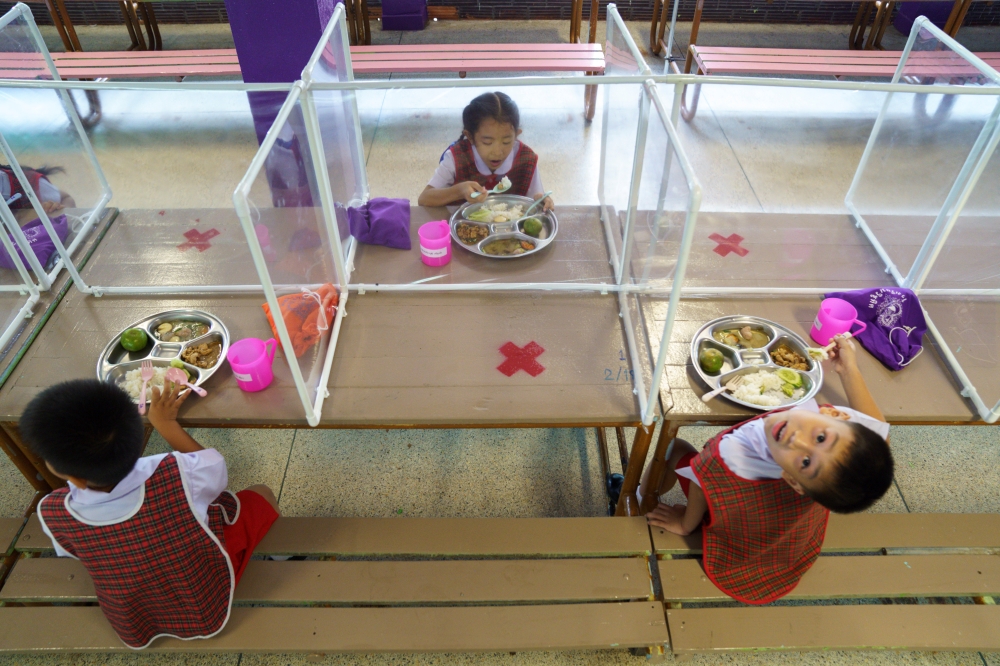
Kindergarten students from the Wichuthit school eat their lunch during a rehearsal social distancing and measures to prevent the spread of the coronavirus disease (COVID-19) ahead of nationwide schools reopening in Bangkok, Thailand, June 23, 2020. REUTER
School kids don’t appear to transmit the new coronavirus to peers or teachers, a French study found, weighing in on the crucial topic of children’s role in propagating Covid-19.
Scientists at Institut Pasteur studied 1,340 people in Crepy-en-Valois, a town northeast of Paris that suffered an outbreak in February and March, including 510 students from six primary schools. They found three probable cases among kids that didn’t lead to more infections among other pupils or teachers.
The study confirms that children appear to show fewer telltale symptoms than adults and be less contagious, providing a justification for school reopenings in countries from Denmark to Switzerland. The researchers found that 61% of the parents of infected kids had the coronavirus, compared with about 7% of parents of healthy ones, suggesting it was the parents who had infected their offspring rather than the other way around.
Understanding the pandemic and the new virus’s transmission patterns is key to determining which parts of society can reopen -- or should be shuttered again in the event of a resurgence -- and mitigate the outbreak’s impact on the economy. The data on kids has been contradictory so far, with some reports corroborating the Pasteur findings and at least one pointing the other way.
Epidemiologist Arnaud Fontanet and colleagues said more studies on schools were needed because of the small number of cases they were able to study. They found that an estimated 41% of the children infected showed no symptoms, compared with about 10% of adults.