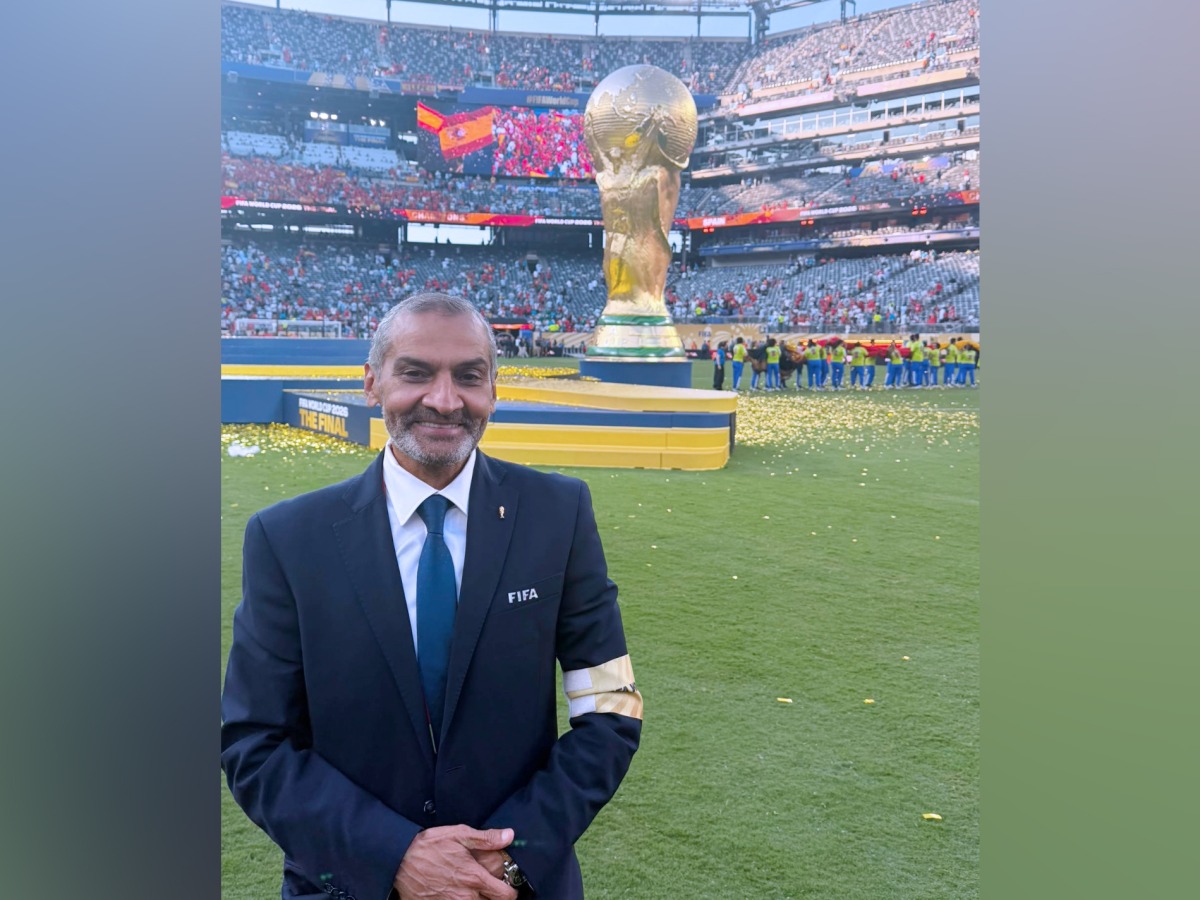
Hani Taleb Ballan poses for a photo at the New York/New Jersey Stadium at the end of the FIFA World Cup final.
Doha, Qatar: Qatari officials continue to play an increasingly influential role on football’s biggest stage, with the FIFA World Cup 2026 once again highlighting the country’s growing contribution beyond hosting major tournaments. From organising global events to shaping key areas of football administration, Qatari expertise has become an integral part of the international game.
One of the leading figures is Hani Taleb Ballan, Vice Chairman of the FIFA Referees Committee, Chairman of the AFC Referees Committee, Chairman of the Arabian Gulf Cup Football Federation Referees Committee, and Chairman of the Qatar Football Association’s Referees Committee.
During the FIFA World Cup 2026, Ballan was part of the team responsible for overseeing the tournament’s refereeing operations alongside FIFA Referees Committee Chairman Pierluigi Collina and FIFA Director of Refereeing Massimo Busacca. His role reflected the growing confidence placed in Qatari officials to help manage the world’s biggest football event.
In an interview, Ballan discussed his responsibilities during the World Cup, the preparation and management of match officials, the participation of Qatari, Asian and Arab referees at the tournament, the progress of refereeing in Qatar, and his vision for developing national officiating talent for future international competitions.
Q - How do you view your participation at the FIFA World Cup 2026?
I am certainly very happy and proud to be part of the team responsible for overseeing the referees at the World Cup and to represent my country at this global event. This was my third participation at World Cup tournaments, after the 2018 Russia and 2022 Qatar World Cups, an assignment that reflects the high level of trust placed in Qatari talent within FIFA.
Working at the World Cup is a great responsibility, especially when the goal is to ensure the highest levels of refereeing fairness in the most important football tournament in the world. Being alongside Pierluigi Collina, Massimo Busacca, and the rest of the referees committee has been a great opportunity to exchange experiences and work within a fully integrated professional system, with the aim of delivering the best possible level of refereeing throughout the tournament.
Q - Qatari personnel continued their presence at international tournaments… Your view this development?
What we are witnessing today confirms that Qatar’s role is no longer confined to hosting tournaments; it has become a key partner in their management and organization. This is the product of years of investment in human capital. The State of Qatar believed early on that human development is fundamental, and therefore we now see Qatari personnel in various organizational, technical, and refereeing committees within the International and Asian Federations.
This presence is not a matter of favoritism, but rather a result of competence, experience, and the ability to achieve, which makes us feel proud and, at the same time, increases our responsibility to maintain this position.
Q - How do you view the Qatari refereeing team’s participation at the World Cup?
The Qatari team that participated in the tournament, consisting of Abdulrahman Al Jassim, Saud Ahmed, Talib Salem, and Khamis Al Marri, has proven over the past years that it is among the best refereeing teams and deserves to be present in the biggest international tournaments. Being at the World Cup is no longer new for Qatari referees; it has become a natural achievement resulting from the great work done by the referees themselves, the Referees Committee, and the Qatar Football Association.
I am proud of what the Qatari referees presented. They performed admirably, managed their matches with high efficiency, and lived up to their responsibilities. This is a continuation of their performance in previous World Cups, the Asian Cup, and other international tournaments.
Q - Khamis Al Marri was in the officiating team for the final. How do you see that?
Khamis Al Marri’s presence on the officiating team for the final match is a culmination of the entire Qatari refereeing system, and he deserves this selection after the outstanding level he demonstrated throughout the tournament.
Q - How would you describe the development of the Qatari refereeing system in recent years?
The Qatari refereeing has witnessed a qualitative leap at all levels. We have continuous training programs, internal and external training camps, technical lectures, the use of the latest technologies, and the assistance of international experts, in addition to a precise evaluation system after each match. Ultimately, the success achieved is the fruit of integrated teamwork, in which each individual performs their role to the fullest, which has contributed to building a generation of referees capable of competing locally, regionally, and globally.
Q - What is the secret to continued success of Qatari referees?
Success doesn’t come by chance; it’s the result of daily work, discipline, and a belief in the importance of learning and never resting on any achievement. Qatari referees operate according to the highest professional standards, and this is what has brought them to the position they deserve today.