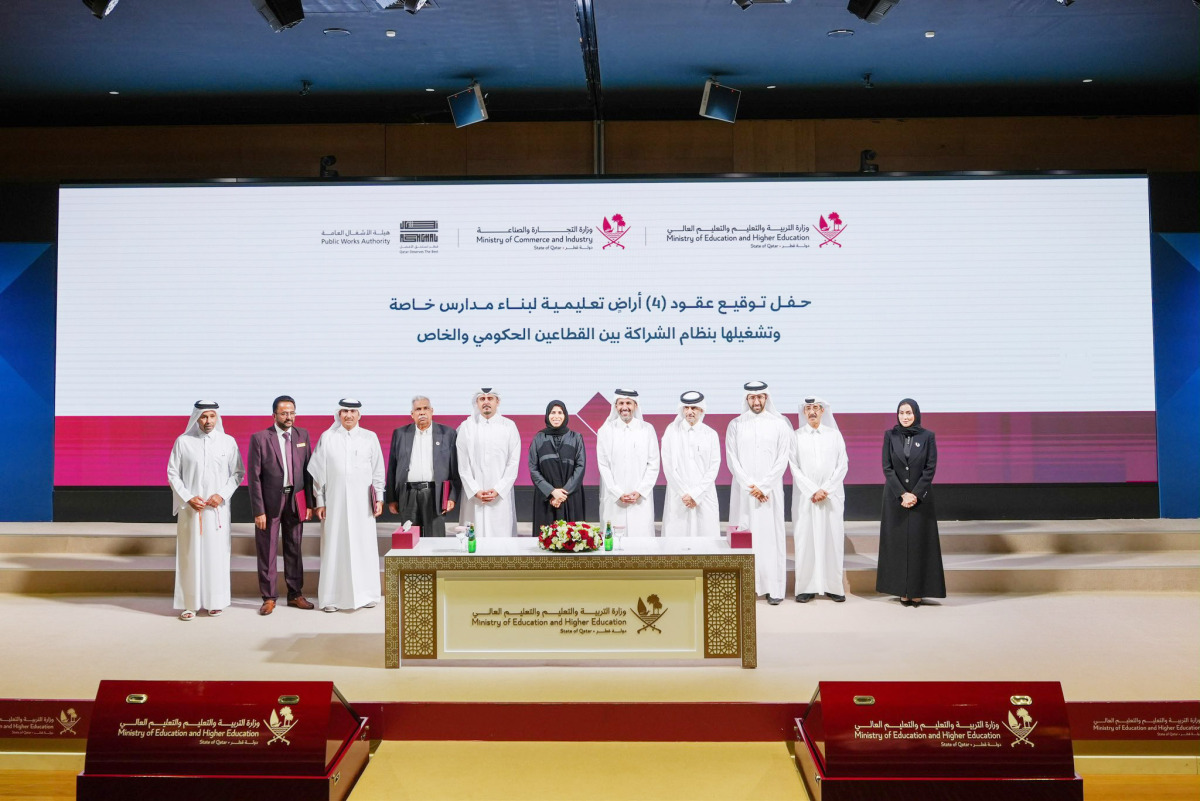
Minister of Education and Higher Education H E Lolwah bint Rashid Al Khater, Minister of Commerce and Industry H E Sheikh Faisal bin Thani bin Faisal Al Thani, and other officials during signing ceremony.
DOHA: The Ministry of Education and Higher Education has signed contracts for four new private schools that will provide 5,000 school seats, with total capital and operating expenditure projected at QR1.48bn over 25 years.
The projects aim to expand Qatar’s educational capacity while offering more diverse and affordable schooling options.
The Education Ministry yesterday signed contracts with the winning national companies to allocate government land for the construction and operation of four private schools. The tenders had previously been issued and evaluated by the Public Works Authority (Ashghal), the Ministry of Commerce and Industry, and the Ministry of Education and Higher Education, under the supervision of the Ministry of Commerce and Industry.
The signing took place during a ceremony held at the main auditorium of the Ministry of Education and Higher Education’s permanent headquarters in the presence of Minister of Education and Higher Education H E Lolwah bint Rashid Al Khater, Minister of Commerce and Industry H E Sheikh Faisal bin Thani bin Faisal Al Thani, and President of Ashghal Eng. Mohammed bin Abdulaziz Al Meer, along with representatives of the companies involved, members of the project committee, senior officials and local media representatives.
Assistant Undersecretary for Private Education Affairs at the Ministry of Education and Higher Education Omar Abdulaziz Al Namaa, signed the contracts on behalf of the education minister with representatives of the four schools.
The schools are MES Indian School in Al Wukair, represented by Braiel Moido Siddique, which will follow the Indian curriculum; Cardiff International School in Al Wukair, represented by Dr. Hamad Mubarak Al Kaabi, which will follow the Egyptian curriculum; Pearl Podar School in Al Mansoura, represented byMohamed Nizar, which will follow the Indian curriculum; and Olive International School in Al Sailiya, represented by Saleh Abdullah Al Sulaiti, which will also follow the Indian curriculum. All four schools will be co-educational, cater to all educational stages and offer affordable tuition fees.
The project forms part of Qatar’s efforts to strengthen public-private partnerships and implement the directives of Amir H H Sheikh Tamim bin Hamad Al Thani to expand private-sector participation in national development and priority projects.
Speaking at the ceremony, Al Namaa said that Qatar’s private education sector currently comprises 354 private schools and kindergartens offering 25 different curricula. He said that more than 271,090 students benefit from their services, while the sector employs 25,372 people from various nationalities and professional backgrounds.
Highlighting the incentives available to investors, Al Namaa said the state provides a range of benefits and facilities to encourage investment and support the sector’s sustainability. He said that these include customs exemptions, exemptions from electricity and water charges, the allocation of land and school buildings, the provision of textbooks, and educational vouchers for Qatari students, alongside other incentives. He said these measures help improve the quality of educational services while reducing the financial burden on parents.
Assistant Undersecretary for Industry and Business Development at the Ministry of Commerce and Industry Saleh Majed Al Khulaifi, described the signing as an important step in strengthening public-private partnerships and expanding private-sector participation in development projects in line with Qatar National Vision 2030.
He said the project reflected the state’s commitment to creating a supportive investment environment by providing land and the necessary infrastructure, while enabling private investors to undertake financing, design, construction, operation and maintenance.
The total capital and operational expenditure expected from the private sector over the project’s 25-year duration is estimated at approximately QR1.48bn, Al Khulaifi said.
President of the Public-Private Partnership Projects Study and Follow-up Committee at Ashghal Eng. Mohammed Masoud Al Marri, highlighted the importance of partnerships in promoting integration between the public and private sectors and supporting sustainable development.
He said the contracts reflected cooperation between government entities and private companies to develop educational infrastructure and improve project implementation in accordance with international best practices. Ashghal, he added, remained committed to expanding private-sector participation in development projects and supporting the delivery of high-quality services that meet community needs.
National Lead of the Public-Private Partnership and Investment Attraction Project in Private Education Dr. Rania Mohammed, said such partnerships strengthened cooperation between government entities and private schools and kindergartens, supported the development of private education, and encouraged the exchange of expertise and effective use of available resources.