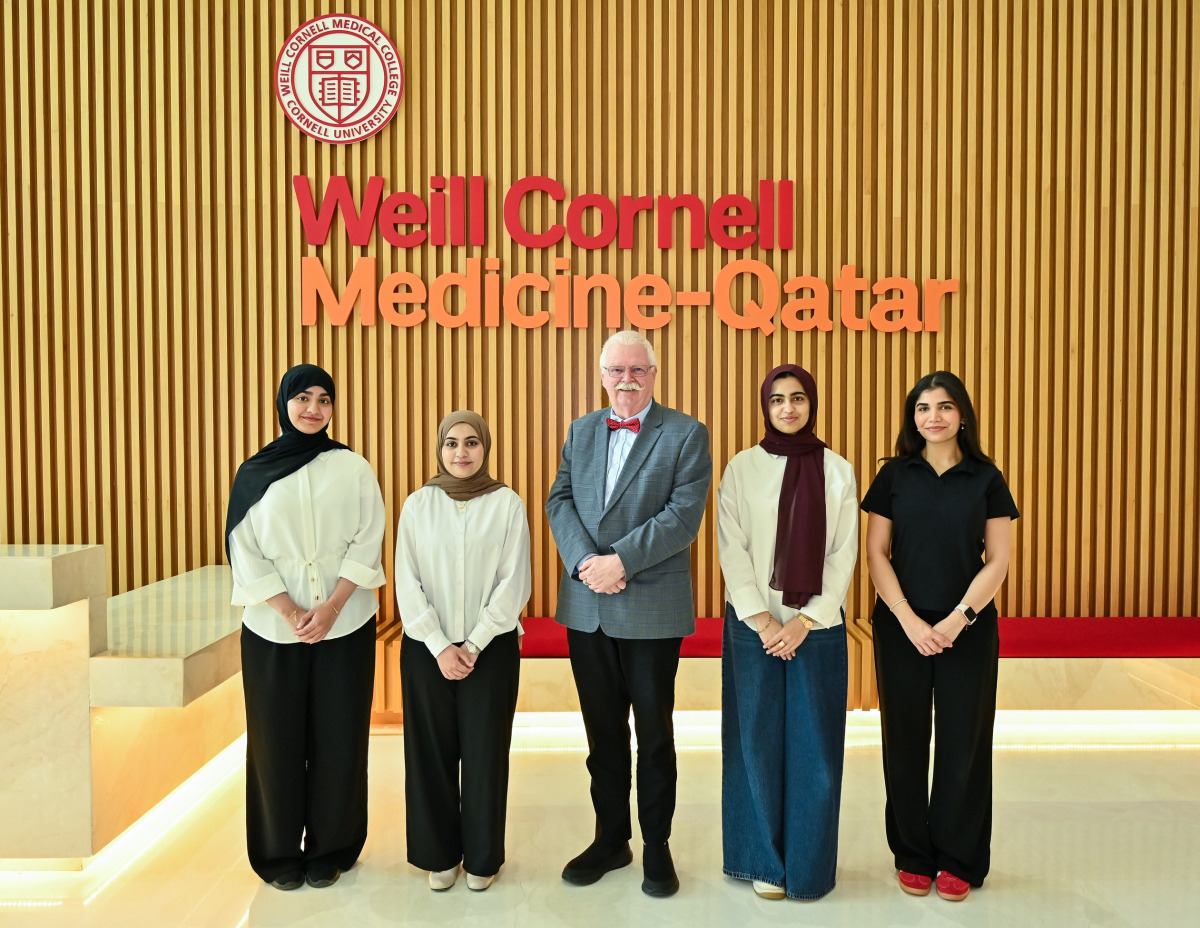
Moomena Gulzar (left), Noor Numan, Dr. Dietrich Büsselberg, Aiza Tanveer Hassan and Maryam Sohail.
Doha, Qatar: Four students at Weill Cornell Medicine-Qatar (WCM-Q) have contributed to two new research publications examining biological processes associated with brain health, neurodevelopmental disorders such as autism, and brain cancer.
The studies, published in the leading journals Neuroscience & Biobehavioral Reviews and Frontiers in Microbiomes, highlight emerging opportunities to understand disease mechanisms and identify potential biomarkers and therapeutic targets.
The publications feature research contributions from current WCM-Q students Maryam Sohail, Aiza Tanveer Hassan, Moomena Gulzar, and Noor Numan, as well as Dietrich Büsselberg, associate dean for admissions and student affairs/professor of systems and computational biomedicine. Alice Njolke Mafe, research scientist at Taraba State University in Nigeria, also contributed to both papers.
The first paper, titled “IGF signaling in autism and related neurodevelopmental disorders: Biomarkers and therapeutic targets,” was published in Neuroscience & Biobehavioral Reviews. It examines the role of insulin-like growth factor (IGF) signaling in autism spectrum disorder (ASD) and related neurodevelopmental conditions, including Rett syndrome, Angelman syndrome, Fragile X syndrome, Phelan-McDermid syndrome, and schizophrenia.
The review explores how two important proteins, IGF1 and IGF2, influence biological pathways involved in brain development and function. These include two signalling pathways (PI3K/AKT/mTOR and MAPK/ERK) that play key roles in neuronal survival, neurogenesis, synaptic plasticity, and cognitive function.
The authors examined evidence suggesting that disruptions in IGF signaling may contribute to the biological mechanisms underlying these conditions. IGF1 has shown particularly promising clinical relevance in Rett syndrome and Phelan-McDermid syndrome, while IGF2 has emerged as a potential therapeutic target for conditions including Angelman syndrome and Fragile X syndrome. All four are rare genetic neurodevelopmental disorders that affect brain development, causing developmental delays, intellectual disabilities, and challenges with communication, learning, and motor skills. The review also discusses the potential of IGF-related biomarkers to support more precise approaches to diagnosis and treatment.
The second paper, “Gut dysbiosis and brain cancer: exploring the emerging role of sweeteners and food additives,” was published in Frontiers in Microbiomes. This review investigates the potential relationship between dietary food additives, changes in the gut microbiome, and glioblastoma, an aggressive form of brain cancer.
The research examines five categories of food additives: artificial sweeteners, food colorants, preservatives, nanoparticles, and emulsifiers. It explores how these substances may influence the composition and function of gut bacteria, potentially affecting the gut–brain axis through changes in microbial metabolites, intestinal barrier integrity, inflammation, and immune responses.
Aspartame receives particular attention as an example of a food additive for which existing research suggests a possible connection between microbiome changes, intestinal barrier disruption, and the regulation of glioblastoma-associated genes. However, the authors emphasize that these proposed mechanisms require further investigation and that direct clinical evidence establishing a causal relationship between food additive consumption and brain cancer remains limited.